
Why Does Distribution Reach Not Always Translate Into Sales?
For FMCG brands, expanding distribution is often considered an important step toward increasing sales. Getting products into more retail outlets can improve market presence, increase customer access, and create more opportunities for purchase.
However, distribution reach alone does not guarantee higher sales.
A brand may have products available across thousands of outlets but still generate disappointing sales if those outlets have low demand, poor product visibility, frequent stockouts, weak retailer engagement, or ineffective field execution.
This is why FMCG businesses need to look beyond the number of outlets they serve and understand whether their distribution is actually productive.
In this guide, we will explore why distribution reach does not always translate into sales, the difference between distribution and productive distribution, the key metrics brands should track, and how field sales technology can help close the gap.
What Is Distribution Reach in FMCG?
Distribution reach refers to the extent to which a product or brand is available across its target retail market.
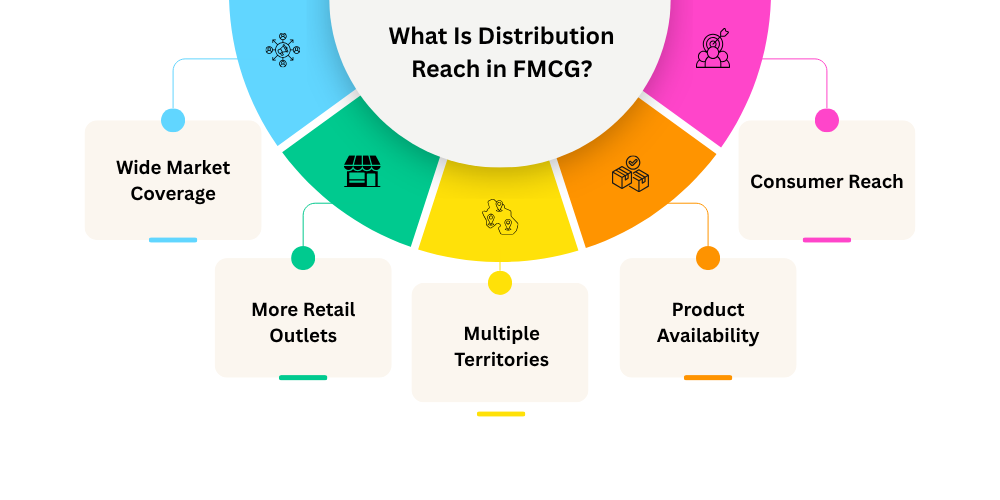
A broad distribution network gives customers more opportunities to find and purchase a product. However, simply increasing the number of outlets does not guarantee that those outlets will generate meaningful sales.
For this reason, FMCG companies should distinguish between having products physically present in stores and having a productive distribution network.
Why Does Distribution Reach Not Always Translate Into Sales?
High distribution reach can create sales opportunities, but several factors determine whether those opportunities actually result in purchases.
A product may be available in many stores but sell slowly because the stores have low customer demand, inadequate inventory, poor shelf placement, weak promotion, or ineffective sales execution. Some outlets may also contribute very little revenue despite being part of the distribution network.
Therefore, FMCG brands need to evaluate not just where their products are available, but also how effectively those outlets are contributing to sales.
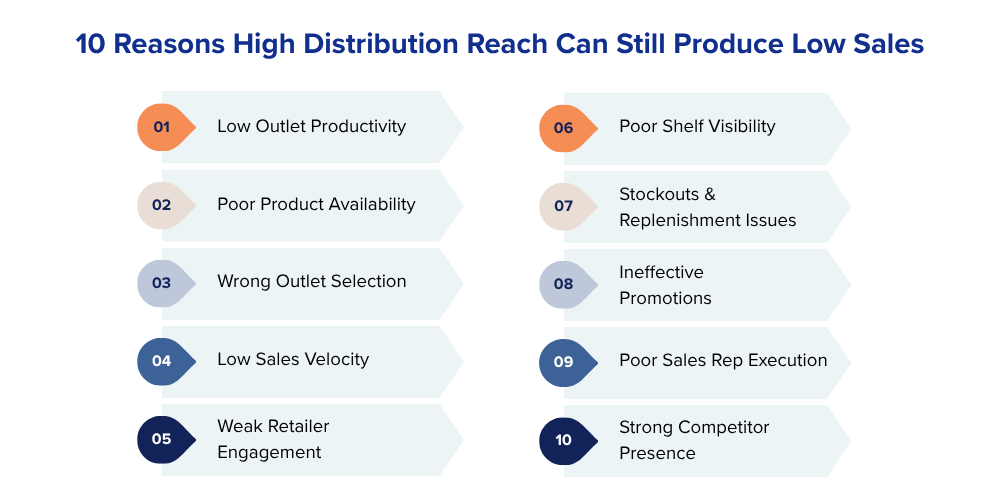
10 Reasons High Distribution Reach Can Still Produce Low Sales
1. Low Outlet Productivity
Not every retail outlet has the same sales potential. A large supermarket located in a busy commercial area may generate significantly more sales than a small neighborhood store. If a brand focuses only on increasing its outlet count, it may end up expanding into locations that have limited revenue potential.
This makes outlet productivity an important consideration.
FMCG companies should analyze the average sales generated by individual outlets and identify which stores consistently generate higher volumes.
Low-productivity outlets may require:
-
Better product assortment
-
More frequent visits
-
Targeted promotions
-
Improved merchandising
-
Retailer incentives
-
Better inventory planning
Instead of asking only, "How many outlets carry our products?" businesses should also ask, "How much sales value does each outlet generate?"
2. Poor Product Availability
Distribution does not always mean that the product is consistently available for customers. A retailer may have initially received a product but run out of stock before the next replenishment cycle.
This creates a gap between distribution and actual sales opportunity.
Product availability can be affected by:
-
Poor replenishment planning
-
Delayed distributor deliveries
-
Inaccurate inventory information
-
High product demand
-
Inefficient ordering processes
-
Poor communication between retailers and distributors
A product cannot generate sales when customers cannot find it. Therefore, FMCG brands should monitor availability regularly rather than assuming that distribution automatically means continuous product presence.
3. Wrong Outlet Selection
Expanding distribution without considering outlet potential can dilute sales productivity. For example, a brand may add 1,000 new outlets but generate very little incremental revenue if those outlets have low category demand.
Brands should consider factors such as:
-
Outlet type
-
Customer footfall
-
Category demand
-
Geographic location
-
Purchasing capacity
-
Historical sales
-
Product suitability
This helps businesses focus on productive outlets rather than simply increasing outlet numbers.
4. Low Sales Velocity
Sales velocity measures how quickly products move through retail outlets over a specific period. A product may be available in hundreds of stores but sell only a few units from each store every month. This creates high distribution with low sales productivity.
For example, Brand A may be available in 2,000 outlets and sell 10 units per outlet per month, while Brand B may be available in only 1,200 outlets but sell 30 units per outlet.
Brand B has lower distribution reach but significantly stronger sales velocity.
Tracking sales velocity can therefore help FMCG companies determine whether distribution expansion is actually producing consumer demand.
5. Weak Retailer Engagement
Retailers play an important role in influencing product visibility and availability. If retailers are not actively recommending or promoting a product, simply having inventory in their stores may not be enough to generate sales.
Weak retailer engagement can result from:
-
Limited communication
-
Poor retailer relationships
-
Lack of incentives
-
Infrequent sales visits
-
Inadequate product knowledge
-
Weak promotional support
Regular retailer interactions can help sales teams understand market feedback, identify issues, and encourage better product execution.
6. Poor Shelf Visibility
A product can be available in a store but still remains difficult for customers to notice. Poor shelf placement, insufficient facings, weak displays, or competitor dominance can reduce product visibility.
This is where retail execution becomes critical.
Sales teams can check whether products are:
-
Placed in the agreed location
-
Properly displayed
-
Available in sufficient quantity
-
Supported by promotional materials
-
Positioned competitively
Improving execution at the shelf can help brands get greater value from their existing distribution.
7. Stockouts and Replenishment Issues
Stockouts are one of the clearest reasons why distribution fails to generate expected sales. A retailer may be classified as an active distribution outlet, but if the product is unavailable when consumers want to buy it, the brand loses the sales opportunity.
Brands should monitor the out-of-stock rate across products, retailers, territories, and distributors.
Frequent stockouts may indicate:
-
Inadequate inventory planning
-
Delayed replenishment
-
Incorrect demand forecasting
-
Distributor-level issues
-
Poor retailer ordering patterns
Reducing stockouts can help brands generate more sales from their existing distribution network before investing heavily in expansion.
8. Ineffective Promotions
Promotions can increase consumer demand, but only when they are executed properly. A brand may distribute promotional stock to retailers without ensuring that the agreed promotion is actually implemented.
For example, a campaign may require:
-
Discounted pricing
-
Special displays
-
Product bundles
-
Point-of-sale materials
-
End-cap placement
If retailers do not execute these requirements, the expected sales uplift may not occur. Monitoring promotion compliance allows FMCG companies to identify where promotional strategies are being implemented successfully and where execution needs improvement.
9. Poor Sales Representative Execution
Sales representatives have a direct role in converting distribution into productive sales. If representatives do not visit planned outlets, fail to capture orders, overlook stock issues, or spend excessive time traveling, distribution performance can suffer.
Sales representative productivity can be evaluated using metrics such as:
-
Productive visits
-
Orders captured
-
Sales value
-
Outlet coverage
-
Visits completed
-
Average orders per day
-
New outlets added
-
Time spent in the field
A large distribution network needs consistent field execution to remain productive.
10. Strong Competitor Presence
Even when an FMCG brand has strong distribution, competitors may capture more sales through better visibility, pricing, promotions, retailer relationships, or product availability.
A retailer may stock several competing products, but customers may purchase the brand that has:
-
Better shelf placement
-
Higher consumer demand
-
More attractive promotions
-
Better pricing
-
Stronger retailer recommendation
-
Better product availability
Therefore, brands should evaluate distribution performance alongside competitive activity instead of looking at outlet presence in isolation.
Distribution Reach vs. Sales: What Is the Difference?
Distribution reach measures how widely a product is available across target retail outlets, while sales measure the actual revenue or volume generated from those outlets. A brand may have products in thousands of stores but still generate low sales if those outlets have limited demand, poor product visibility, frequent stockouts, or weak retail execution.
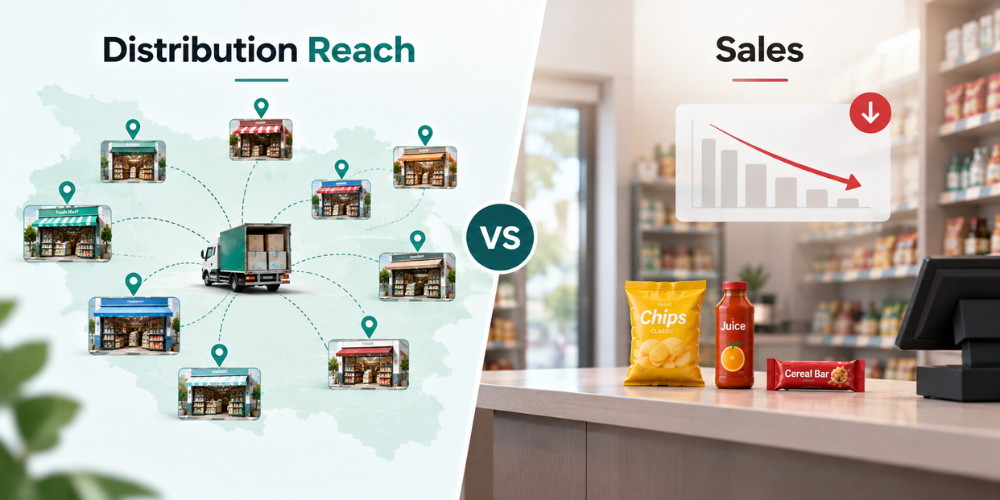
For example, a brand with products in 8,000 outlets may have greater distribution reach than a competitor present in 5,000 outlets. However, if the competitor generates higher sales from each outlet, its distribution may be more productive.
This is why FMCG brands should look beyond the number of outlets they reach and evaluate distribution effectiveness, outlet productivity, product availability, and sales performance. The goal is not simply to reach more stores but to ensure that the right outlets consistently generate sales.
By analyzing distribution and sales together, businesses can identify whether expansion is creating real revenue growth or simply increasing market presence without sufficient commercial returns.
How to Measure Whether Distribution Is Driving Sales
FMCG brands should combine distribution data with sales and field execution data to understand whether their distribution strategy is working. Several measurements can provide useful insights.
Compare Distribution Growth With Sales Growth
Suppose distribution increases by 30% but sales increase by only 5%. This may indicate that the newly added outlets are not generating sales at the same rate as existing outlets.
Businesses should investigate:
-
New outlet productivity
-
Product availability
-
Sales per outlet
-
Order frequency
-
Product mix
-
Retailer engagement
Analyze Sales by Outlet
Instead of looking only at total sales, break sales down by individual outlets.
This helps identify:
-
High-performing outlets
-
Low-performing outlets
-
Declining outlets
-
New outlets
-
Inactive outlets
Track Distribution by Territory
A national distribution figure can hide significant regional differences. For example, one territory may have strong distribution and sales, while another has high distribution but poor outlet productivity.
Territory-level analysis allows managers to identify these differences and take targeted action.
Key FMCG Distribution and Sales KPIs to Track
To understand whether distribution is producing sales, FMCG brands should monitor a combination of distribution, execution, and sales metrics.
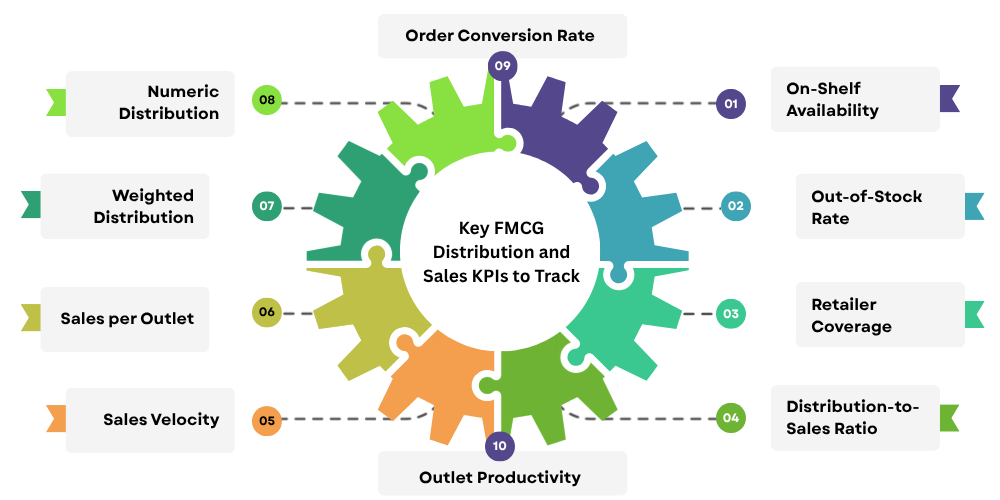
Numeric Distribution
Measures the percentage of target retail outlets where a specific product is available, helping brands evaluate overall market presence and reach.
Weighted Distribution
Measures product distribution while considering each outlet’s sales importance, showing whether products are available in high-value retail locations.
Sales per Outlet
Shows the average sales generated from each active retail outlet, helping brands identify productive stores and improve outlet-level performance.
Sales Velocity
Measures how quickly products sell through retail outlets, helping brands understand demand, identify slow-moving products, and improve replenishment decisions.
Outlet Productivity
Shows how effectively individual retail outlets contribute to sales, helping brands identify high-performing stores and improve underperforming outlet productivity.
Order Conversion Rate
Measures the percentage of eligible retailer visits resulting in orders, helping sales teams evaluate visit effectiveness and improve conversion performance.
On-Shelf Availability
Shows whether products are physically available for customers at retail locations, helping brands identify availability gaps that can reduce sales.
Out-of-Stock Rate
Measures how frequently products become unavailable at retail outlets, helping brands identify stock issues and minimize lost sales opportunities.
Retailer Coverage
Shows the percentage of targeted retail outlets reached by field sales representatives, helping brands measure market coverage and execution consistency.
Distribution-to-Sales Ratio
Comparing distribution growth with sales growth helps identify whether expansion is generating proportional commercial returns.
These metrics should be analyzed together rather than independently. A brand with strong distribution but weak sales per outlet may need to improve execution before expanding further.
How to Improve Sales From Existing Distribution
Before aggressively expanding into more outlets, FMCG brands should determine whether their current distribution network is being fully utilized.
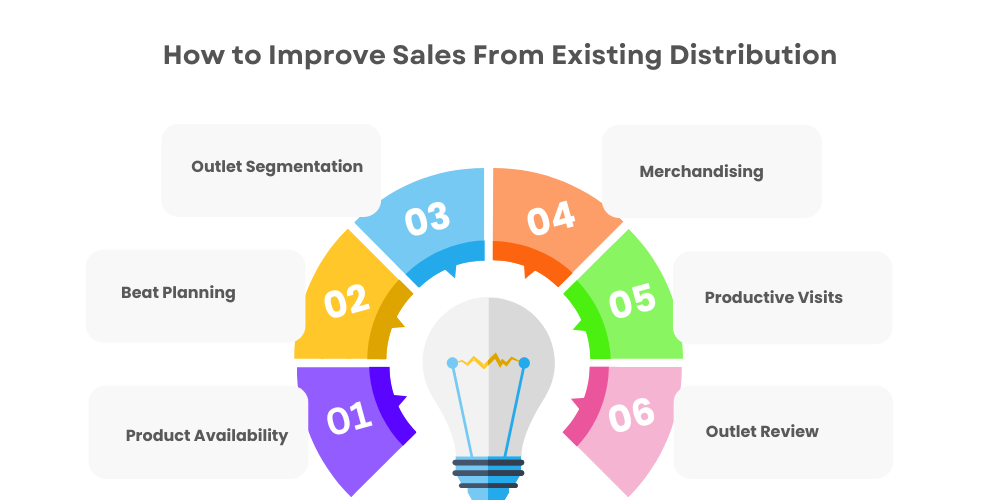
Here are several ways to improve sales from existing outlets.
Improve Outlet Segmentation
Group outlets based on sales potential, location, category, size, and purchasing behavior to allocate sales resources effectively and prioritize opportunities.
Strengthen Beat Planning
Create structured sales routes based on outlet frequency and territory requirements, helping representatives reduce travel time and focus on productive outlets.
Improve Product Availability
Monitor outlet stock levels and identify replenishment needs, allowing representatives to capture timely orders and reduce future stockout risks.
Improve Merchandising
Ensure products receive adequate shelf space, visibility, facings, and promotional support to attract customers and improve sales performance across outlets.
Focus on Productive Visits
Prioritize retailer visits that contribute to orders, product availability, distribution, customer relationships, and measurable sales growth from existing outlets.
Review Low-Performing Outlets
Identify outlets that consistently generate low sales despite regular distribution.
The business can then determine whether these outlets need additional support or whether resources should be redirected to higher-potential locations.
How Field Sales Technology Helps Close the Distribution-to-Sales Gap
Managing distribution across thousands of outlets becomes difficult when information is collected through spreadsheets, paper forms, phone calls, and disconnected systems. Field sales technology can provide managers with a centralized view of activities taking place at the retail level.
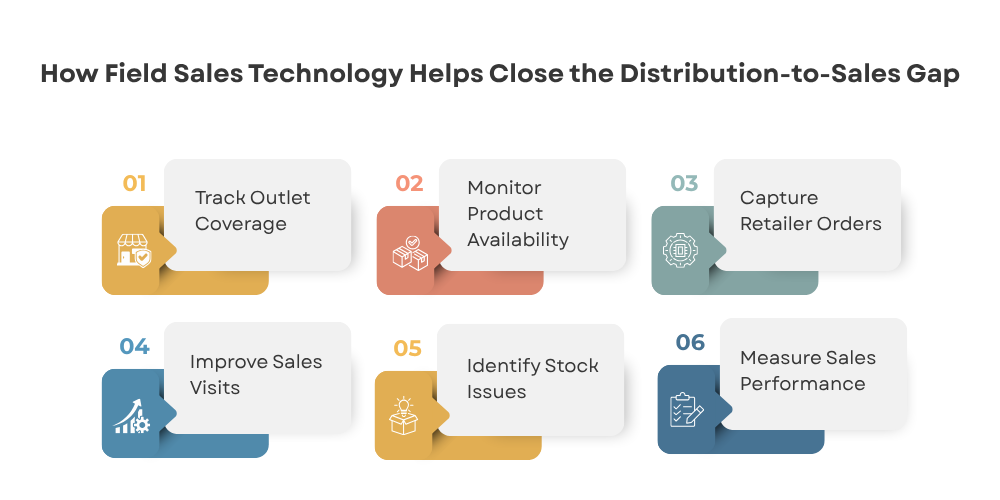
A field sales platform can help businesses monitor:
-
Retailer visits
-
Sales representative locations
-
Orders
-
Product availability
-
Stock levels
-
Sales activity
-
Outlet performance
-
Routes
-
Attendance
-
Payments
-
Visit photos
-
Territory performance
With centralized data, sales managers can compare planned activities with actual execution and identify underperforming territories or outlets.
Use Field Data to Identify Sales Gaps
Suppose a territory has 90% retailer coverage but produces significantly lower sales than another territory with similar coverage.
Managers can investigate:
-
Average order value
-
Order conversion
-
Product availability
-
Sales representative productivity
-
Stockouts
-
Outlet quality
-
Competitor activity
This turns distribution data into actionable sales intelligence.
Improve Visibility With Real-Time Field Information
When field teams record visits and orders through a mobile application, managers can receive information more quickly than with traditional manual reporting.
This can help them respond to issues such as missed visits, stock problems, inactive outlets, or declining sales more quickly.
How Delta Sales App Helps FMCG Brands Improve Distribution and Sales
For FMCG companies managing large field sales teams, Delta Sales App can help connect distribution activities with field execution and sales performance.

Sales managers can monitor important field activities such as:
-
Retailer and customer visits
-
Sales representative locations
-
Planned and completed visits
-
Orders captured from the field
-
Routes and territories
-
Daily field activities
-
Attendance
-
Payments and collections
-
Automated reports
The platform also supports tools for field sales automation, beat planning, customer visit tracking, order management, GPS-based employee tracking, and field reporting.
By bringing field information into a centralized system, FMCG businesses can gain better visibility into whether sales teams are reaching the right outlets, completing planned activities, capturing orders, and maintaining consistent market execution.
The goal is not simply to expand distribution. It is to help businesses make their existing distribution more productive and identify where additional market expansion can generate meaningful sales.
Conclusion
Distribution reach supports FMCG growth, but reaching more outlets does not automatically increase sales. Low outlet productivity, poor availability, stockouts, weak merchandising, ineffective promotions, and poor field execution can limit results.
Brands should focus on productive distribution by tracking sales per outlet, sales velocity, weighted distribution, retailer coverage, order conversion, and product availability.
By combining effective distribution, strong retail execution, accurate field data, and sales technology, FMCG brands can identify lost opportunities and improve sales from existing outlets.
Want to turn your FMCG distribution and field activities into measurable sales performance?
Delta Sales App helps businesses manage retailer visits, orders, sales teams, routes, attendance, payments, and field activities from one centralized platform.
Book a demo of Delta Sales App today to see how it can help your team improve field execution, monitor distribution performance, and make better sales decisions.