
Why Do Trade Promotions Fail at the Retail Level?
A promotion can look perfect on paper: the discount is attractive, the retailer agrees, the sales target is ambitious, and the campaign goes live. Then something happens between the plan and the shelf.
The price never gets updated. The display never shows up. The promoted SKU runs out of stock. Reps report visits late. Retailers run the offer differently from store to store. By the time anyone notices the promotion's underperforming, a big chunk of the budget's already spent. That's the real lesson here: a successful trade promotion isn't just about offering a better deal. It comes down to how accurately it's planned, how consistently it's executed, and how fast a business can spot the gaps and actually act on them.
For consumer goods companies, this matters because trade promotions are a serious investment. McKinsey reported in 2026 that many companies put around 8% to 11% of revenue into trade incentives, and those investments frequently underdeliver when they're missing clear objectives, visibility, or disciplined execution.
So why do trade promotions fail at the retail level, and more importantly, how can brands catch problems early and fix execution? This blog looks at the major causes of promotion failure, the warning signs worth watching, and how better data and field visibility can improve promotional performance.
What Counts as a "Failed" Trade Promotion?
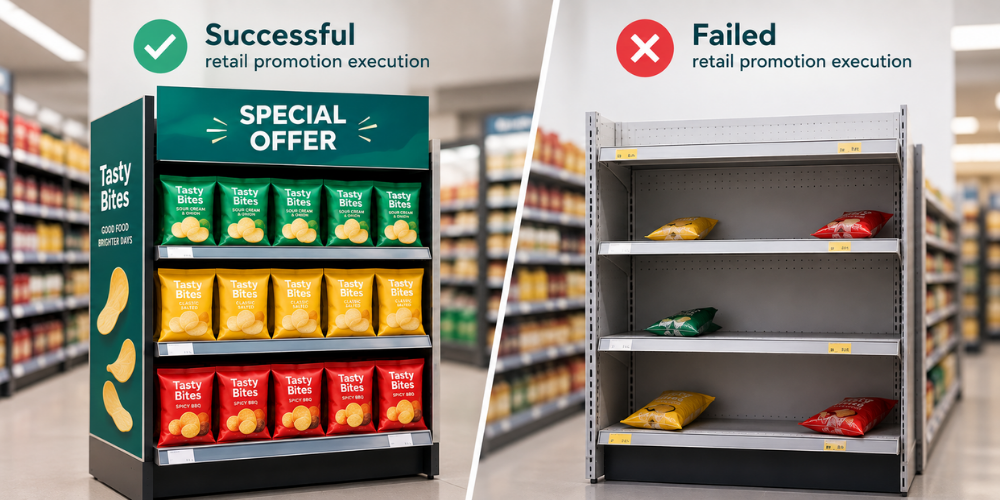
A trade promotion doesn't need zero sales to count as a failure. A campaign can push higher sales volume and still destroy margin or fail to generate enough incremental sales to justify what got spent on it. In practical terms, a promotion has failed the moment its results fall well short of the commercial objective it was actually set up to hit.
Common Ways Failure Shows Up
Trade promotion failure can manifest in various ways that can be frustrating for brands:
-
No meaningful sales lift: Sales remain close to the normal baseline despite promotional spending.
-
Negative ROI: The extra revenue generated fails to cover the costs of discounts, retailer incentives, merchandising, and other related expenses.
-
Out-of-stocks: Customers are left disappointed when they can't find the promoted product due to poor inventory management.
-
Retailer non-compliance: The agreed-upon terms, like pricing, display, placement, timing, or promotional mechanics, are not followed by retailers.
-
Low incremental sales: Existing customers may just buy earlier or in larger quantities during the promotion, without creating new demand.
-
Margin erosion: Higher volume comes at the expense of profitability.
According to NIQ, over half of trade promotions yield little to no sales lift, underscoring the point that merely increasing the number of promotions doesn't guarantee improved outcomes.
Why Most Brands Don't Catch Failure Until It's Too Late
The biggest problem usually isn't the promotion itself. It's the delay in noticing something's already going wrong. A promotion can run for weeks while performance data trickles in through spreadsheets, emails, distributor reports, or periodic updates. By the time anyone compares the actual results against the expected outcome, there's often little room left to fix anything. Without timely visibility, managers only ever see the outcome, never the problem while it was still fixable.
The Top Reasons Trade Promotions Fail at Retail
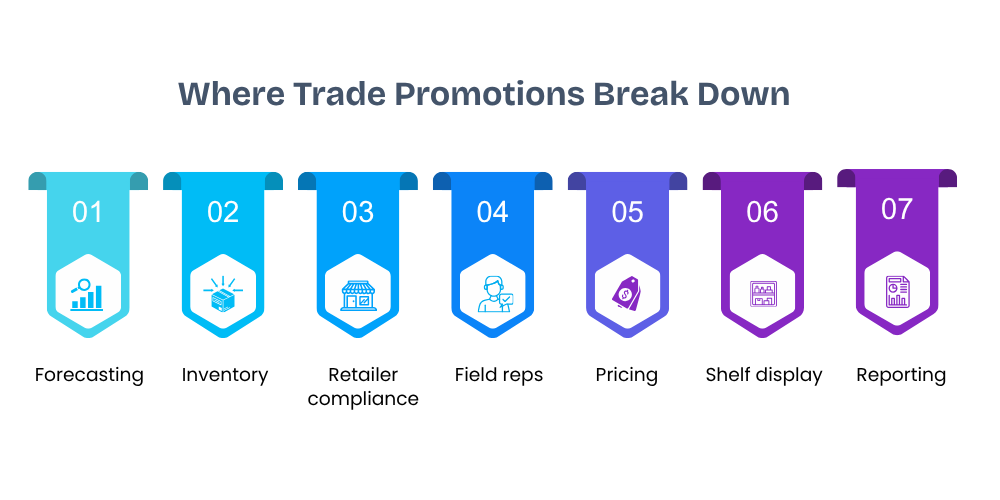
A trade promotion can have the right discount, the right product, and the right target outlets and still fail at the shelf. The real problem usually lives between the promotional plan and how it actually plays out in the market. Poor demand forecasting, retailers not following the plan, stock availability issues, weak field execution, and delayed reporting can turn a well-planned campaign into wasted trade spend fast. When those breakdowns don't get caught early, brands keep pouring money into promotions that barely generate incremental value. Understanding where those failures actually happen is the first step toward better promotional performance, protected margins, and retail execution that actually holds up.

-
Poor Forecasting and Demand Planning
A trade promotion can have the right discount, the right product, and the right target outlets and still fail at the shelf. The real problem usually lives between the promotional plan and how it actually plays out in the market. Poor demand forecasting, retailers not following the plan, stock availability issues, weak field execution, and delayed reporting can turn a well-planned campaign into wasted trade spend fast. When those breakdowns don't get caught early, brands keep pouring money into promotions that barely generate incremental value. Understanding where those failures actually happen is the first step toward better promotional performance, protected margins, and retail execution that actually holds up.
-
Retailer Non-Compliance: Pricing, Display, and Timing
A trade promotion can have the right discount, the right product, and the right target outlets and still fail at the shelf. The real problem usually lives between the promotional plan and how it actually plays out in the market. Poor demand forecasting, retailers not following the plan, stock availability issues, weak field execution, and delayed reporting can turn a well-planned campaign into wasted trade spend fast. When those breakdowns don't get caught early, brands keep pouring money into promotions that barely generate incremental value. Understanding where those failures actually happen is the first step toward better promotional performance, protected margins, and retail execution that actually holds up.
-
Poor Field Execution and Rep-Level Compliance Gaps
Reps are usually the ones responsible for turning the promotional plan into actual retail execution: visiting assigned outlets, confirming the promotion's actually live, checking displays, noting observations, and reporting issues. In many trade promotions, this task falls specifically to in-store promoters, who are stationed at the outlet to manage pricing, displays, and stock visibility throughout the campaign. When those activities aren't managed consistently, management has no way of knowing which outlets are compliant and which need someone to step in. Clear field tasks, structured reporting, and a consistent visit process- the kind an in-store promoter management system provides are what turn a promotion plan into something measurable, instead of a hope.
-
Disconnected Sales, Finance, and Trade Marketing Teams
Trade promotions pull in multiple teams at once. Trade marketing designs the campaign. Sales executes it in the market. Finance tracks spending and profitability. Distribution manages inventory and supply. When every department is pulling from a different data source, disagreements creep in over promotional costs, sales results, retailer participation, and actual ROI. A shared view of promotional performance gets everyone working from the same numbers, which is what lets decisions actually happen fast instead of getting stuck in a reconciliation argument.
-
Manual Processes and Spreadsheet-Based Planning
Spreadsheets can hold up fine for small promotional programs, but complexity grows fast once the number of products, retailers, territories, and promotional periods starts climbing. Manual updates open the door to duplicate records, incorrect calculations, missing outlet information, delayed updates, inconsistent reporting, and version-control headaches. The more manual the process gets, the harder it is to hold onto a reliable picture of what's actually happening with execution.
-
Promotion Overlap and Cannibalization
Running several promotions at once makes performance genuinely hard to read. A discount on one product might just siphon sales from another product in the same portfolio. A promotion can also just pull purchases forward in time rather than create real incremental demand, a pattern known as promotion cannibalization. Brands need to check not just whether the promoted product sold more, but whether the campaign actually created incremental value across the broader portfolio, not just moved existing demand around.
-
Poor Post-Promotion Analysis: No Feedback Loop
A promotion shouldn't just end the moment the offer expires. Brands need to actually compare planned results against actual sales, participation, compliance, inventory movement, spending, and profitability. Skip that review and the same weak promotion mechanics get repeated in the next campaign without anyone noticing. Post-promotion analysis is what closes that feedback loop, showing a business what actually worked, what failed, and what needs to change next time around.
-
Deduction and Chargeback Discrepancies
Promotional deductions get genuinely hard to reconcile when sales, retailer claims, invoices, and the actual agreed terms are scattered across disconnected systems. Disputes crop up when a retailer claims a discount that was never actually agreed to, promotional conditions get interpreted differently by different people, or the supporting documentation is nowhere to be found. Keeping organized promotional records and tying field-level evidence to the commercial terms is what actually makes reconciliation transparent instead of a monthly headache.
-
Ineffective Trade Spend Allocation
Not every retailer, product, territory, or promotion deserves the same level of investment. Blanket discounts often send money toward outlets that would've bought the product anyway, while genuinely high-potential outlets go underfunded. McKinsey points to limited ROI visibility and allocating incentives on intuition rather than actual incremental impact as major reasons trade spend keeps underperforming. Effective allocation means understanding where promotional investment actually creates new growth, rather than just subsidizing sales that were going to happen regardless.
The Hidden Cost of Trade Promotion Failure
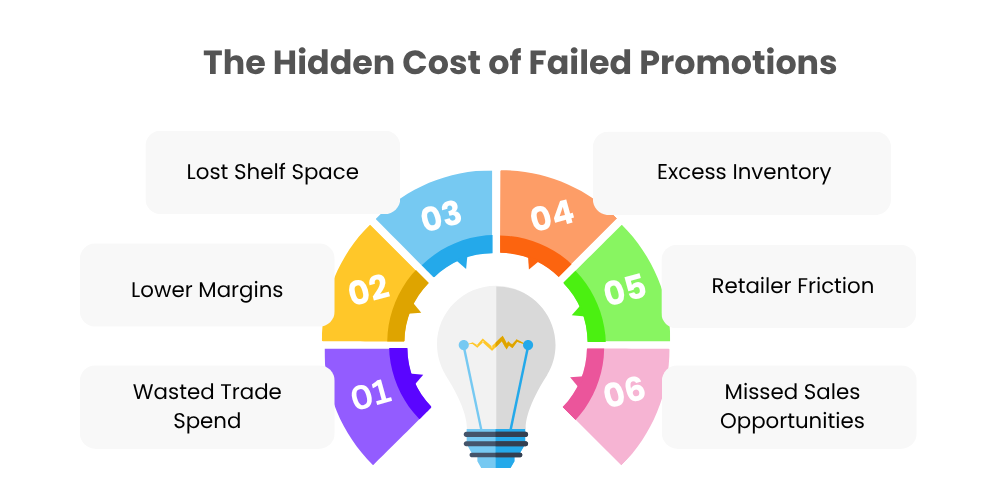
The impact of a failed trade promotion goes far beyond the discount or incentive offered to retailers. When a promotion underperforms, brands can lose valuable trade spend, weaken retailer relationships, and miss opportunities to improve shelf presence and category performance. Poor execution can also leave excess inventory, reduce margins, and make future promotional planning less effective. These hidden costs often accumulate across multiple campaigns, making it important for businesses to look beyond sales volume and understand the broader commercial impact of promotion failure.
-
Wasted Trade Spend
Trade promotions can eat up a serious chunk of a company's commercial budget. McKinsey has reported that CPG companies historically put around 20% of revenue into trade promotions, with 59% of those promotions losing money in the analysis they referenced. More recent McKinsey research shows trade incentives running at 8% to 11% of revenue across industries generally. The lesson here is simple: when promotional spending is this large, even a modest improvement in effectiveness moves the needle on profitability in a real way.
-
Strained Retailer Relationships
Promotions run on mutual expectations. When a brand promises a discount, a display, an incentive, or some other benefit, the retailer expects it to actually happen the way it was agreed. Poor communication, wrong pricing, delayed materials, or disputed claims chip away at that trust fast. Consistent execution and clear promotional records are what keep both sides on the same page about what was agreed, what got delivered, and what still needs fixing.
-
Lost Shelf Space and Category Performance
Retailers only have so much shelf space. If a promotion keeps failing to move the volume it was supposed to, retailers get less willing to hand over valuable shelf positions or display areas to that brand again. Competitors step right into that gap and pick up the shopper attention instead. Promotional performance ripples out beyond one campaign; it can shape future distribution, shelf presence, and category growth well after the promotion itself has ended.
Early Warning Signs Your Trade Promotion Is Underperforming
Waiting for the final campaign report is often too late. Managers should monitor leading indicators throughout the promotion.
-
Sell-Through Rate Lagging Behind Forecast
If products are not moving at the expected rate, the campaign may have a problem with pricing, visibility, availability, targeting, or retailer participation. Comparing actual sell-through with the planned baseline can help identify weak territories or outlet groups early.
-
Retailer Compliance Gaps Mid-Cycle
If a significant number of outlets haven't implemented the agreed price, display, or promotional mechanic by the halfway point, that needs to get addressed right away, not at the post-mortem. Field teams verify execution through structured outlet visits and supporting evidence, which is exactly what catches this in time to actually fix it.
-
Sudden Drop in Reorder Frequency
A promotion might spike orders at first, but a sudden drop-off in reorder activity is a warning sign of weak consumer movement, excess retailer inventory, or just temporary forward buying dressed up as demand. Monitoring reorder patterns is what separates genuine demand growth from a short-term bump that fades the second the promotion ends.
-
Inventory Buildup at DC or Store Level
High inventory doesn't automatically mean a promotion is working. If stock keeps piling up while consumer movement stays weak, retailers or distributors end up stuck trying to clear it after the campaign ends. That creates markdown pressure and drags down the profitability of whatever promotion comes next.
How to Prevent Trade Promotion Failure
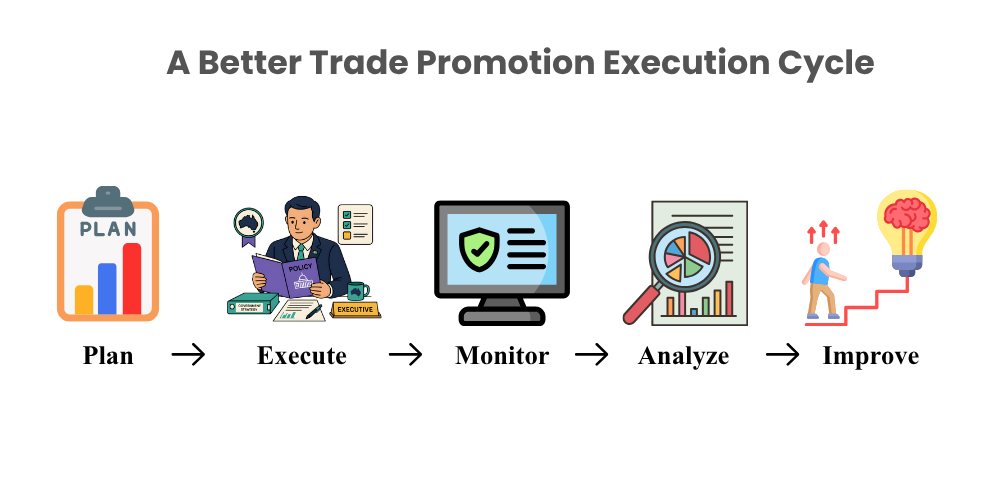
Preventing trade promotion failure takes more than just picking the right discount or incentive. Brands need planning, field execution, retailer compliance, inventory availability, and performance measurement all connected across the full life of the promotion. With real visibility into what's happening at the retail level, teams can catch execution gaps early and adjust before those gaps start hurting results. Here are the strategies that actually help businesses improve promotion effectiveness, control trade spend, and get a stronger return on it.
-
Build a Single Source of Truth for Trade Data
Sales, promotion, outlet, inventory, and execution information should be accessible through a consistent reporting structure. A centralized data environment reduces the risk of teams working from outdated spreadsheets or conflicting versions of the same report.
-
Automate Compliance Monitoring
Promotional compliance becomes easier to manage when field teams follow structured tasks and managers can review execution data without waiting for manual summaries. Outlet visits, promotional observations, photographs, comments, and location-based information can provide a clearer picture of what is happening in the market.
-
Align Teams with Shared KPIs
Sales, finance, trade marketing, and distribution all need to agree upfront on how promotional success actually gets measured. Useful metrics: incremental sales, sales lift, promotional ROI, retailer participation, compliance rate, sell-through, stock availability, and margin impact. A shared measurement framework is what stops every department from judging the same promotion by a different yardstick.
-
Run Post-Event Analysis Every Time
Every promotion should teach the team something useful for the next one. Compare planned versus actual performance, identify the outlets that outperformed or underperformed, review compliance gaps, check inventory movement, and figure out whether the promotion created real incremental sales or just borrowed from next month. The goal isn't reporting what happened for the record. It's improving the next promotional decision.
How Delta Sales App Helps Prevent Trade Promotion Failure
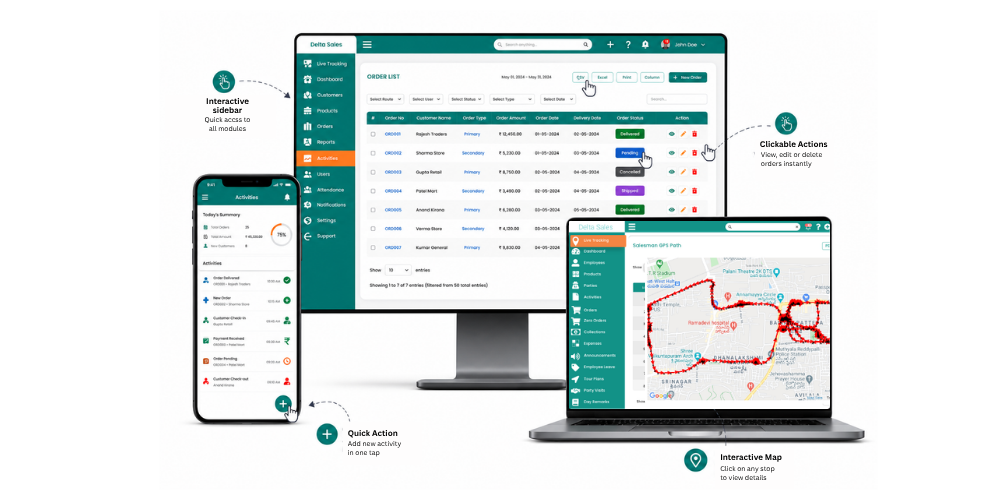
A strong promotional strategy still needs strong field execution. This is where Delta Sales App can support sales teams by bringing field activities, outlet visits, employee tracking, and reporting into a more connected workflow.
-
Real-Time Visibility into Retail Execution
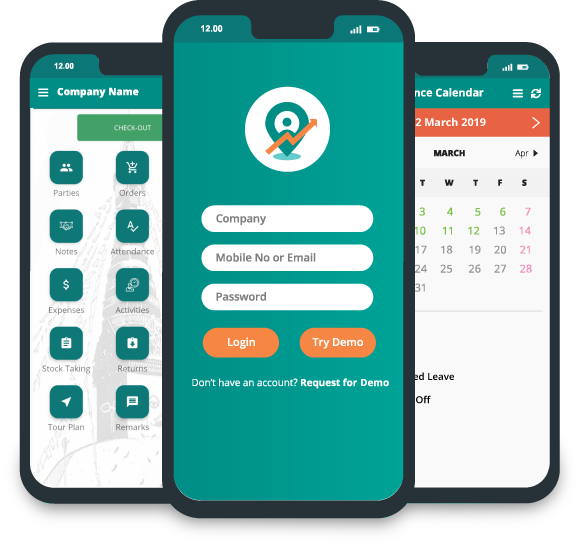
Managers can use a retail execution app to track field activity and visit information, understanding where sales representatives are working and what is happening across assigned outlets. Instead of relying entirely on delayed updates, managers get better visibility into field execution through the app and can quickly identify areas that need attention.
-
Automated Compliance and Deduction Tracking
For compliance, structured field activities can help representatives record promotional execution, visit details, observations, and supporting evidence from outlets. For financial reconciliation, centralized records can provide sales and finance teams with a clearer reference point when reviewing promotional claims and deductions. The goal is to reduce dependence on scattered files and make supporting information easier to access.
-
Centralized Data Across Sales, Trade, and Finance
A centralized sales workflow closes the information gap between field teams and management. Sales activities, outlet visits, customer information, orders, and performance reports all live in one connected system, which makes it much easier for managers to review execution and actually spot trends instead of hunting for them across five tools.
-
Faster Post-Promotion Analysis and Reporting
Once promotional activity and field data get captured consistently, managers have a real foundation for comparing execution against what was expected. That's what lets a team identify which outlets performed well, where compliance broke down, and what needs fixing before the next promotional cycle rolls around.
Conclusion
Trade promotions don't fail because of one big mistake. They fail because of small, avoidable gaps that quietly compound over time. Weak forecasting leads to stockouts or overstock. Retailer non-compliance goes unnoticed until the promotion window's already closed. Field execution slips through the cracks because nobody has real-time visibility into what's happening at the outlet level. And by the time post-promotion analysis actually happens, if it happens at all, the trade spend is already gone.
The good news is none of that is inevitable. With real visibility into field execution, compliance, and spend, brands can catch underperforming promotions early, course-correct while the campaign's still live, and turn post-event analysis into a habit instead of something that only happens when someone remembers to do it.
If your team is still piecing together promotion performance from spreadsheets, WhatsApp updates, and retailer reports that show up late, it's worth seeing what a connected system actually looks like.
Book a free demo of Delta Sales App and see how real-time execution tracking, automated compliance monitoring, and centralized trade data can help your team stop losing money on promotions that were never set up to succeed in the first place.