
Why Growing Your Sales Team Without a Tracking System Makes Problems Bigger, Not Better

Building a sales team is a great opportunity for any business. But just because you hire more people doesn't mean you are going to solve sales problems. Many businesses find the opposite to be true. As the team grows, the daily calls from sales reps, late reports, missed retailer visits, duplicate market coverage, and unanswered questions of what’s really going on in the field also grow. Managers spend more time managing people than they do sales strategy.
The prevailing view is that these are growing pains. It’s hard to know where your team is, which retailers have been visited, whether orders have been picked up, or how productive each rep is throughout the day without a proper field sales tracking system.
Many companies that make things people use every day are getting bigger. These companies, the people who help get their products to stores, the people who make the products, and the wholesale businesses are spending money on SFA. It helps the people in charge keep track of what's happening when their teams are out in the field. The people in charge can see what is going on and make sure everyone is doing their job. They can also make sure they have the people in the right places and make important decisions quickly. Sales force automation software is what this special software is called. It helps the managers of these companies, like the FMCG companies, make decisions about their field teams.
In this blog, we’ll discuss why just hiring more salespeople without a system to track them often leads to bigger operational problems instead of better results. We’ll also look at how the right technology can help your business scale efficiently without losing control.
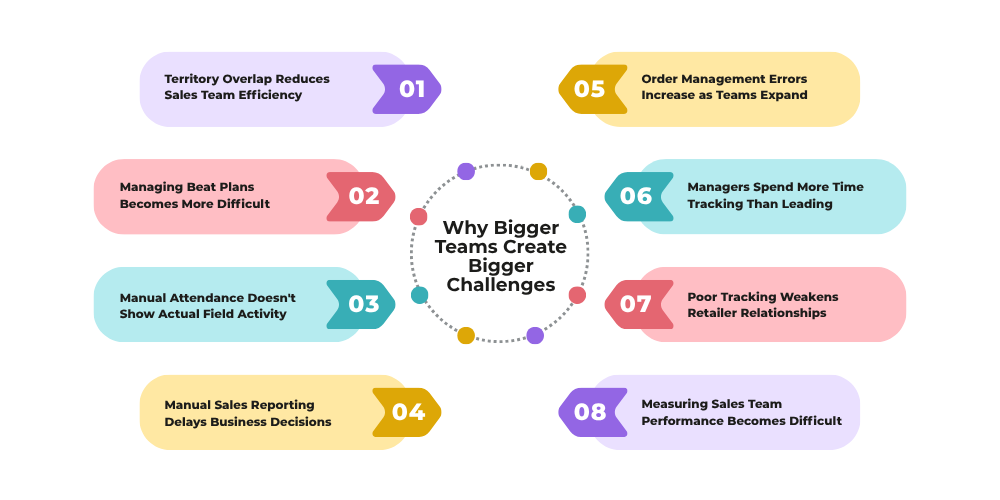
Why Bigger Teams Create Bigger Challenges
Adding sales representatives multiplies the number of daily activities taking place in multiple territories. Managers are suddenly confronted with questions like:
- Which retailer did who visit?
- But how many outlets were really covered?
- Who was the sales rep who didn't follow their planned route?
- Did he take orders at every visit?
- What retailers need to be followed up with?”
It is difficult to get those answers without a centralized tracking system.
Most companies begin to rely on phone calls, WhatsApp updates, Excel sheets, or handwritten reports. These approaches quickly become unreliable as the team expands. The result is delayed decision-making, inconsistent reporting, and poor visibility into field operations.
Here are the biggest challenges faced by companies that scale their sales team without a proper tracking system:
1. Limited Field Visibility Leads to Decision-Making
When the sales team gets bigger, it is really tough to stay on top of what is happening in the field every day. The sales team does a lot of things every day. Without being able to see what is going on now, managers have to call people or send messages or wait for reports at the end of the day. This makes it very hard for managers to do something about problems when they happen. Managers need to know what the sales team is doing with the field activities. The field activities are very important to the sales team. This invisibility can result in:
- Retailer visits missed
- Order pickup late
- Outlets omitted
- Missed sales opportunities
A field sales tracking app helps managers see what is happening in the field now. This means they can make decisions and solve issues before they hurt sales. The app gives managers real-time updates on field activities. They can fix problems fast. This helps keep sales on track.
2. Territory Overlap Reduces Sales Team Efficiency
Expanding your sales team without clearly defined territories often leads to confusion. It can be tricky to grow your sales team without clearly defined territories. Productivity suffers when several reps call on the same retailer without achieving other territory coverage.
Typical challenges include:
- Repeated visits to retailers
- No coverage in the market
- More expensive travel
- Lost sales opportunities
Territory management software is a great way to assign your territories so that you can make sure that the territories are balanced and that you’re getting the most out of your sales team.
3. Managing Beat Plans Becomes More Difficult
As the number of sales representatives increases, manually managing daily routes and retailer visits becomes more challenging. Poor beat planning results in wasted travel time and inconsistent The more sales reps you have, the more difficult it is to manually manage daily routes and retailer visits. A poorly planned beat wastes travel time and leads to inconsistent market coverage. Businesses often experience:
- Off-schedule calls
- Non-productive routes
- Decreased performance
Managers can use a beat-planning software to develop optimized routes, and completed visits can be viewed in real time.
4. Manual Attendance Doesn't Show Actual Field Activity
Checking off a list doesn’t mean sales reps are actually visiting their assigned retailers. Businesses need more accountability than manual attendance can provide as teams grow.
A GPS attendance system checks:
- Places to Check In
- Working time
- Movements on the field
- Retailer trip
This ensures that attendance reflects actual work done in the field.
5. Manual Sales Reporting Delays Business Decisions
Larger sales teams generate more data every day. When reporting is done manually, managers spend valuable time collecting updates instead of analyzing performance.
This often results in delays:
- Sales reviews
- Inventory planning
- Performance monitoring
- Business Choices
Automated sales reports and analytics help managers make decisions quicker. They get real-time data.

6. Order Management Errors Increase as Teams Expand
As the volume of orders increases, the manual collection of orders gets more error-prone. Deliveries, customer satisfaction, and efficiency can be affected by even small mistakes.
Typical problems are:
- Wrong quantities
- Products out of stock
- Double orders
- Processing time delay
A sales order management system automates order entry, which reduces mistakes and accelerates order processing.
7. Managers Spend More Time Tracking Than Leading
When managers do not have a system to track things they use up a lot of time trying to catch up with the salespeople, helping them and making the team work better.
They frequently need to check:
- Where the representatives live
- Often they have to make sure:
- whether orders were received
- Reasons for missed planned visits
Sales force automation software gives managers a place to see all field activities automatically recorded. This helps them focus on growing their business of always checking in.
8. Poor Tracking Weakens Retailer Relationships
Consistent retailer engagement becomes harder as the sales team gets bigger. Missed visits and delayed follow-ups can quickly erode customer trust.
Businesses can experience:
- Retailer visits missed
- Late orders
- Bad follow-ups
- Poor communication
A customer visit tracking system helps to make sure that each retailer is served on time, improving customer satisfaction and long-term relationships.
9. Measuring Sales Team Performance Becomes Difficult
Growing your team also increases your investment. Without reliable performance data, it's difficult to know whether your expansion is delivering results.
Important metrics include:
- Sales per rep
- Retail coverage
- Daily visits
- Territory effectiveness
A sales performance dashboard provides real-time insight into these KPIs so that managers can measure performance and make better business decisions.
Signs Your Growing Sales Team Needs a Tracking System
Not all businesses know when they have outgrown their current sales processes. Warning signs usually develop slowly, becoming more apparent as the sales team grows. What works for a small team can easily become unwieldy as the number of sales reps, visits to retailers, and daily activities grow.
If your managers spend more time gathering updates than making strategic decisions, then your business clearly needs a field sales tracking system. Some common signs to watch out for are:
- Managers rely on phone calls or WhatsApp to track field activities.
Managers who are constantly calling sales reps or checking in on messaging apps don’t have real-time visibility into field operations. This not only wastes valuable time but also delays decision-making efficiency. - Retailers are often missed or delayed visits.
“It’s hard to make sure you hit all the outlets you’re assigned to without a good tracking system. When appointments are late, orders are lost, customers are less satisfied and competitors have a chance to improve their presence. - Sales representatives don't consistently follow their assigned beat plans.
Manually managed beat plans can result in reps missing some outlets or taking unplanned routes. This leads to inconsistent market coverage and team productivity. - Daily sales reports arrive late or contain inaccurate information.
Collecting reports manually becomes harder as the team grows. If reporting is late or inaccurate, managers can’t understand sales performance or respond quickly to market changes. - Attendance is recorded, but actual field activity cannot be verified.
Marking attendance doesn't prove that representatives visited retailers or completed their scheduled work. Without GPS-based verification, measuring field productivity becomes difficult. - More common are order mistakes and slow processing.
Orders taken via phone, paper forms, or messaging apps are more likely to be incorrect. Wrong quantities, products that are not there at all, and delays in processing can all impact operations and customer satisfaction. - Sales territories overlap, causing duplicate retailer visits.
If the territory assignments are not well defined, the team learns that many reps are calling on the same retailers and other markets are not being called on at all. This translates into higher travel costs and less efficiency overall. - Team performance is difficult to measure using real-time data.
Without centralized reporting and dashboards, managers cannot measure productivity, benchmark rep performance, track retailer coverage, or even identify areas for improvement.
How Delta Sales App Helps Growing Sales Teams Scale Efficiently
Growth of the sales team is only half the battle. The real success is to manage that team well as your business grows. The Delta Sales App is a comprehensive Sales Force Automation (SFA) software built for manufacturers, distributors, wholesalers, and FMCG companies to streamline field operations, improve visibility, and grow without losing control.
Here is how its key features help a growing sales team:
-
Track Sales Representatives in Real Time with Field Sales Tracking
Knowing where your sales reps are and what they are doing is critical for effective management. A field sales tracking system provides managers with real-time visibility to employee locations, completed visits, and daily activities. This removes the guesswork, increases accountability, and allows for quicker decision-making.
-
Plan Smarter Routes with Beat Planning
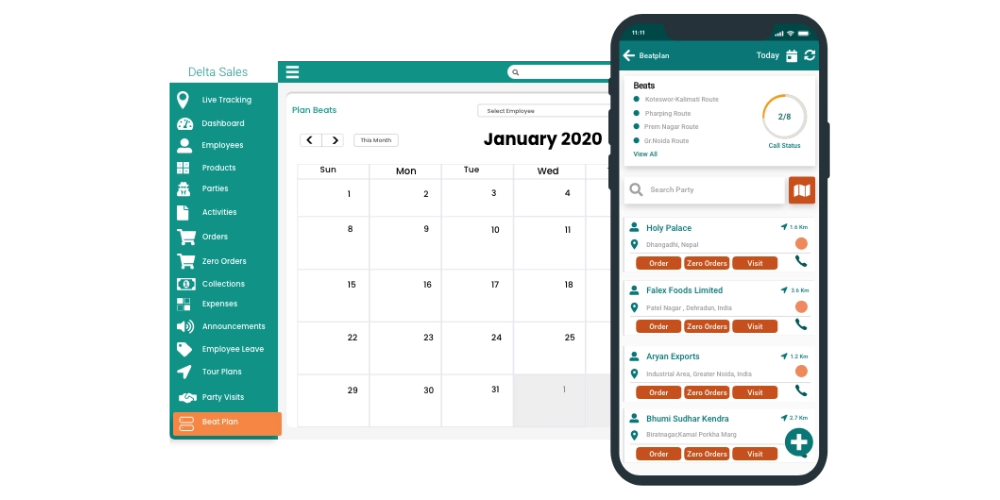
Once you have a team though, the daily hand route assignments aren’t efficient. Beat Planning helps managers build optimized beat plans, assign retailer visits, and track route progress. This will enhance market coverage and reduce unnecessary travel time and fuel costs.
-
Verify Attendance with GPS Attendance & Leave Management
Traditional attendance systems only show who actually signed themselves in gps Attendance & Leave Management uses location data to verify attendance, making sure that representatives actually start their work from the location assigned to them. It also simplifies leave approvals and attendance management from a single platform.
-
Avoid Market Conflicts with Territory Management
Expanding teams often struggle with overlapping territories and uneven retailer coverage. Territory Management allows businesses to assign clear sales areas to each representative, preventing duplicate visits and ensuring every market receives proper attention.
-
Collect Orders Faster with Sales Order Management
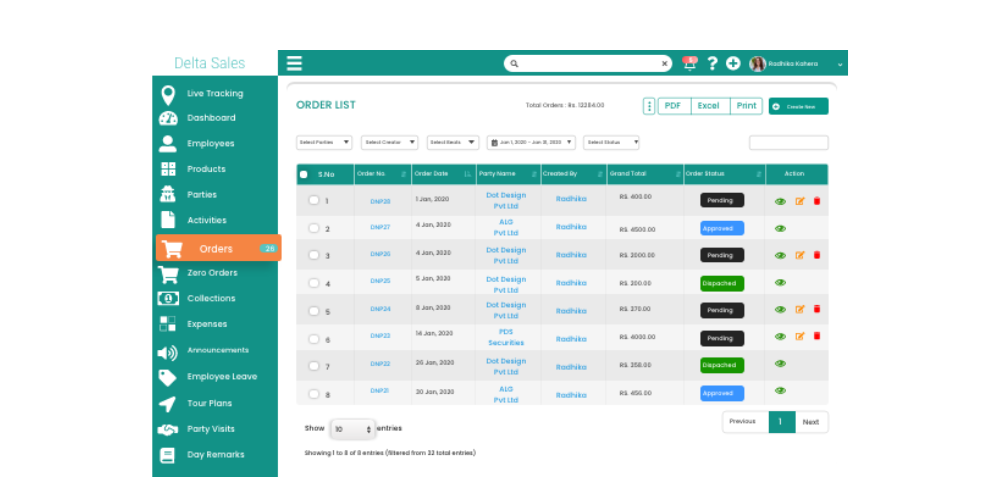
Manual order collection often includes delays and errors. With Sales Order Management, sales reps can enter orders directly from retailers with the mobile app. Orders flow directly to the back office, reducing paperwork, improving order accuracy, and expediting fulfillment.
-
Build Stronger Retailer Relationships with Customer Visit Tracking
Working with retailers on an ongoing basis is crucial for continued growth. Customer Visit Tracking: Records each retailer visit, simplifying tracking of visit frequency, follow-ups, and customer interactions. This helps to ensure that no retailer is missed, and builds customer relationships over time.
-
Make Better Decisions with Reports & Analytics
Timely, accurate information promotes business growth. Reports & Analytics offers real-time dashboards on sales performance, retailer coverage, attendance, orders and team productivity. Instead of waiting for manual reports, managers can quickly spot trends, track KPIs, and make informed business decisions.
The Delta Sales App combines all of these capabilities into one platform that empowers businesses to increase productivity, decrease manual work, improve team accountability and confidently scale their field sales operations.
Conclusion
Hiring more sales representatives may help your business grow, but growth without visibility typically brings more problems than opportunities. As your team grows, it becomes increasingly difficult to manage retailer visits, attendance, territories, orders, and performance manually. Small operational gaps can quickly become lost sales and decreased productivity without the right system.
With a field sales tracking system like the Delta Sales App, you get the power to control your field operations. From real-time tracking and beat planning to sales order management, territory management, and detailed reports & analytics, it has everything you need to manage growing sales teams efficiently from a single platform.
As you look to scale your field sales team, don’t let manual processes hold back your growth.
Book a free demo of Delta Sales App today and find out how you can boost team productivity, expand retailer coverage, gain real-time visibility, and make smarter sales decisions with a powerful Sales Force Automation (SFA) solution.