
Why Is Retailer Segmentation Important for FMCG Distribution?
A retailer placing a large order every week shouldn't be managed exactly the same way as a small outlet that orders once a month. Yet that's often exactly what happens when FMCG businesses treat their entire retail network as one undifferentiated group.
As the outlet count grows, sales teams end up dealing with different store formats, purchasing patterns, order values, locations, customer demand, and growth potential all at once. Give every retailer the same visit frequency, product assortment, and sales attention, and you end up wasting field effort in some areas while genuine opportunities go unnoticed in others.
That's where retailer segmentation comes in. Grouping outlets by sales volume, location, purchase frequency, outlet type, and business potential tells an FMCG company which retailers actually need more attention, which products should be prioritized where, and where distribution resources are most likely to pay off.
For sales managers, segmentation also sharpens the whole picture of the market. Instead of just counting how many outlets got visited, they can check whether high-value retailers are actually getting covered properly, whether emerging outlets are getting enough attention, and whether the product mix even matches what different outlet groups actually need.
This blog covers why retailer segmentation matters for FMCG distribution, the key parameters businesses use to segment retailers, the benefits of a structured segmentation approach, and how technology helps sales teams manage outlet data and improve distribution execution.
What Is Retailer Segmentation in FMCG?
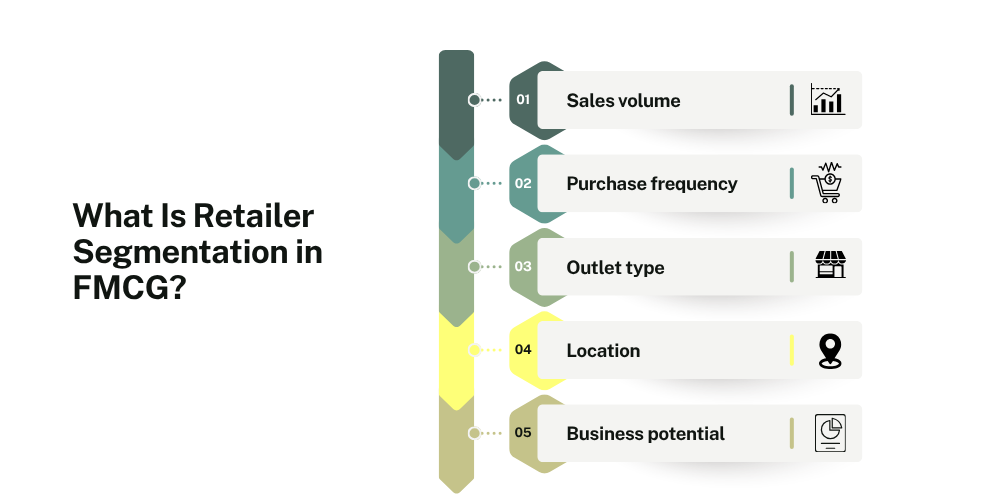
Retailer segmentation is the process of grouping retail outlets into meaningful categories based on their characteristics, purchasing patterns, business potential, location, and role in the distribution network. Instead of applying the same visit frequency, product assortment, and sales approach to every outlet, FMCG companies can create different strategies for different retailer groups.
For example, a high-volume supermarket may require frequent visits, a wider product assortment, and closer monitoring of stock availability. A smaller neighborhood outlet may generate lower sales but still have strong growth potential because of its location or consistent customer demand. Treating both outlets in exactly the same way can result in inefficient use of field resources.
By using sales tracking and outlet-level data, businesses can identify differences in sales performance, order behavior, purchase frequency, and retailer potential. These insights help sales managers determine which outlets should receive more frequent visits, which products should be prioritized, and where additional distribution support may be needed.
Retailer segmentation can also support better territory management. When outlets are grouped according to their location, sales potential, and business importance, companies can organize field coverage more effectively and assign sales representatives based on actual market requirements. This makes it easier to prioritize important outlets without increasing unnecessary travel or visits.
The goal is not simply to label retailers as high-value or low-value. A useful segmentation model helps sales teams understand which outlets deserve more attention, what each retailer is likely to need, and how field resources should be prioritized. It can also support decisions around product assortment, stock allocation, visit frequency, and distribution coverage.
For instance, a high-potential outlet with strong sales growth may deserve more frequent visits and a broader assortment, while a low-activity outlet may require a different service frequency. Similarly, retailers that frequently place orders may need more consistent replenishment support. Connecting these patterns with order management and sales data can give managers a clearer view of retailer needs.
Retailer segments should also be reviewed regularly. Outlet performance, purchasing behavior, product demand, competition, and market conditions can change over time. An outlet that was once a high-priority account may decline, while a smaller retailer may become increasingly important as its sales grow. Regularly updating outlet data helps businesses keep their field sales strategy aligned with current market opportunities.
The parameters used to create these segments will vary depending on the product category, distribution structure, and business objectives. However, several factors are commonly used to evaluate outlet importance and determine how sales teams should prioritize retailers.
Why Retailer Segmentation Matters in FMCG Distribution
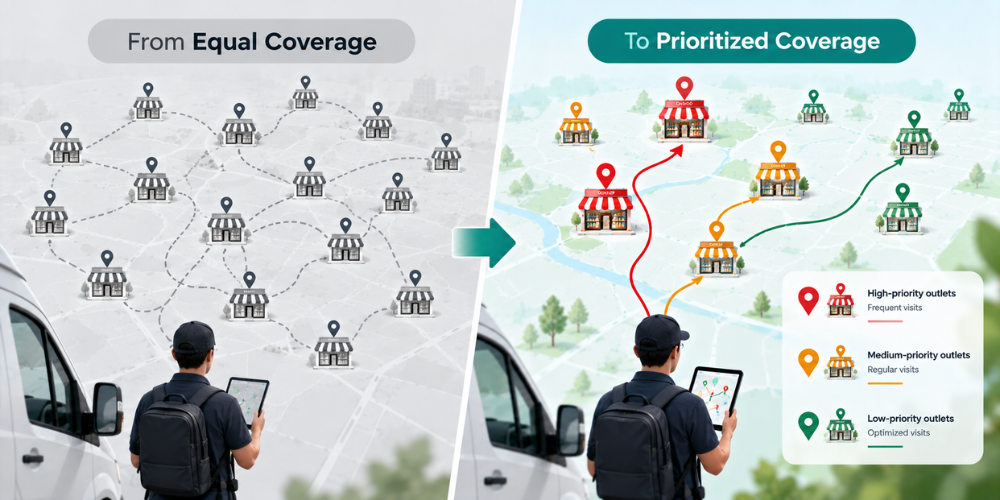
A distribution network can span thousands of outlets, and not every one of them contributes equally to sales or needs the same amount of attention. Effective segmentation is what actually connects field resources to real outlet needs, instead of spreading them evenly and calling it fair
-
Improves Sales Force Efficiency
A rep only has so many working hours in a day and can't give every outlet the same level of attention. Retailer segmentation lets managers prioritize outlets by actual business value and potential: high-priority stores get more frequent visits, lower-priority ones follow a different schedule. That's what actually improves sales force efficiency, since reps end up spending time where it's most likely to move sales, availability, and the retailer relationship forward.
-
Optimizes Product Placement by Outlet Type
Different outlets often have different customer profiles and product requirements. A neighborhood grocery store may focus on fast-moving everyday products, while a larger supermarket may have space for a wider range of SKUs. Segmenting outlets helps businesses align product assortment with the type of store and its customers. This can improve product availability while reducing the risk of pushing unsuitable products into outlets where demand is limited.
-
Enables Better Route Planning
Segmentation also improves how reps move through their assigned markets. Group outlets by priority, location, and visit frequency, and managers can build routes that actually make sense, instead of a fixed schedule that treats every store like it deserves equal time. Paired with route planning, segmentation cuts unnecessary travel and frees up more time for the visits that actually count.
-
Supports Data-Driven Decision Making
Without segmentation, outlet data can become a large collection of individual records with little strategic meaning. Grouping outlets creates a clearer view of patterns across the market. Managers can compare sales performance, order frequency, outlet potential, and coverage across different segments. This supports better decisions about sales targets, visit frequency, assortment, and resource allocation.
Key Parameters Used to Segment Retailers
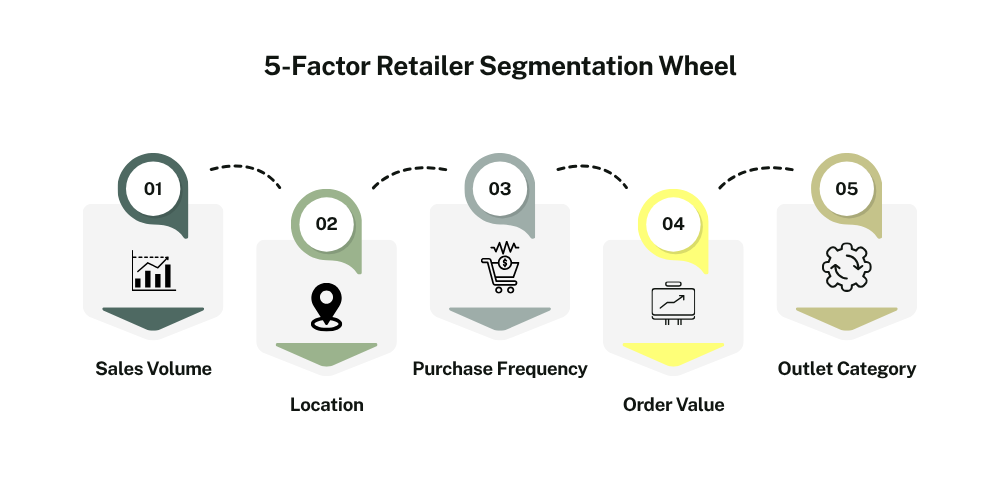
There is no single segmentation model that works for every FMCG business. The right parameters depend on the product category, market, distribution structure, and business objectives. However, several factors are commonly useful.
-
Outlet Size and Sales Volume
Sales volume is one of the most straightforward ways to gauge outlet importance. Businesses can classify outlets by average sales, order size, revenue contribution, or how much of a specific product moves through them. High-volume outlets get more attention; smaller ones follow a different service model. But current sales shouldn't be the only thing that matters here. A smaller outlet on a consistent growth trajectory can end up more valuable than a currently larger outlet whose demand is already sliding.
-
Location and Market Type (Urban/Rural)
Location can influence purchasing behavior, product demand, outlet density, and distribution costs. Urban outlets may have higher foot traffic and broader product availability, while rural outlets may operate with different purchasing cycles and distribution constraints. Considering market type alongside outlet performance helps businesses develop more practical sales territory strategies.
-
Purchase Frequency and Order Value
How often a retailer orders can reveal useful information about demand and replenishment needs. An outlet placing frequent orders may require regular visits and reliable stock availability. Another retailer with a higher average order value but lower frequency may require a different approach. Combining purchase frequency with order value gives businesses a more complete picture than looking at either metric alone.
-
Outlet Category (Kirana, Supermarket, Wholesale, etc.)
The outlet category is another useful segmentation layer. A kirana store, a supermarket, a wholesale outlet, a convenience store, and a specialty retailer all differ in assortment needs, customer profile, ordering behavior, and merchandising requirements. Classifying by category lets a sales team plan visits and product strategy around how each outlet actually operates, not a one-size-fits-all approach.
Benefits of Retailer Segmentation for FMCG Brands
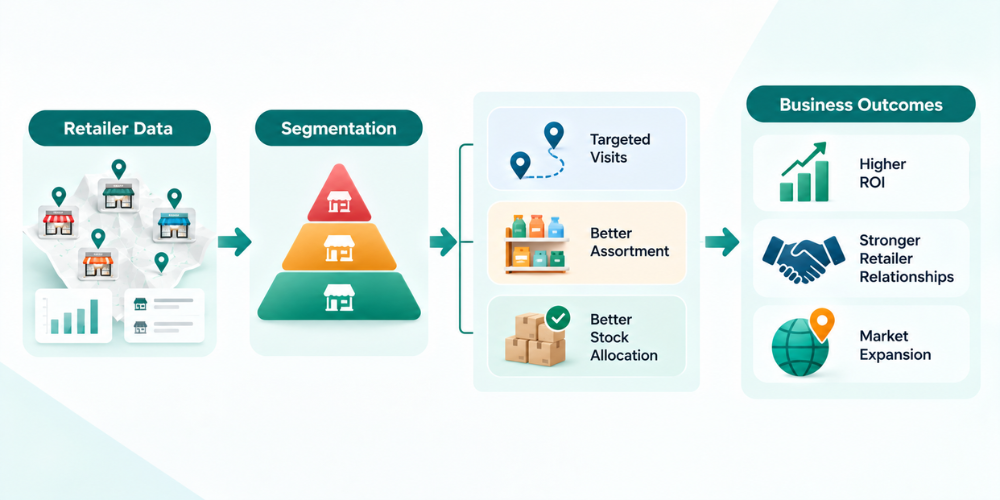
Retailer segmentation helps FMCG brands move from a one-size-fits-all distribution approach to a more targeted strategy. By understanding the differences between outlet groups, businesses can use their sales and distribution resources more effectively while improving coverage and retailer engagement.
-
Higher ROI on Distribution Efforts
Every field visit has a cost in terms of representative time, travel, and operational resources. Segmentation helps companies direct these resources toward outlets where they can have the greatest commercial impact. Instead of maximizing the number of visits, businesses can focus on making the right visits more productive. This can improve the return generated from field distribution activities.
-
Better Inventory and Stock Allocation
Not every retailer needs the same products or quantities. Using outlet-level sales and order information, businesses can identify which products move faster across different retailer groups. This helps distributors and sales teams make better decisions about inventory allocation. The result can be a closer match between product availability and actual market demand.
-
Stronger Retailer Relationships
Retailers are more likely to value a sales approach that reflects their actual business needs. For example, a high-volume retailer may need frequent replenishment and broader assortment support, while a smaller outlet may need help identifying the products that are most relevant to its customers. By segmenting retailers, sales representatives can have more relevant conversations instead of following the same sales routine at every outlet.
-
Improved Market Penetration
Segmentation can also reveal gaps in distribution. A business may discover that certain high-potential outlet categories have low product availability in a particular region. It can then prioritize those outlets instead of continuing to focus heavily on already well-covered stores. This creates opportunities to expand market penetration while making distribution coverage more deliberate.
How Technology Simplifies Retailer Segmentation
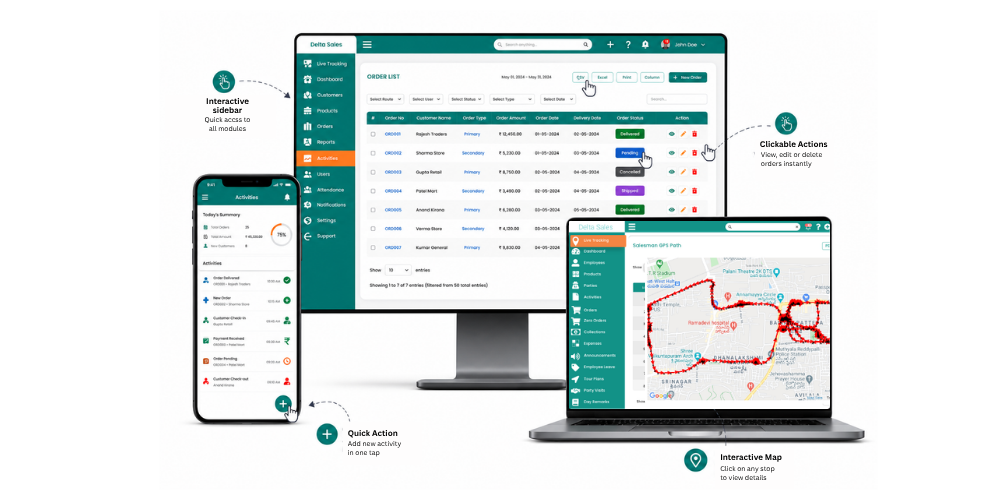
Manual segmentation becomes difficult as an FMCG business grows. Spreadsheets may contain outlet lists, sales information, and visit records, but keeping this information updated across a large field team can be challenging. A digital system can make the process more consistent by bringing outlet and field information together.
-
Role of Sales Tracking Apps in Segmentation
A sales tracking app can help businesses collect and organize information from field activities, including outlet visits, orders, sales activity, and representative performance. With a centralized view of field data, managers can identify differences between outlet groups and use those insights to refine segmentation over time. For FMCG businesses managing a large distributor network, this can make outlet prioritization more practical and easier to maintain.
-
Real-Time Data Collection from the Field
Retail markets change continuously. Sales volumes shift, new outlets appear, existing retailers change their purchasing behavior, and product demand can vary by season. If segmentation depends on outdated information, the resulting strategy can quickly lose relevance. Field teams using digital tools can capture updated outlet information during visits. Managers can then use fresher data to review outlet performance, coverage, and changing market conditions.
-
Automated Retailer Classification
Technology can also reduce the manual effort involved in organizing large outlet databases. Based on defined business rules and available outlet information, retailers can be grouped according to factors such as sales performance, order behavior, outlet category, or priority. For example, a company could create segments such as high-value outlets, growth-potential outlets, regular outlets, and low-activity outlets. These categories can then support different visit frequencies and sales strategies.
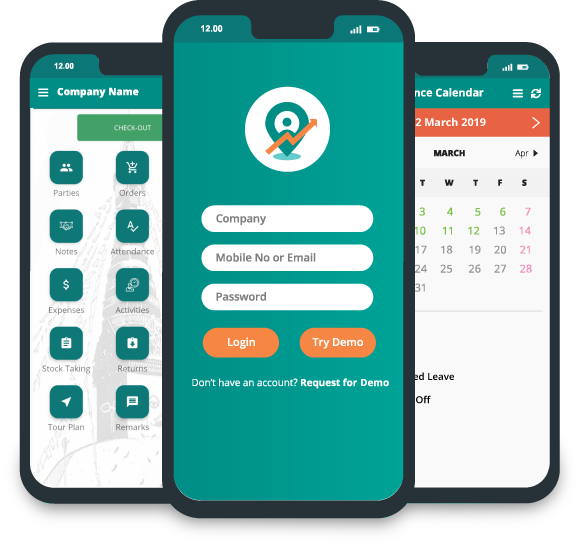
For businesses looking to connect retailer data with field execution, Delta Sales App brings sales force activities, outlet information, order management, and field visibility into one system. This can help managers make more informed decisions about outlet coverage and sales execution as their distribution network grows.
Common Mistakes to Avoid in Retailer Segmentation
Segmentation only works when the categories reflect what is actually happening in the market. Poor segmentation can create the same inefficiencies it was intended to solve.
-
Relying on Outdated Retailer Data
An outlet's importance is not permanent. Sales performance, product demand, competition, customer traffic, and purchasing behavior can change over time. A retailer classified as high-priority six months ago may no longer have the same potential, while another outlet may have grown significantly. Regularly updating outlet information helps keep segments relevant.

-
Ignoring Regional Buying Behavior
A segmentation model that works in one market may not work equally well in another. Consumer preferences, income levels, product demand, outlet density, seasonality, and purchasing habits can differ between regions. Applying the same classification criteria everywhere without considering local market behavior can lead to poor prioritization. FMCG businesses should combine standardized segmentation criteria with regional insights to make their distribution strategy more effective.
Conclusion
Retailer segmentation is not simply about putting stores into different categories. It is about understanding that every outlet has a different level of value, potential, demand, and service requirement.
When FMCG companies segment retailers using sales performance, location, purchasing behavior, outlet type, and updated field information, they can make better decisions about visit frequency, product assortment, distribution coverage, and resource allocation.
The real advantage comes when segmentation becomes an ongoing process rather than a one-time exercise. As outlet behavior changes, businesses can update their priorities and keep field execution aligned with actual market opportunities.
With the right technology, FMCG teams can make this process easier by connecting retailer information with field activities and sales data.
If you want to improve outlet visibility, sales execution, and distribution management with a more connected approach, Book a free demo of Delta Sales App today.