
Why Is Retail Coverage More Important Than Sales Calls?
Your sales team made 80 calls today. The dashboard looks impressive. "But how many important outlets did they actually cover? How many stores had your products on the shelf? How many retailers did you lose? How many sales did you lose because your products weren’t there? This is where the difference between sales calls and retail coverage comes into play.
You get a sales call saying that a rep was in the outlet. Retail coverage is an indication of how well your sales team is covering the market. For FMCG companies, distributors, and companies with large field sales teams, call volume alone can present a misleading view of sales performance. You could make hundreds of calls and still miss important outlets.
In this blog, we will look at why retail coverage is a more meaningful field sales metric, how it differs from sales calls, and how businesses can improve coverage with better planning, outlet segmentation, and sales force automation.
What Is a Sales Call?
A sales call is a personal interaction where a sales representative engages with a retailer, distributor, customer, or potential client to achieve specific sales goals. During a typical visit, a sales representative might:
-
Place an order
-
Review stock levels
-
Talk about current promotions or special offers
-
Receive payments
-
Present new product lines
-
Collect insights about the market
Sales teams often measure performance through metrics such as calls made, productive calls, orders taken, and sales generated. The problem is that call count mainly measures activity, not market reach. For example, a representative may complete 30 calls in a day, but if 10 high-value outlets were not visited, the call target alone does not tell the full story.
What Is Retail Coverage?
Retail coverage is all about how well a sales team connects with and supports the right retail outlets in a specific area or market. Rather than just asking, "How many calls did the salesperson make?" it focuses on the question, "How much of the target market did the sales team actually engage with?" Retail coverage can encompass:
-
The number and percentage of outlets visited
-
Frequency of visits to each outlet
-
Availability of products in retail stores
-
Visibility of products on shelves
-
Coverage across various territories
-
Engagement with new outlets
-
Distribution of products among outlets
-
Outlets that were missed or not visited
This makes retail coverage a crucial aspect of retail execution and field sales management. For instance, if a territory has 1,000 relevant retail outlets and your team visits 700 of them during the designated period, your coverage stands at 70%. This provides managers with a much clearer understanding of market reach compared to merely knowing the total number of calls made.
Key Differences Between Sales Calls and Retail Coverage
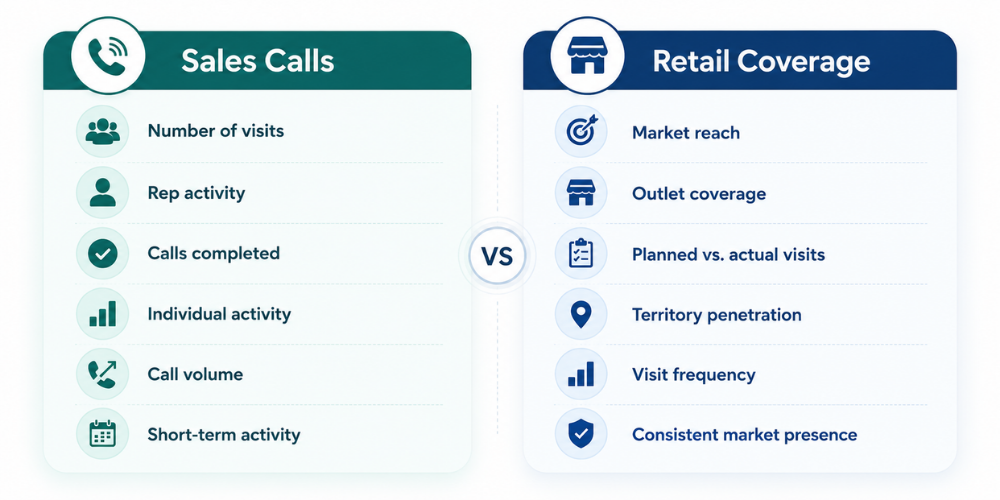
While sales calls and retail coverage are interconnected, they highlight distinct facets of field sales performance. A sales call reflects the effort a salesperson puts in, showcasing their activity level, whereas retail coverage reveals how well the business connects with its intended audience.
-
Purpose: A sales call measures individual visits made by a sales representative, usually to take orders, collect payments, check stock, or communicate with retailers. Retail coverage looks at whether the sales team is reaching the required number of outlets across a territory.
-
Focus: Sales calls track what the rep is doing. Retail coverage tracks how far the business actually reaches into the market. Thirty calls sounds productive on paper, but it means a lot less if the rep keeps hitting the same outlets while important retailers go unvisited.
-
Metrics tracked. Call-based tracking usually covers total calls, productive calls, orders, and average calls per day. Retail coverage looks at coverage percentage, planned vs. actual visits, outlet-wise coverage, visit frequency, product availability, and territory coverage.
-
Outcome. A high call count shows reps are out there working, but it doesn't say much about whether products are actually available across the market. Strong coverage is what keeps product availability, distribution, shelf presence, and retailer engagement intact.
-
Scalability. Call counts get hard to interpret once a business spans multiple territories and thousands of outlets. Coverage gives the broader view, showing managers which territories, outlet categories, or markets are covered well and where the gaps actually are.
A straightforward way to grasp the distinction is that sales calls reflect the efforts of the sales team, while retail coverage indicates how far the business extends into the market. For a field sales team, the real impact of their activity is realized only when it leads to significant market presence.
Why Sales Calls Are Not Enough
Sales calls are an important part of field sales, but they do not tell the complete story. A representative can hit the daily call target and still leave important outlets uncovered, miss stockout situations, or overlook changes in competitor activity. When call volume becomes the main measure of performance, teams may end up optimizing for more visits rather than better market coverage.
This is why sales managers must look beyond just the call count. To truly figure out if field activities are driving market growth, they need to evaluate factors like outlet coverage, product availability, shelf visibility, retailer relationships, and how well they penetrate their territories.
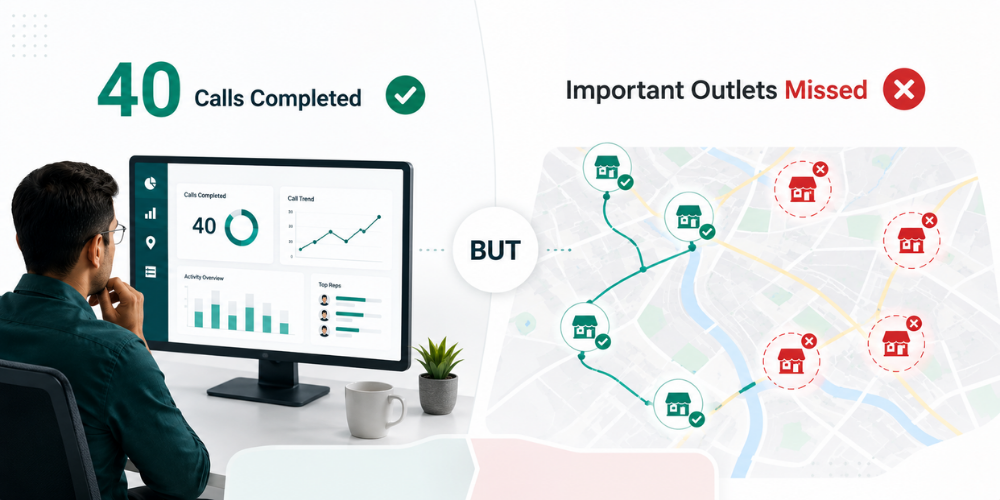
1. It focuses on quantity, not market presence.
A rep who completes 40 calls looks more productive on paper than one who completes 25. But what if the 25 hit every important outlet in the territory while the 40 stayed clustered in a small area? A higher call count doesn't automatically mean better coverage. A coverage-first approach looks past the raw number of visits and asks whether the right outlets are getting visited at the right frequency.
2. It doesn't account for shelf visibility or stock availability.
A visit doesn't guarantee your product is actually available or visible in that store. A rep can walk in, take an order, and move on, and if the product later goes out of stock or ends up poorly displayed or missing from the shelf, the sale is lost anyway. A retail execution app provides visibility into product availability, inventory, merchandising, and what's actually happening at the outlet level.
3. It misses unvisited and untapped outlets.
Call-based reporting tells you where reps went, but it doesn't clearly flag the outlets they skipped. If a territory has 2,000 potential outlets and a team logs 1,000 calls, that doesn't mean half the market got covered. Some outlets may have been visited five times, while others got zero. Tracking outlet coverage is what surfaces that gap.
4. It provides limited insight into competitor activity.
Retail is always shifting. Competitors launch products, roll out retailer schemes, grab more shelf space, or push harder into areas your team isn't regularly visiting. Tracking calls alone won't show managers any of that. Regular, structured coverage gives field teams more chances to pick up on competitor moves, market intel, pricing shifts, and retailer feedback.
5. It can inflate performance metrics without real sales impact.
A high call count makes a dashboard look good, but if those visits aren't reaching priority outlets, improving stock availability, generating orders, or expanding distribution, the activity isn't doing much for the business. Activity metrics only mean something when they're tied to actual sales outcomes.
6. It doesn't build long-term retailer relationships
Retailer relationships come from consistent engagement, not the occasional drop-in. Regular coverage lets reps understand what a retailer actually needs, catch shifting demand, communicate schemes, sort out problems, and keep products available. Over time, that's what builds stronger retailer relationships and better distribution, not the call count.
Why Retail Coverage Matters More
Retail coverage offers a deeper understanding of market dynamics. While sales calls indicate that a representative has visited an outlet, coverage reveals whether the right outlets are consistently and effectively engaged. This is crucial because sustainable sales growth relies not just on order-taking but also on ensuring product availability, broadening distribution, nurturing retailer relationships, and maintaining product visibility in the marketplace.
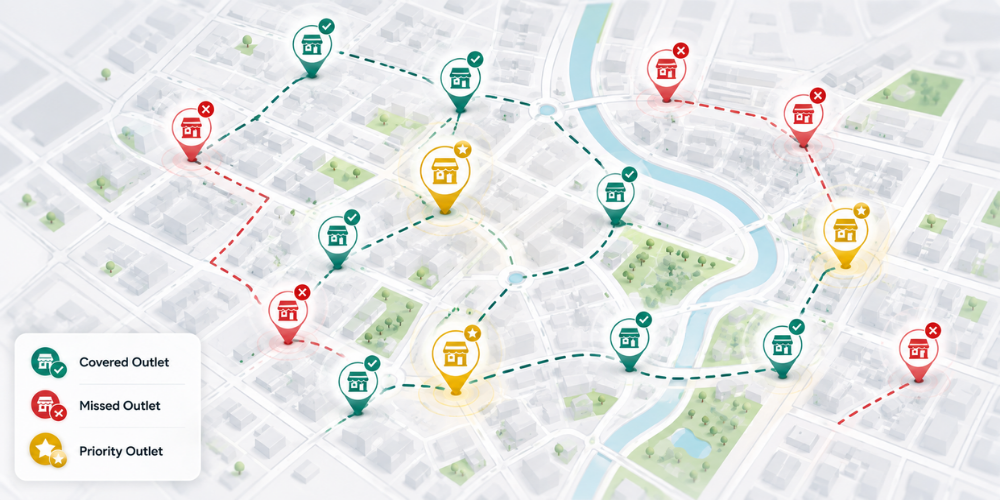
By prioritizing retail coverage, sales managers can pinpoint shortcomings in outlet reach, territory penetration, visit frequency, stock availability, and retail execution. These insights empower teams to optimize their field resources and transform routine sales visits into tangible market growth.
1. Better market visibility and shelf presence
Consistent outlet coverage gives reps more chances to actually check product availability, shelf placement, displays, and merchandising standards. That matters especially for FMCG brands fighting over limited shelf space. Better coverage catches execution gaps before they turn into real sales problems.
2. Stronger relationships with retailers over time
Retailers who get consistent visits have more chances to raise what they need and give feedback. Reps pick up on which products are moving fast, which are stuck, what retailers actually want from distributors, which schemes are working, what competitors are offering, and what customers are asking for. That turns a field visit into real market intelligence instead of just another box checked off.
3. More accurate demand forecasting
Better coverage means better access to market-level information. When reps consistently capture orders, inventory, retailer feedback, and product movement, managers can spot demand patterns with more confidence. That feeds directly into sales forecasting, inventory planning, distribution management, and replenishment.
4. Reduces stockouts and lost sales
A product can't sell if it isn't there. Regular coverage helps a sales team catch low stock or stockouts early, so a rep can place a replenishment order or flag it to the distributor before the sale is lost for good.
5. Improves brand consistency across outlets
Keeping execution consistent gets harder across hundreds or thousands of outlets. Coverage lets managers see whether stores are getting regular attention and whether products, displays, pricing, and promotions are actually being executed the way they're supposed to be, territory by territory.
6. Scales better than call-based tracking
As a sales organization grows, just piling on more calls doesn't automatically expand market reach. A sales operation that actually scales needs to know which outlets should be visited, how often, which territories have coverage gaps, who's responsible for which outlet, and whether planned visits are actually happening. That's where field sales automation and SFA software make the real difference.
How to Improve Retail Coverage
It’s not just about asking sales reps to make more calls to improve retail coverage. The goal is to visit the right outlets, at the right frequency, in the right territory, with a clear purpose. This requires better planning, better prioritization of outlets, and more visibility into field activities.
The use of structured beat plans, outlet segmentation, route planning, and sales force automation can help businesses reduce missed visits and identify coverage gaps faster. Managers can also monitor coverage metrics on a regular basis to see if their field teams are hitting priority outlets and maintaining a steady market presence.
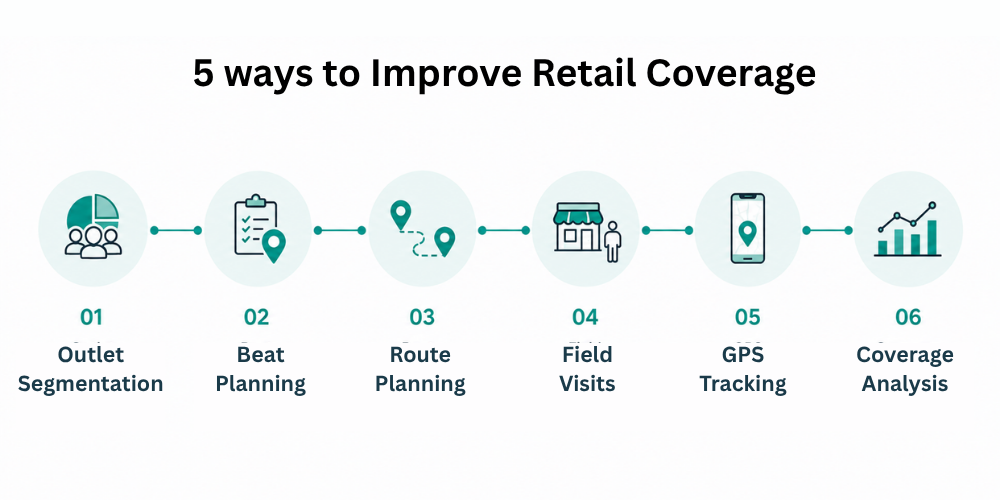
1. Use route planning and beat plans.
A structured route plan gets reps visiting outlets efficiently instead of deciding day-to-day where to go. With a beat plan, managers organize outlets by location, territory, and visit frequency, which cuts down unnecessary travel and keeps coverage consistent.
2. Set visit frequency by outlet tier
Not every outlet deserves the same attention. Businesses can sort outlets into tiers: A outlets (high-value or high-volume, needing frequent visits), B outlets (medium-value, regular coverage), and C outlets (lower-volume, less frequent visits). Understanding customer visit frequency can help sales managers determine how often different outlet types should be covered.
3. Train reps on a coverage-first mindset
Reps need to understand their job isn't just hitting a daily call number. It's building distribution, maintaining retailer relationships, improving product availability, gathering market intel, and keeping execution consistent. A coverage-first mindset gets reps thinking about market reach and outlet quality, not just how many stops they made today.
4. Track coverage percentage, not just call count
One of the biggest shifts is adding coverage percentage to the dashboard: Retail Coverage % = Outlets Visited ÷ Total Target Outlets × 100. If a territory has 500 target outlets and reps visit 400, that's 80% coverage, and it tells you immediately whether the team is actually reaching the market it's supposed to. Worth tracking alongside it: planned vs. actual visits, outlet-wise coverage, territory-wise coverage, new outlet coverage, visit frequency, product availability, and productive outlet coverage.
5. Use Sales force automation tools.
Managing coverage by hand gets hard fast as the number of reps, territories, and outlets grows. SFA software helps managers plan visits, assign outlets, monitor rep activity, and analyze coverage from a single dashboard.
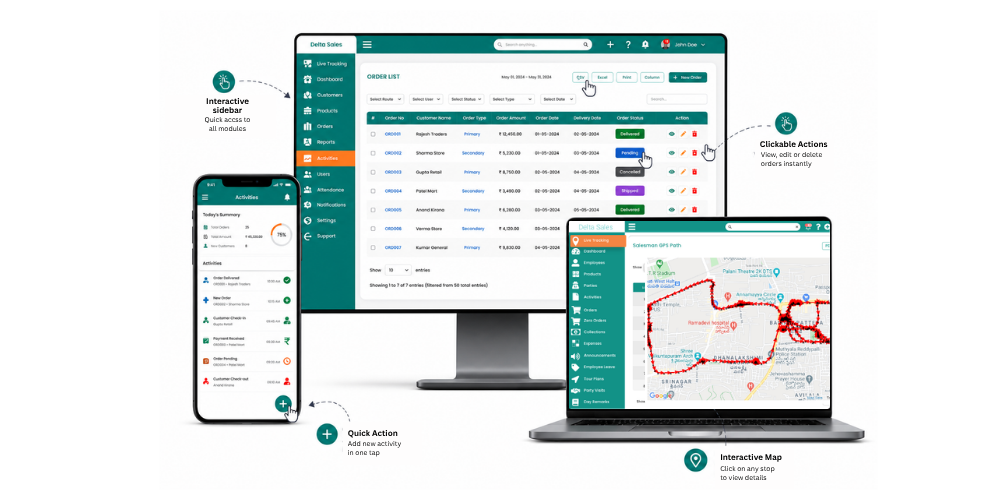
Delta Sales App, for example, handles beat planning, GPS-based tracking, outlet management, order management, and automated sales reports. Managers can use it to see whether planned visits are actually happening, catch coverage gaps, and improve field execution instead of relying on manual reports that arrive too late to act on. The point isn't tracking more calls; it's using field data to make sure reps are consistently reaching the right outlets.
Common Mistakes to Avoid
Improving retail coverage requires more than simply increasing the number of outlet visits. Many sales teams continue to focus heavily on call targets while overlooking whether those visits are reaching the right stores and contributing to better market coverage. These mistakes can make field performance look stronger on paper than it actually is.
Here are some common mistakes businesses should avoid:
-
Confusing call quantity with coverage quality
A high call count doesn't mean strong coverage. A rep can complete 30 calls while repeatedly hitting the same outlets and leaving several important retailers untouched. Managers need to weigh call activity against total target outlets, coverage percentage, and planned vs. actual visits, not just the raw number.
-
Ignoring outlet segmentation
Not every outlet carries the same sales potential or needs the same visit frequency. Treating a small neighborhood store the same as a high-volume outlet wastes field resources. Segmenting outlets by sales volume, potential, location, and purchase frequency helps a team prioritize visits properly.
-
Not tracking coverage separately from sales metrics
Sales revenue and retail coverage tell you different things. A territory can post good numbers today while still having weak outlet penetration, and that gap turns into a growth problem later. Coverage, sales, productive outlets, distribution, and visit frequency need to be tracked as separate, connected metrics, not folded into one number.

-
Relying on manual reports
When coverage data lives entirely in spreadsheets or end-of-day reports, managers often don't catch missed visits or territory gaps until it's too late to do anything about them. Field sales tracking software gives that visibility in real time instead of after the fact.
-
Focusing only on existing retailers
Repeatedly visiting the same established outlets while ignoring everything else is a common mistake. Real retail coverage also means finding the uncovered, new, and untapped outlets that could actually grow distribution and market reach.
Conclusion
Sales calls tell you how much activity your sales team is doing. Retail coverage shows you how much of your market you actually hit with your team. That’s quite a difference.
A sales representative can make dozens of calls but miss the most important outlets in a territory. In contrast, a good coverage plan can guarantee that high-priority retailers are always visited, products are always in stock, market information is transmitted to managers, and distribution is developed in an orderly way. The growing FMCG, distribution, and field sales organizations’ goal is not to eliminate sales calls. It should be to get every call to add to broader, more meaningful retail coverage. Structured beat plans, outlet segmentation, GPS-based field location tracking, and sales force automation software can help businesses move from measuring activity to managing actual market reach.
Want to expand your team’s retail reach? Schedule a free demo of the Delta Sales App and learn how automated field sales management can enable your team to plan, track, and optimize outlet coverage.