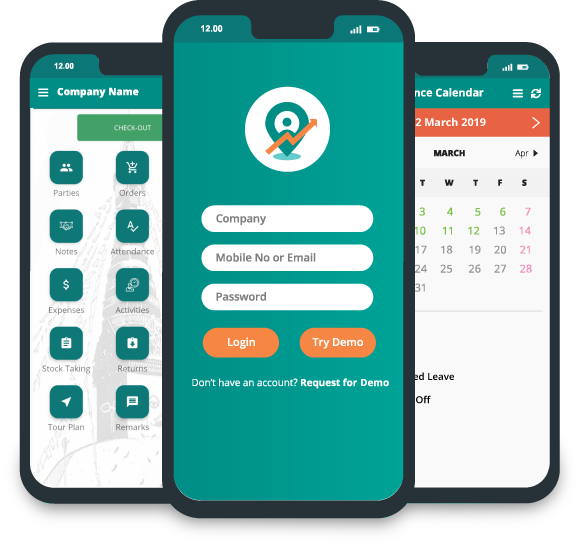

8 Proven B2B Sales Strategies for Success in 2026

B2B sales in 2026 isn't just about pumping more leads into the pipeline. For companies selling through distributors, wholesalers, retailers, and field reps, growth still comes down to what happens after the lead is generated.
A rep needs to reach the right outlets, follow the right beat, carry accurate product information, capture orders correctly, follow up on collections, and report what actually happened in the market. Managers need visibility into all of that without spending the whole day chasing spreadsheets, WhatsApp updates, and end-of-day phone calls. At the same time, buyers are getting more comfortable with digital interactions. A distributor might research a supplier online before ever speaking to a rep. A retailer might confirm product availability over WhatsApp before agreeing to a visit at all. A procurement team might compare suppliers remotely and only request an in-person meeting once the opportunity's actually serious.
In this blog, we’ll explore 8 proven B2B sales strategies that can help field sales teams improve territory execution, increase rep productivity, reduce operational inefficiencies, and build stronger customer relationships in 2026.
Why Field-Based B2B Sales Teams Need a Different Playbook in 2026
Field sales operates completely differently from a purely digital funnel. A rep might need to cover 15 or 20 outlets in a territory, check distributor stock, collect orders, follow up on outstanding payments, verify displays, and still submit a DSR before the day's done.
The variables are far less predictable too. Traffic reroutes the plan. A retailer's closed when they shouldn't be. A distributor runs out of a fast-moving SKU. A competitor drops a promotion out of nowhere. A customer who normally orders every week suddenly cuts back. That's exactly why generic advice like "generate more leads" or "send more emails" doesn't solve the actual operational problems an outside sales team deals with.
B2B buyers increasingly move between digital and human channels, which makes a hybrid model more relevant than ever. McKinsey research has found that buyers use multiple channels throughout the purchasing journey, and many still value in-person interaction at key stages.
For field-led businesses, that means digital tools should support field execution, not replace it. The real question for sales managers in 2026 isn't just how to sell more. It's how to make territory coverage, customer visits, order capture, collections, and sales coaching more deliberate.
8 Proven B2B Sales Strategies for 2026
B2B sales success in 2026 comes down to more than generating leads or racking up more customer visits. Field teams need a structured approach that ties together territory mapping, digital engagement, customer relationships, order management, and data-driven decisions. The strategies below focus on practical ways sales managers can improve field execution, cut down wasted time, boost rep productivity, and produce more consistent results.
1. Build a Hybrid Field + Digital Selling Model
The strongest sales process is rarely 100% field-based or 100% digital. Different customers need different levels of interaction. A new distributor weighing a long-term partnership probably wants an in-person conversation. An existing retailer checking stock availability probably just needs a quick digital exchange. A rep can confirm an appointment over WhatsApp, do the physical visit, and follow up with a digital product catalogue afterward; the key is making sure each channel actually serves a purpose instead of duplicating effort.

- When to send a rep in-person vs. when to go digital
Use an in-person visit when physical presence actually adds value: new distributor onboarding, high-value account negotiations, territory expansion discussions, product demonstrations, retail execution checks, merchandising verification, collection discussions that need direct engagement, accounts with declining order volume, and strategic relationship building. Digital communication can handle most of the lower-complexity interactions instead: order confirmations, stock availability checks, routine follow-ups, appointment scheduling, product information, payment reminders, replenishment prompts, and post-visit follow-ups. This approach protects a rep's most valuable resource: field time. Instead of visiting every account at the same frequency regardless of need, managers can figure out which interactions genuinely require someone showing up in person and which don't.
-
Using Pre-Visit Digital Touchpoints to Warm Up Retailers/Distributors
A field visit becomes more productive when the customer already knows why the rep is coming. Before visiting, the rep can send a product update, confirm stock requirements, share a new SKU, or ask whether the customer needs anything specific. This creates a simple sequence:
Digital touchpoint → planned visit → order or action → digital follow-up
The field visit is then used for selling and relationship building rather than discovering basic information that could have been collected beforehand.
2. Assign the Right Reps to the Right Territories and Accounts
Territory allocation gets treated as an administrative exercise more often than it should be. It's really a productivity decision. Two reps can share the same target and work the same hours and still produce very different results, because one has a well-balanced territory and the other spends half the day traveling between scattered outlets. Territory design needs to account for geography, account potential, customer density, sales history, product mix, and expected visit frequency.
Designing Balanced Territories to Cut Travel Time and Avoid Overlap
Poor territory design creates several problems. One rep may be overloaded with high-volume outlets while another has too much unused capacity. Two reps may unknowingly visit the same accounts. Remote customers may receive inconsistent coverage because they are difficult to reach. A practical territory review should examine:
-
Number of active outlets
-
Revenue contribution
-
Average order value
-
Customer density
-
Travel distance
-
Visit frequency
-
Distributor locations
-
Growth potential
-
Rep capacity
-
Historical sales performance
The objective is not simply to divide outlets equally. It is to create territories that are operationally manageable and commercially meaningful.
Scoring Outlets/Accounts by Revenue Potential Before Beat Planning
Not every outlet deserves the same visit frequency. A high-volume retailer, strategic distributor, or rapidly growing account may justify weekly or even more frequent attention. A low-volume outlet with limited potential may need less frequent visits. A simple account scoring model can combine:
Current revenue + growth potential + order frequency + strategic importance + collection risk
That score can then inform beat planning. This prevents a common field-sales mistake: treating every customer as equally important simply because every customer appears on the master list.
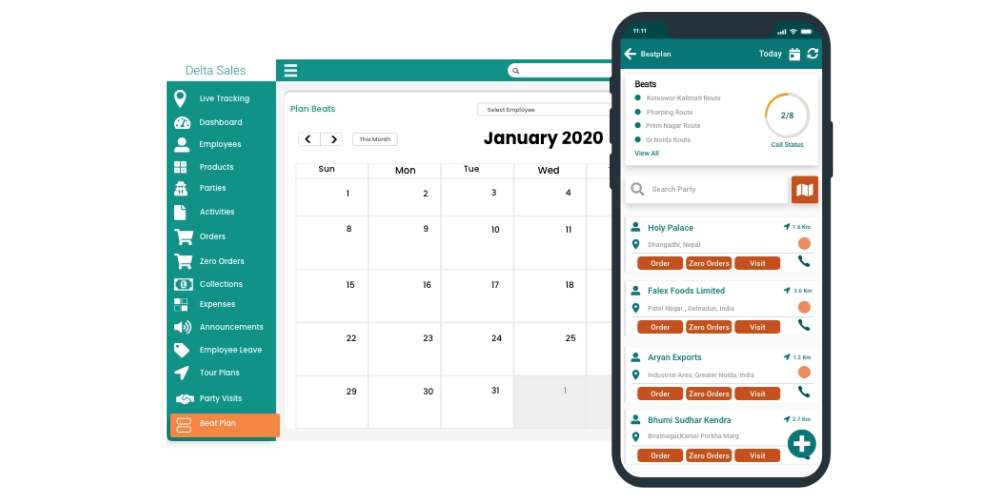
3. Optimize Beat Plans and Route Efficiency
A beat plan should answer one basic question: which customers does this rep visit, on which day, and in what order? Leave that entirely up to individual reps and the results vary a lot. Some organize their routes naturally well. Others end up revisiting the same areas for no reason, skipping the harder outlets, or losing too much time in transit. A structured beat plan creates real consistency without stripping the rep's ability to respond to what's actually happening on the ground.
Smart Route Planning to Maximize Daily Customer Visits
Route planning should account for geography as well as business priorities. A practical route may group nearby outlets while prioritizing customers with higher order potential. Managers should review:
-
Planned versus actual travel distance
-
Number of customer visits
-
Time spent travelling
-
Missed visits
-
Outlet frequency
-
Average order value by route
-
Productive visits versus non-productive visits
The goal is not to force the maximum number of visits into a day. Ten productive visits can be more valuable than twenty rushed visits that produce little commercial activity.
Using GPS Tracking to Improve Beat Plan Compliance
GPS data gives managers a clearer view of field execution. Instead of relying entirely on a rep's end-of-day statement, managers can compare planned outlets with actual check-ins and visit locations. This makes it easier to identify skipped outlets, repeated visits, unusual route deviations, or areas where a beat plan needs to be redesigned. For example, if a rep is consistently checking in outside the planned territory, the issue may not necessarily be poor discipline. The territory itself may be inefficient. Data can help managers investigate the actual reason rather than assuming the problem is the salesperson.
With the Delta Sales App, managers can compare GPS-based check-ins against planned beats, identify skipped or out-of-route visits, and understand how field activity is actually happening across territories.
4. Automate Order Taking and Payment Collection
Manual order capture creates friction at multiple points in the sales process. A rep writes an order in a notebook, transfers it into a spreadsheet, sends it to the office, and someone else enters it into another system. Every additional handoff creates an opportunity for an incorrect SKU, quantity, price, discount, or customer record. Mobile order capture reduces that gap.
Reducing Manual Errors with Mobile Order & Invoice Capture
A field representative should be able to access customer information, product catalogues, pricing, previous orders, and relevant stock information while standing in front of the customer. The order can then be captured digitally at the point of sale. This creates a cleaner workflow:
Customer discussion → order entry → confirmation → synchronization → reporting
For businesses operating in areas with unreliable connectivity, offline functionality becomes particularly important. A rep should not lose the ability to capture an order simply because the mobile network is weak. An offline-first workflow allows the rep to continue working and synchronize the data when connectivity returns.
Speeding Up Collections with Real-Time Payment Tracking
Sales growth without collection discipline can create a cash-flow problem. Field teams often collect payments alongside orders, but collection information can become fragmented across receipts, spreadsheets, messages, and accounting records. Digital collection tracking gives managers better visibility into:
-
Amount collected
-
Outstanding balance
-
Collection date
-
Customer account
-
Rep responsible
-
Payment status
-
Collection performance
This also makes customer conversations more informed. Instead of asking, "Did this customer pay?" a manager can review the latest collection information before discussing the account with the rep.
5. Equip Field Reps with Real-Time Mobile CRM Access
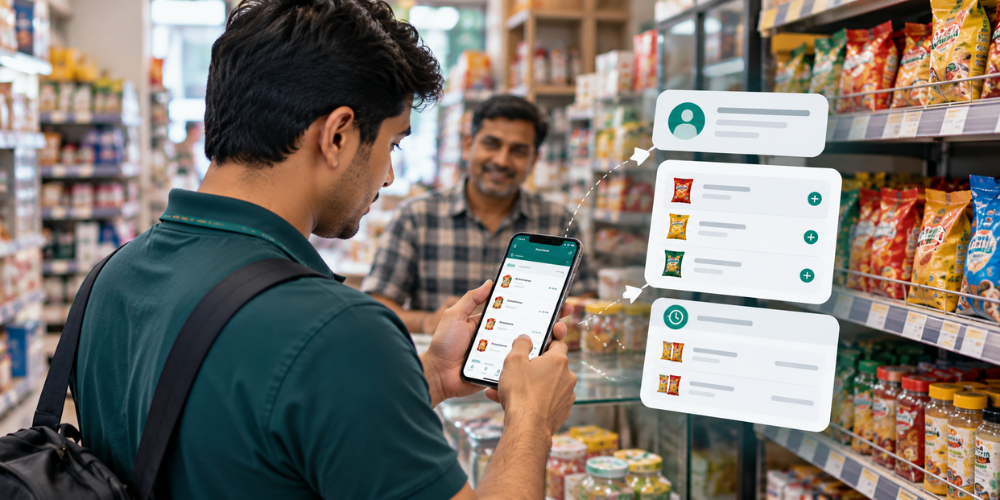
A field representative should not have to call the office every time a customer asks a basic account question. The more information available on the rep's mobile device, the less time is lost waiting for internal responses.
-
Giving reps offline-capable access to customer and stock data
A useful field CRM should give reps access to what actually matters in the moment: customer profile, previous orders, product catalogue, order history, outstanding payments, visit history, sales targets, distributor information, and relevant stock data.
Offline access matters, especially when reps are working rural territories, warehouses, industrial areas, or markets where mobile connectivity can't be counted on. The goal is simple: give the rep what they need to decide while they're still standing in front of the customer, not after they've driven back to a signal.
-
Closing the Reporting Gap Between Field Reps and Managers
The traditional DSR often creates a reporting delay. A rep completes the day's work, returns home, prepares a report, and sends it to a manager. By the time the manager reviews it, the opportunity to respond to a market issue may already have passed. Automated reporting changes the timing. When visits, orders, collections, expenses, and attendance are captured through a mobile system, managers can see activity closer to when it happens. That makes the DSR less of a paperwork exercise and more of an operational data source.
6. Use AI and Activity Data to Prioritize High-Value Visits
AI should not be introduced into field sales simply because it is a popular technology category. The useful question is
Can data help the team decide what to do next?
For field sales, this can mean using order history, visit frequency, revenue trends, product movement, collection behavior, and customer activity to identify where attention may be needed.
Flagging At-Risk or High-Potential Outlets Before the Visit
Consider a retailer that normally orders 100 units every two weeks but has dropped to 55 units over the last three cycles. The rep may not notice the pattern while moving through a territory. A data-driven system can flag the account for review. The same approach can identify potential growth opportunities. For example:
-
A retailer repeatedly purchasing one product category but not related SKUs
-
An account whose order value is steadily increasing
-
A customer whose visit frequency has fallen
-
A distributor showing declining secondary sales
-
A high-value account approaching its normal reorder window
These signals help managers and reps prioritize attention. AI can support this process by synthesizing multiple signals and recommending where a seller should focus. Recent B2B sales research increasingly points toward AI being most useful when it is connected to specific workflows such as opportunity prioritization, personalization, and administrative automation rather than deployed as a generic productivity layer.
Automating Non-Selling Admin So Reps Spend More Time Selling
Field representatives already spend considerable time on activities that are necessary but not directly revenue-generating. These include:
-
Manual report preparation
-
Data entry
-
Attendance records
-
Expense calculations
-
Visit documentation
-
Internal follow-ups
-
Order transcription
Salesforce research has similarly identified administrative and other non-selling work as a significant share of sales representatives' time. Automation should remove repetitive work without removing the human parts of selling. The rep should spend less time preparing reports and more time discussing assortment, resolving customer issues, identifying new opportunities, and strengthening relationships.
7. Track the Right Field Sales KPIs to Coach Performance
A sales dashboard can contain dozens of numbers. That does not mean every number deserves management attention. Field sales managers should focus on KPIs that explain whether activity is translating into commercial outcomes.
-
Activity metrics that predict revenue: visits, orders, conversion
Useful field sales KPIs to track: planned visits, completed visits, beat compliance, productive visits, orders booked, visit-to-order conversion, average order value, revenue by territory, SKU coverage, collection value, outstanding payments, travel distance, new outlet additions, and repeat order rate.
The real point is connecting activity with outcomes. If one rep completes 25 visits and generates only five orders while another completes 15 visits and generates ten, visit count alone doesn't explain what's actually happening. Managers need to look at conversion, account quality, territory characteristics, product mix, and customer potential to understand why.
-
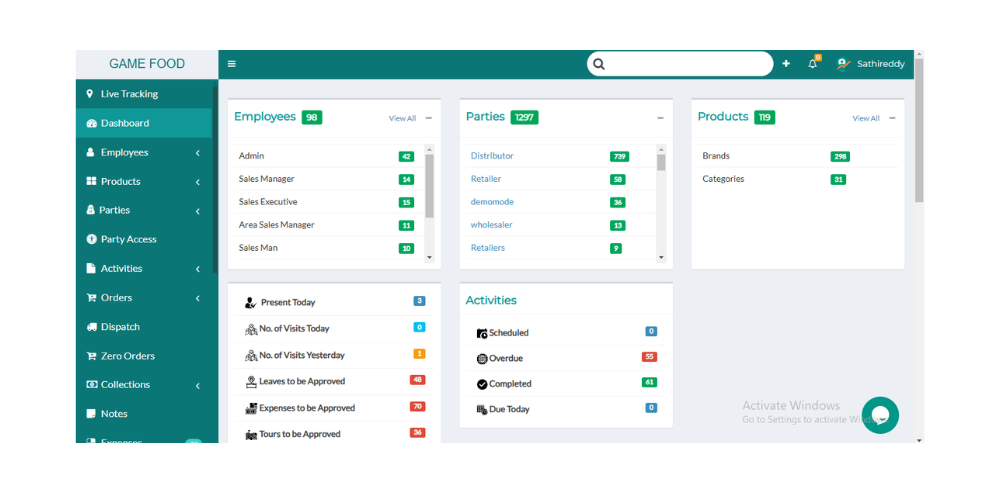
Using Real-Time Dashboards to Coach Underperforming Reps
A dashboard should not become a tool for publicly comparing representatives. Its better use is diagnosis. Suppose a rep's sales are declining. The manager can examine:
-
Are visits down?
-
Are visits stable but orders declining?
-
Are orders stable but collections falling?
-
Is travel increasing without an increase in coverage?
This creates better coaching conversations because the manager can discuss the underlying behavior rather than simply saying, "Your sales are low."
8. Strengthen Distributor and Retailer Relationships for Retention
Acquiring a customer is only one part of B2B sales. For distribution-led businesses, repeat orders, assortment expansion, payment discipline, and territory relationships often determine long-term account value. A strong field sales process should therefore treat every visit as more than an opportunity to take an order.
-
Turning Regular Visits into Upsell and Cross-Sell Opportunities
A rep visiting a retailer should know what the customer already buys. That creates opportunities to identify gaps. For example: A retailer regularly purchases beverages but carries only a limited selection of pack sizes. A distributor orders a core product range but has not introduced recently launched SKUs. A wholesaler purchases high-volume products but does not stock complementary products. The rep can use order history to make a relevant recommendation instead of presenting an unrelated sales pitch. This is where field sales data becomes useful at the customer level. The conversation changes from "What would you like to order today?" to: "You normally reorder these products every two weeks. Your last order was lower than usual, and you haven't stocked this related SKU yet. Would you like to review the current requirement?" That is a much more informed sales conversation.
-
Using visit and order history to flag churn risk early
Customer churn rarely shows up as one obvious event. It usually starts quietly fewer visits, smaller orders, longer reorder intervals, a shrinking SKU count, unresolved complaints, payment delays creeping longer, or just reduced engagement overall.
Tracking these signals together lets managers step in earlier. From there, the rep can get a specific action to take: understand what's actually going on, work to recover the relationship, introduce a relevant product, resolve a service issue, or talk through a replenishment plan. That turns retention into an actual operational process, rather than something that only gets reviewed after the customer's already gone.
Key Takeaways: What Separates Top Field Sales Teams in 2026
Successful field sales execution is rarely built around one tactic. It comes from connecting several operational decisions.
-
Better territory design reduces unnecessary travel and improves account coverage.
-
Better beat planning ensures reps spend their time on the right outlets.
-
GPS visibility helps managers understand whether planned field activity is actually happening.
-
Mobile order capture reduces manual errors and shortens the distance between customer conversation and order processing.
-
Collection automation gives teams better visibility into outstanding payments.
-
Offline-capable mobile tools keep field operations moving when connectivity is unreliable.
-
Real-time reporting reduces the delay between a market event and a management response.

And sales KPIs give managers the evidence needed to coach representatives based on actual field behavior. The practical lesson is straightforward: do not measure field sales only by the final revenue number. Look at the operational chain that produces that revenue.
-
Are the right outlets being visited?
-
Are planned beats being followed?
-
Are visits producing orders?
-
Are orders accurate?
-
Are collections happening on time?
-
Are representatives spending enough time selling instead of preparing reports?
Are managers seeing problems early enough to act? That is where field sales management technology can make a measurable operational difference.
Conclusion
Improving B2B field sales is not about asking reps to make more visits or work longer hours. It is about helping them spend their time on the right customers, follow efficient routes, capture orders accurately, and act on reliable field data. When territory planning, customer engagement, order management, and performance tracking work together, sales teams can operate with greater consistency and visibility.
Delta Sales App helps bring these processes together in one platform, with features for beat planning, GPS-based employee location tracking, order and collection management, attendance, expense tracking, and real-time sales reporting. This gives managers better visibility into field operations while allowing sales reps to focus more on selling and customer relationships.
Want to see how it can fit into your sales workflow? Book a free demo and explore how Delta Sales App can help your field team manage daily sales activities more efficiently.