
How Can Location Intelligence Improve Field Sales Decisions?
A sales manager might know how much a territory sells, how many visits a rep completes, and which customers place the most orders. But there's one more question that changes how all those numbers actually read: where is all this happening?
For field sales, location reveals patterns that a standard sales report usually misses. A territory with falling sales doesn't necessarily have a performance problem. It might have poor customer coverage, inefficient routes, accounts distributed unevenly, or a rep spending too much of the day just getting from one stop to the next.
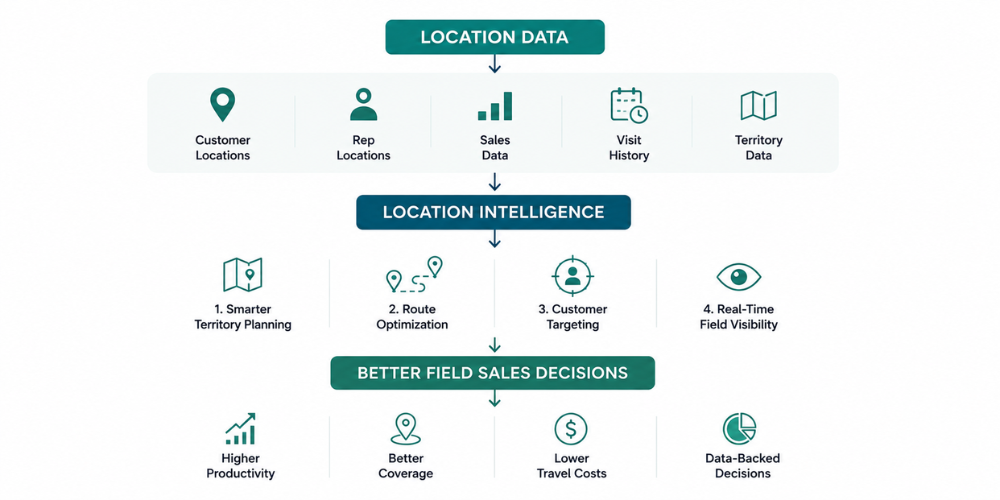
That's where location intelligence in field sales earns its place. Combine geographic information with customer, sales, visit, and field activity data, and a business can actually see what's happening across its territories instead of guessing. Instead of using location data just to check where a rep is right now, it can answer bigger questions: which areas need better coverage, whether reps are following efficient routes, where the high-value customers are actually concentrated, which territories still have untapped potential, and how well the sales team is using its time overall.
For businesses running distributed field sales teams, that kind of insight feeds directly into territory planning, route optimization, customer targeting, field productivity, and decision-making generally.
So how exactly does location intelligence change field sales decisions in practice? This post covers what location intelligence actually means, how it's different from basic GPS tracking, the problems it addresses, and how it helps with territory planning, route optimization, customer targeting, and field sales productivity.
What is Location Intelligence?
Location intelligence is the process of using location-based data to understand business activity, spot geographic patterns, and make better decisions. In field sales, it ties the physical location of customers, reps, territories, and field activities to actual business information: sales performance, visit history, order data, customer value.
Take a field sales team working across multiple cities. A standard sales report might show one territory outperforming another. Location intelligence adds another layer on top: where the customers are concentrated, where the sales are actually happening, how territories are being covered, and how reps are moving between stops. That's what turns location data into something more than a tracking mechanism. It becomes real sales intelligence. It can show a manager that a high-sales area has a dense cluster of retailers getting fewer visits than it should, that two customer visits scheduled for the same day are miles apart for no good reason, that parts of a territory have plenty of active customers but weak coverage, that high-value customers are clustered in a specific area, or that a rep is spending more time traveling than actually meeting customers.
Combine that geographic view with sales and customer data, and a business can make real decisions on territory management, customer coverage, route planning, resource allocation, and field productivity.
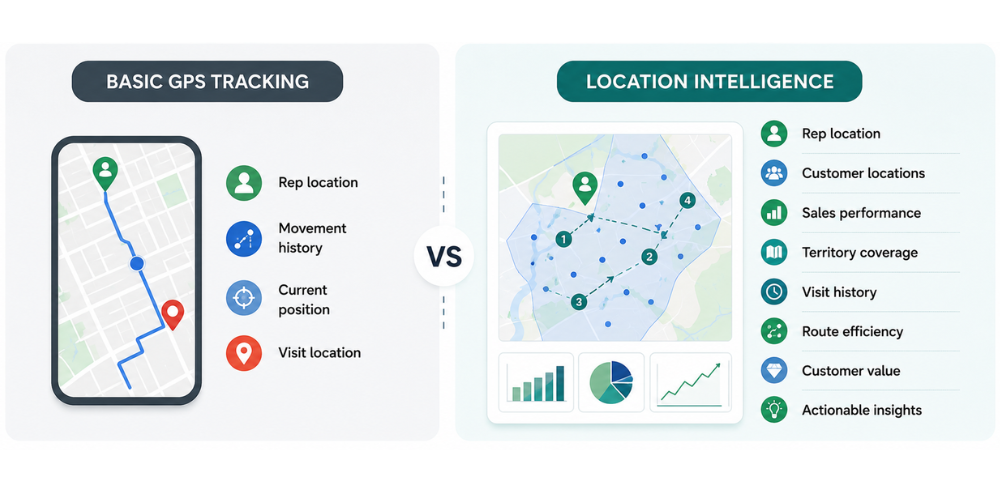
GPS tracking tells managers where a rep is or where they've been. Useful, but limited. Location intelligence goes further by connecting that location data to everything else going on around it. GPS tracking can show a rep is standing at a particular retailer.
Location intelligence answers why that location matters, how often it should get visited, what sales it generates, and how it fits into the rep's broader territory and route. That distinction matters, because just collecting location data doesn't automatically improve anything. It has to get tied to sales performance, customer information, visit records, territory data, and field activity before it becomes an actual insight.
The short version: GPS tracking tells you where your sales team is. Location intelligence tells you what that location actually means for your sales strategy.
Common Challenges in Traditional Field Sales
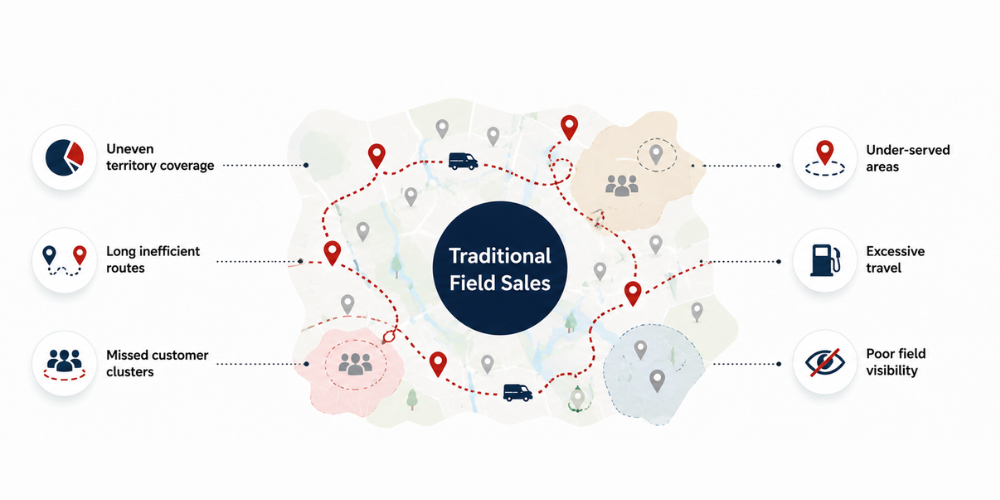
Field sales teams cover large territories, juggle multiple customer segments, and deal with routes that shift constantly. Reps might have clear daily targets, but managers don't always have enough geographic context to know if the team is actually using its time and territory well. When location data isn't tied to sales and customer information, a handful of operational problems tend to show up.
1. Poor visibility across sales territories.
Managers might know a territory's total sales without knowing how well that territory is actually being covered. Some areas get frequent visits, while other customer clusters get neglected. Without geographic context, it's hard to tell whether weak performance comes from low market potential, thin customer coverage, or just poor execution.
2. Inefficient sales routes.
Without real route planning, reps end up moving between customers inefficiently. A daily plan might include stops that are geographically nowhere near each other, burning travel time that could've gone to actual selling. Over time, that adds up in wasted hours, higher fuel costs, and fewer productive visits.
3. Uneven customer coverage.
Not every customer gets the same attention. Reps naturally gravitate toward familiar or conveniently located accounts, leaving harder-to-reach customers with fewer visits. Without location-based visibility, spotting that coverage gap is genuinely hard.
4. Difficulty identifying high-potential areas.
Sales data shows which products or territories are performing well, but it doesn't always reveal where the untapped opportunity actually is. An area with plenty of potential retailers but weak sales might just need stronger distribution and more frequent visits, and that's easy to miss without a geographic view.
5. Decisions based on incomplete data.
Traditional field sales decisions usually run on sales reports, rep updates, spreadsheets, or end-of-day summaries. All useful, but none of them show the full relationship between where things are happening and how that's affecting performance. Combining location data with sales information is what fills that gap.
6. Difficulty measuring field productivity.
A high visit count doesn't necessarily mean a productive day. Travel time, customer value, territory coverage, visit frequency, and actual sales outcomes all matter too. Without geographic context, it's hard to tell the difference between a busy rep and one who was actually productive.
How Location Intelligence Improves Field Sales Decisions
Location intelligence pays off when a business uses geographic data alongside sales and customer information, instead of treating location as its own separate metric. Sales managers can use it to see where opportunities actually exist, how resources are being used, and what needs to change to improve field performance. Here's how that plays out in practice.
1. Smarter sales territory planning.
Real territory planning is about more than dividing a map into chunks. It has to account for customer density, sales potential, geographic distance, visit frequency, and rep workload. Location intelligence lets managers see where customers actually sit and weigh that against sales performance, which reveals territories that are overloaded, areas with thin coverage, or regions where potential is going unused.
Say one rep manages a territory with hundreds of active retailers while another covers an area with far fewer accounts, and both have similar sales targets. That's an uneven workload hiding in plain sight until someone looks at the map alongside the numbers. Combining customer location data, field sales team performance, and territory information lets managers actually fix that: more balanced territories, better retailer coverage, stronger territory performance, smarter allocation of reps, and identification of the areas nobody's really covering. That's what turns territory management from a static line on a map into an actual data-driven process.
2. Optimized route planning for field reps.
A rep's productivity depends not just on how many customers they see, but on how efficiently they get between them. This is where a route planning app earns its keep: factor customer locations into route planning, and a sales team can organize daily visits in an order that actually makes sense, instead of an arbitrary one, cutting unnecessary travel and freeing up more time for customer interactions.
If five customers are scheduled for the same day, visiting them by geographic proximity beats following whatever order they happened to get added to the list. Location intelligence, paired with a route planning app, helps identify shorter, more practical routes; customers who are close together; travel that's clearly wasted; opportunities to group visits; and better daily planning overall. That matters most for large field teams covering a lot of ground every day. Better route optimization means less time driving and more time actually selling, taking orders, doing merchandising, and building the relationship.
3. Better customer targeting and segmentation.
Customer segmentation gets a lot more useful once a business knows not just who its customers are, but where they actually are. Location intelligence surfaces geographic clusters and lets a business weigh those against sales performance, order frequency, customer value, and visit history.
A manager might find several high-value retailers clustered in one area, which justifies more frequent visits or prioritizing that area in the daily plan. Or an area with plenty of potential customers and weak sales might point to a real expansion opportunity. Combining location insight with segmentation helps prioritize high-value customers, high-potential areas, underperforming territories, customers who need more frequent visits, and areas with weak coverage, so field teams spend their time where it actually moves the business forward.
4. Real-time visibility into field activities.
Traditional sales reporting tells you what happened after the fact. Location intelligence gives managers a more immediate view of what's happening right now. With a GPS-based tracking system, a manager can see rep movement, customer visits, and territory coverage as it's all happening, not the next morning.
If a rep has several planned visits but is spending an unusual amount of time at one stop, a manager can catch that in the moment instead of waiting for an end-of-day report. Combine that tracking with field sales analytics and reports, and managers can compare the plan against what's actually happening and catch the gaps: are reps covering their assigned territories, are the planned visits actually getting done, which areas are under-covered, how much time is going to travel, and does the day's activity actually match the plan? That's what gives managers real field visibility and lets them make faster, better operational calls instead of reacting to yesterday's numbers.
Key Benefits of Location Intelligence in Sales
When location intelligence is integrated into everyday sales operations, it can do more than improve visibility. It can help businesses use their sales force more efficiently, reduce operational waste, and make decisions based on actual field data.

For organizations managing teams across multiple territories, these benefits can have a direct impact on field sales productivity, customer coverage, and sales performance.
-
Increased sales productivity
Sales productivity isn't just about racking up more visits. It's about getting reps to spend more of their working day on things that actually contribute to sales. Location intelligence helps here by improving territory allocation, organizing customer visits, and cutting out unnecessary movement.
A rep with a well-planned route and a balanced territory spends less time traveling and more time meeting customers, taking orders, following up with retailers, checking product availability, collecting payments, and spotting new sales opportunities. Managers can then use field sales analytics to compare visit activity, territory coverage, travel patterns, and sales results together, which gives a much fuller picture of a rep's actual productivity than just counting how many stops they made.
-
Reduced travel time and costs.
Travel is unavoidable in field sales. Wasted travel isn't. Analyze customer locations alongside planned visits, and a business can build genuinely more efficient routes, saving working hours and travel costs at the same time.
For companies running large field teams, even a small cut in travel time per rep adds up fast across hundreds of working days and multiple territories. Better location-based planning means less unnecessary travel, lower fuel and transportation costs, less dead time between visits, tighter daily routes, and more productive hours in the field overall. That's why route optimization matters so much for businesses whose reps see a lot of customers every single day.
-
Data-backed decision-making.
The biggest advantage of location intelligence might be that it adds geographic context to sales data that already exists. A standard sales report might tell a manager a territory generated ₹10 lakh in sales. Location intelligence fills in where those sales happened, which customers contributed, how often they were visited, and how the territory was covered overall.
That's the shift from asking "what happened" to asking "where did it happen, why might that be, and what should we actually do about it?" Combine sales analytics, customer data, GPS tracking, visit history, and territory information, and a business gets real, informed decisions on resource allocation, customer coverage, sales routes, and territory performance, instead of guesses dressed up as strategy. That's really the whole point of location intelligence: turning raw geographic data into something a sales team can actually act on.
How Delta Sales App Helps Implement Location Intelligence in Your Sales Strategy
Location intelligence works best when a business can tie geographic information to what its sales team is actually doing all day. A standalone map shows where reps are. A field sales management system connects that to attendance, customer visits, orders, territories, routes, and sales performance, which is where the real value is.
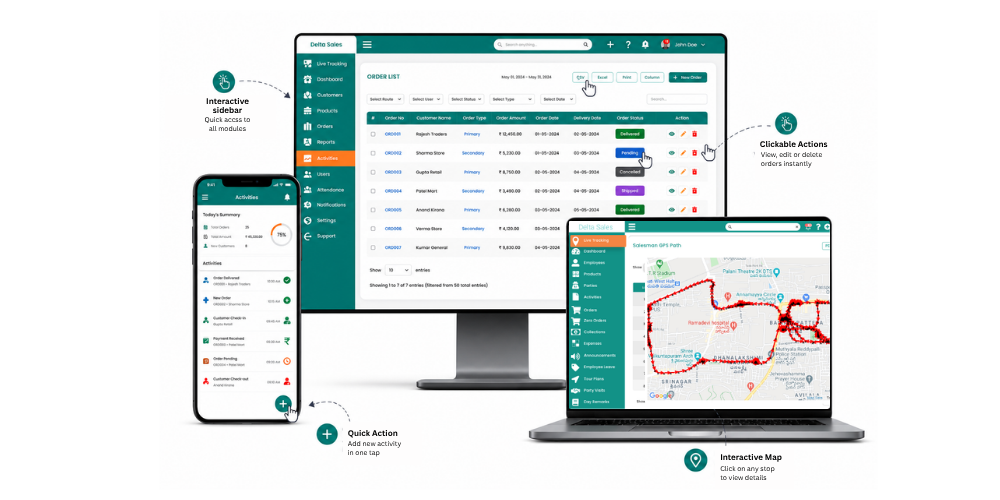
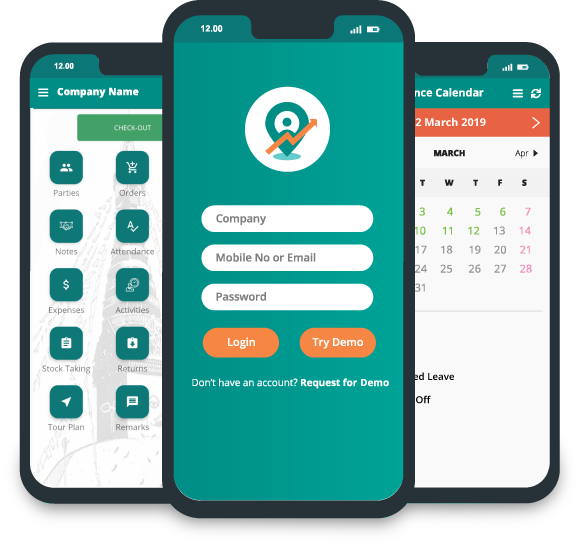
Delta Sales App brings all of that together, so location data becomes part of the everyday sales force automation and field sales management process, not a separate tool nobody checks.
-
Real-time location tracking of field reps.
Delta Sales App gives managers real-time GPS-based employee location tracking, so they're not relying entirely on manual updates or end-of-day reports to know whether reps are actually operating in their assigned areas and following their planned schedule. That visibility helps managers monitor rep movement, verify visit locations, understand territory coverage, catch gaps between planned and actual activity, and hold distributed teams accountable. Pair GPS tracking with attendance and visit data, and managers get a much clearer read on field activity and productivity as a whole.
-
Smart route and territory planning.
Managing territory well means understanding both the customers and the geography the team is covering. Delta Sales App supports beat plans, tour plans, route planning, and territory management, so reps aren't left to figure out their own daily route from scratch. Managers can structure visits around assigned territories, customer locations, and sales priorities instead. That improves daily visit planning, retailer coverage, territory mapping, route efficiency, rep productivity, and how often customers actually get visited. For teams covering a large number of retailers or distributors, that kind of structured planning makes day-to-day operations noticeably more organized.
-
Location-based reporting and insights.
Location data gets a lot more useful once it's analyzed alongside everything else happening in the field. Delta Sales App combines field activity with reporting and analytics, so managers can evaluate customer visits, sales activity, attendance, territory coverage, and rep performance as one connected picture rather than separate reports. That's what lets a manager see whether a territory is genuinely getting the coverage it needs or whether reps are burning too much time in transit between stops.
Conclusion
Location intelligence empowers field sales teams to make informed decisions by linking the locations of sales activities with the events occurring there. Rather than solely depending on sales numbers or visit tallies, managers can leverage geographic insights to grasp territory coverage, customer distribution, travel habits, and the activities of field representatives. With enhanced sales territory planning, optimized routes, targeted customer outreach, and real-time visibility into field operations, location intelligence enables businesses to boost sales productivity while minimizing unnecessary travel and operational hiccups.
The true advantage lies in integrating location data with the entire sales process. When GPS tracking, customer details, visit logs, territory management, order information, and sales analytics collaborate, managers can achieve a holistic view of field operations and make decisions grounded in real-world data. For companies aiming to enhance visibility in their sales processes, Delta Sales App offers a comprehensive suite of tools for GPS tracking, beat planning, territory management, field activity monitoring, and sales reporting, all in one user-friendly platform.
Are you ready to transform your field sales decisions with data-driven insights? Schedule a free demo of Delta Sales App and discover how location-based intelligence can elevate your sales operations.
FAQs
1. What's the difference between location intelligence and GPS tracking?
GPS tracking just shows where a rep is or where they've been. Location intelligence takes that same data and connects it to sales performance, customer value, visit history, and territory information, so a business understands not just where someone is, but what that location actually means for the sales strategy.
2. How does location intelligence improve sales territory planning?
It lets managers see customer density, sales potential, and geographic distance side by side, instead of dividing territories by guesswork. That makes it easier to spot overloaded territories, underserved areas, and reps carrying an unfair share of the workload, then rebalance accordingly.
3. Can location intelligence actually reduce travel time for field reps?
Yes. Mapping customer locations against planned visits lets a business build routes that group nearby stops together instead of sending a rep back and forth across a territory. Even a modest cut in daily travel time adds up fast across a large team and hundreds of working days.
4. Does location intelligence work with existing field sales or CRM software?
It's most useful when it's built into a platform that already tracks attendance, visits, orders, and territories, rather than run as a separate mapping tool. That's exactly how Delta Sales App approaches it: GPS tracking sits alongside beat planning, route management, attendance, and reporting, so location data feeds straight into daily decisions instead of living in its own disconnected tool.
5. How does Delta Sales App specifically support location-based sales decisions?
Delta Sales App gives managers real-time GPS visibility into field reps, combined with beat and tour planning, territory management, and location-based reporting. That means managers can see whether reps are covering their assigned areas, compare planned visits against what actually happened, and spot territories that are overloaded or underserved, all from one dashboard instead of piecing it together from spreadsheets and phone calls.
6. Is location intelligence only useful for large field sales teams?
It helps most as teams and territories scale, since manual tracking gets harder to manage past a certain size. But even smaller teams benefit from knowing which customers are underserved, which routes waste time, and where untapped sales potential is sitting on the map. Delta Sales App's tiered plans mean a business can start with basic field tracking and expand into fuller route and territory intelligence as the team grows.