
What Are the Most Important Retail Execution KPIs For FMCG Brands?
For FMCG brands, strong retail execution is essential for turning distribution and sales strategies into actual results at the store level. A product may have strong demand and wide distribution, but poor execution can still lead to empty shelves, missed promotions, inadequate product visibility, and lost sales.
This is why FMCG companies need measurable retail execution KPIs to understand how effectively their sales representatives, distributors, and retail partners are executing plans in the market.
From retailer coverage and on-shelf availability to planogram compliance and sales rep productivity, these metrics help brands identify gaps and improve execution across outlets.
In this guide, we will explore the most important retail execution KPIs for FMCG brands, how to measure them, common execution challenges, and how technology can help sales teams monitor performance more effectively.
What Is Retail Execution in FMCG?
Retail execution refers to how effectively an FMCG brand's sales and distribution strategies are implemented at retail outlets. It involves making sure that the right products are available at the right outlets, displayed correctly, adequately stocked, promoted according to plan, and supported by regular sales visits.
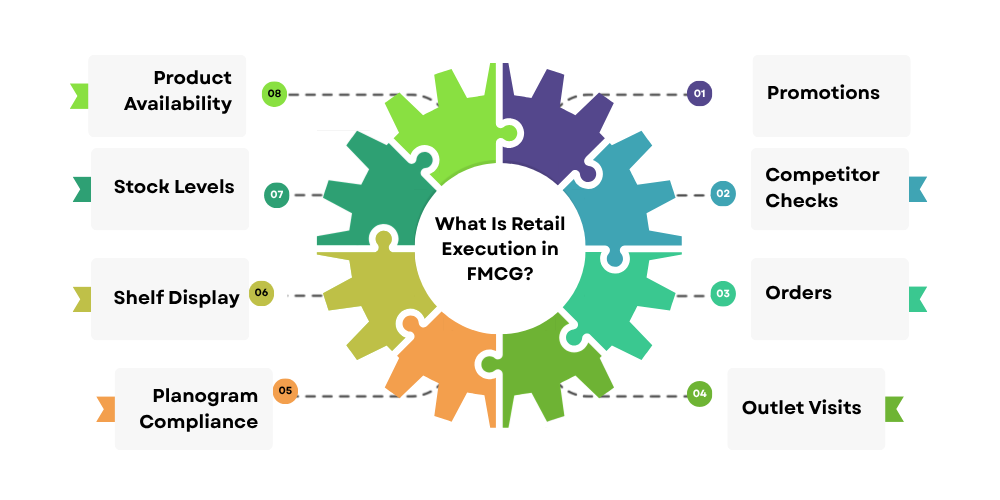
Effective retail execution typically covers activities such as:
-
Visiting planned retail outlets
-
Checking product availability
-
Monitoring inventory levels
-
Capturing orders
-
Maintaining product visibility
-
Checking promotional displays
-
Verifying planogram compliance
-
Monitoring competitor activity
-
Ensuring sales representatives complete assigned visits
-
Collecting retail execution data
For FMCG brands operating across thousands of outlets, manually monitoring these activities can be difficult. Retail execution KPIs provide a measurable way to determine whether field teams and retail partners are meeting execution targets.
Why Are Retail Execution KPIs Important for FMCG Brands?
FMCG companies often operate across large territories with numerous distributors, sales representatives, retailers, and product categories. Without measurable KPIs, sales managers may struggle to determine where execution is working and where improvements are needed.
Tracking the right metrics can help businesses:
-
Measure retail outlet coverage
-
Identify missed or incomplete visits
-
Improve product availability
-
Reduce stockouts
-
Monitor sales representative performance
-
Improve merchandising execution
-
Measure promotional compliance
-
Identify underperforming outlets
-
Improve order conversion
-
Compare territory performance
-
Make better field-sales decisions
The key is not simply to collect more data. FMCG brands should focus on KPIs that connect field activities with actual business outcomes.
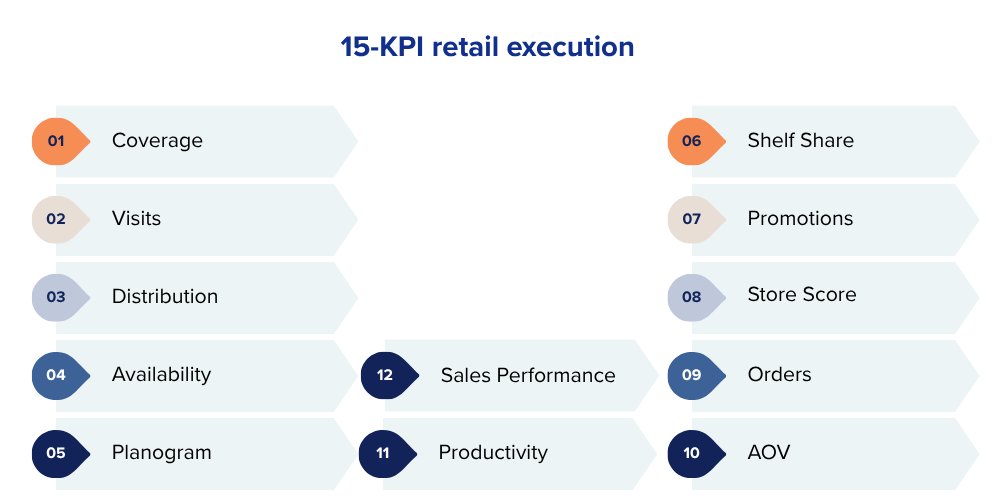
15 Most Important Retail Execution KPIs for FMCG Brands
There is no single set of KPIs that works for every FMCG business. However, the following metrics provide a strong foundation for measuring retail execution performance.
1. Retailer Coverage
Retailer coverage measures the percentage of targeted outlets that are actually reached by the sales team during a specific period.
A simple formula is:
Retailer Coverage = Visited Target Outlets ÷ Total Target Outlets × 100
For example, if a sales representative is assigned 100 outlets and visits 90 of them during the planned period, retailer coverage is 90%. High coverage indicates that sales teams are reaching a larger portion of their assigned market.
Low coverage may indicate:
-
Poor route planning
-
Excessive travel time
-
Large territories
-
Missed visits
-
Inefficient sales processes
-
Inadequate field-force capacity
Tracking coverage by territory, representative, distributor, and outlet category can reveal where execution gaps exist.
2. Visit Compliance
Visit compliance measures how consistently sales representatives complete the visits assigned in their sales plans.
For example:
Visit Compliance = Completed Planned Visits ÷ Total Planned Visits × 100
A representative may have 25 planned visits but complete only 20. In this case, visit compliance would be 80%. This KPI helps sales managers determine whether planned field activities are actually being executed. Combining visit compliance with GPS-based location data can provide additional visibility into whether representatives reached the expected outlets.
3. Numeric Distribution
Numeric distribution measures the percentage of relevant retail outlets where a particular product is available.
For example, if a brand's product is present in 700 out of 1,000 target outlets:
Numeric Distribution = 700 ÷ 1,000 × 100 = 70%
A higher percentage indicates broader physical distribution. However, numeric distribution does not consider the sales importance of each outlet. A product available in many small outlets may have lower market impact than one available in fewer but higher-volume stores. Therefore, FMCG brands often analyze numeric distribution alongside weighted distribution.
4. Weighted Distribution
Weighted distribution considers the sales importance of outlets where a product is available. Instead of simply counting outlets, this KPI considers the contribution of those outlets to the relevant market or category. This makes weighted distribution particularly useful when FMCG brands want to understand whether their products are present in the most commercially important stores.
For example, a product could have relatively moderate numeric distribution but strong weighted distribution if it is available across high-volume retailers. Comparing both metrics gives sales teams a clearer picture of retail distribution performance.
5. On-Shelf Availability
On-shelf availability measures whether products are physically available for customers to purchase when they visit a store.
A product can be distributed to a retailer but still be unavailable on the shelf because of:
-
Stockouts
-
Poor replenishment
-
Inventory stored in the backroom
-
Delayed deliveries
-
Merchandising problems
-
Incorrect inventory records
This makes on-shelf availability one of the most important FMCG retail KPIs. High distribution without strong availability can still result in lost sales. Field representatives can improve this KPI by regularly checking shelves, identifying low-stock products, capturing orders, and reporting availability issues.
6. Out-of-Stock Rate
The out-of-stock rate measures how frequently products are unavailable at retail outlets.
A simplified formula is:
Out-of-Stock Rate = Out-of-Stock Observations ÷ Total Product Availability Checks × 100
A high out-of-stock rate can indicate problems with inventory planning, replenishment, distribution, or ordering.
FMCG brands should monitor this metric by:
-
Product
-
Outlet
-
Territory
-
Distributor
-
Sales representative
-
Product category
Identifying repeated stockouts can help businesses address supply and inventory visibility issues before they result in prolonged lost sales.
7. Planogram Compliance
Planogram compliance measures whether products are displayed according to the brand's agreed merchandising layout.
For example, a planogram may specify:
-
Product position
-
Shelf placement
-
Number of facings
-
Product sequence
-
Display height
-
Promotional placement
Field representatives can capture store images during visits to verify whether the required arrangement is being followed. Strong planogram compliance can improve product visibility and ensure retailers execute merchandising standards consistently across locations.
8. Share of Shelf
Share of shelf measures how much shelf space a brand's products occupy compared with competing products within the same category. For example, if a brand occupies 20 out of 100 visible shelf facings in a category, its approximate share of shelf is 20%.
This KPI can help FMCG brands understand:
-
Product visibility
-
Competitive presence
-
Merchandising effectiveness
-
Shelf-space negotiations
-
Retail execution quality
Monitoring share of shelf across different stores and territories can also reveal where competitors are gaining stronger visibility.

9. Promotion Compliance
Promotion compliance measures whether retailers are implementing promotional activities according to the agreed campaign requirements.
This may include:
-
Promotional pricing
-
Discounts
-
Displays
-
POS materials
-
Product placement
-
Promotional bundles
-
End-cap displays
A campaign may generate strong results in one region but underperform elsewhere because promotional execution is inconsistent. Monitoring promotion compliance allows FMCG brands to identify stores where campaigns are not being executed as planned.
10. Perfect Store Score
The perfect store score evaluates how closely a retail outlet meets predefined execution standards.
A brand might evaluate criteria such as:
-
Product availability
-
Correct assortment
-
Shelf visibility
-
Display compliance
-
Pricing
-
Promotion compliance
-
Planogram compliance
-
POS material availability
Each criterion can receive a score, which can then be combined into an overall store-execution score. For example, an FMCG company could create a 100-point score based on several execution parameters. This provides a more comprehensive view than monitoring one KPI independently.
11. Order Conversion Rate
Order conversion rate measures the percentage of sales visits that result in an order.
For example:
Order Conversion Rate = Visits With Orders ÷ Eligible Sales Visits × 100
If representatives visit 100 eligible retailers and capture orders from 65, the order conversion rate is 65%.
A low conversion rate could indicate:
-
Poor product availability
-
Pricing issues
-
Weak sales pitches
-
Low retailer demand
-
Poor assortment
-
Strong competitor presence
-
Inadequate sales representative preparation
This KPI becomes more useful when analyzed alongside outlet-level sales and visit data.
12. Average Order Value
Average order value measures the average sales value generated from each order.
Average Order Value = Total Order Value ÷ Number of Orders
For example, if 100 orders generate $20,000 in sales, the average order value is $200.
Tracking AOV can help FMCG brands understand whether sales representatives are maximizing opportunities during retailer visits.
Businesses can potentially increase AOV through:
-
Cross-selling
-
Upselling
-
Better assortment recommendations
-
Product bundles
-
Minimum order programs
-
Promotion-based selling
13. Sales Representative Productivity
Sales representative productivity measures how effectively field employees use their working time and assigned territories.
Relevant metrics can include:
-
Productive visits
-
Total visits
-
Orders captured
-
Sales value
-
Average orders per day
-
Productive calls
-
Time spent in outlets
-
New outlets covered
Sales rep productivity should not be measured simply by counting visits. A representative completing 20 low-value visits may contribute less than someone completing 15 highly productive visits.
For this reason, FMCG companies should combine activity metrics with sales and execution outcomes.
14. Sales per Outlet
Sales per outlet measures the average sales generated from retail outlets within a particular territory, product category, or sales period.
Sales per Outlet = Total Sales ÷ Number of Active Outlets
This KPI helps brands identify high-performing and underperforming outlets. For example, if two territories have similar outlet coverage but one generates significantly higher sales per outlet, managers can investigate differences in:
-
Product assortment
-
Outlet quality
-
Sales execution
-
Representative performance
-
Distribution
-
Promotions
-
Competitive activity
15. Stock Availability
Stock availability measures whether the required quantity and assortment of products are available at the retail level. While on-shelf availability focuses on what consumers can see and purchase, stock availability can provide a broader view of whether the outlet has adequate inventory. Tracking stock availability helps brands identify potential problems before they become sales losses.
For example, a representative may identify that a retailer has only two units of a fast-moving SKU remaining. Capturing a replenishment order during the visit can help prevent a future stockout.
How to Measure Retail Execution KPIs Effectively
Tracking KPIs manually through spreadsheets can become difficult as the number of outlets and field employees increases. A more effective approach is to create a centralized system where sales teams can capture field information during retailer visits.
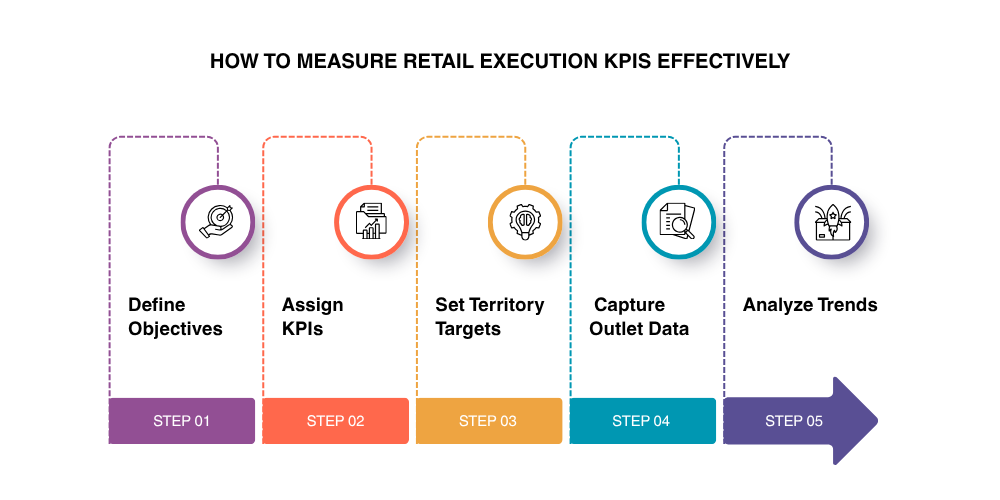
An FMCG brand can follow these steps:
1. Define Clear Execution Objectives
First, determine what the business wants to improve.
For example:
-
Increase retailer coverage
-
Reduce stockouts
-
Improve promotional compliance
-
Increase productive visits
-
Improve order conversion
2. Assign Measurable KPIs
Each objective should have a measurable KPI to track progress and identify execution gaps. For example, Retailer Coverage measures market reach, while Visit Compliance tracks completion of planned visits. On-Shelf Availability helps monitor product availability, and Out-of-Stock Rate identifies stock-related issues. For merchandising, Planogram Compliance measures adherence to display standards. Similarly, Sales Rep Productivity evaluates field performance, while Sales per Outlet helps measure sales performance across individual retailers.
Each objective should have a measurable KPI to track progress and identify execution gaps. For example, Retailer Coverage measures market reach, while Visit Compliance tracks completion of planned visits. On-Shelf Availability helps monitor product availability, and Out-of-Stock Rate identifies stock-related issues. For merchandising, Planogram Compliance measures adherence to display standards. Similarly, Sales Rep Productivity evaluates field performance, while Sales per Outlet helps measure sales performance across individual retailers.
3. Set Territory-Level Targets
Targets should account for territory size, outlet density, product category, and market potential. A single target for every territory may not accurately reflect market conditions.
4. Capture Data at the Outlet Level
Field teams should capture relevant information during each retailer visit, such as:
-
Location
-
Visit status
-
Orders
-
Product availability
-
Stock levels
-
Display compliance
-
Photos
-
Competitor information
-
Retailer feedback
5. Analyze Trends Rather Than Individual Visits
One missed visit does not necessarily indicate poor execution. Managers should analyze KPI trends over days, weeks, and months to identify consistent patterns.
What Causes Poor Retail Execution Performance?
Even when FMCG companies have clear sales strategies, execution can suffer due to operational problems.
Common causes include:
Poor Route Planning
Poorly planned routes increase travel time between outlets, reduce productive visits, create inefficient territories, and prevent sales representatives from covering priority retailers consistently.
Inaccurate Outlet Data
Outdated or incorrect outlet information can lead to missed retailers, duplicate records, inefficient territory planning, and poor decisions about sales coverage and market potential.
Limited Inventory Visibility
Limited inventory visibility makes it difficult for sales representatives to know product availability, causing missed orders, delayed fulfillment, stock-outs, and lost retail sales opportunities.
Inconsistent Field Monitoring
Without consistent field monitoring, managers may struggle to identify missed visits, poor coverage, low productivity, and execution gaps until they begin affecting sales performance.
Manual Reporting
Manual reports and spreadsheets can delay field data collection, increase reporting errors, consume managers’ time, and prevent teams from responding quickly to emerging problems.
Poor Communication
Disconnected communication between sales representatives, distributors, and managers can delay order updates, problem resolution, stock information, and corrective actions across the distribution network.
How FMCG Brands Can Improve Retail Execution
Improving retail execution requires a combination of process discipline, field-force management, accurate data, and technology.
Businesses can improve execution by:
-
Creating structured beat plans
-
Optimizing sales routes
-
Setting territory-specific targets
-
Monitoring retailer coverage
-
Tracking planned vs. completed visits
-
Capturing orders digitally
-
Monitoring product availability
-
Using store photos for merchandising verification
-
Reviewing sales representative performance
-
Identifying underperforming outlets
-
Analyzing KPI trends regularly
Most importantly, FMCG brands should connect field activities with measurable business outcomes. A high number of visits is not enough if those visits do not improve distribution, availability, orders, or sales.
How Technology Helps Track Retail Execution KPIs
Technology can give FMCG businesses a centralized view of field activities and retail execution performance. A field sales automation platform can allow sales representatives to record activities directly from their mobile devices while managers monitor performance through centralized dashboards.
Depending on the platform, businesses can track:
-
GPS-based sales representative locations
-
Retailer visits
-
Planned and completed visits
-
Orders
-
Product availability
-
Payments
-
Sales activity
-
Visit photos
-
Routes
-
Attendance
-
Territory performance
-
Automated reports
This reduces dependence on manual reporting and gives managers faster access to field information. For teams operating in areas with unreliable connectivity, offline functionality is particularly valuable because representatives can continue recording field activities and synchronize data when connectivity becomes available.
How Delta Sales App Supports FMCG Retail Execution
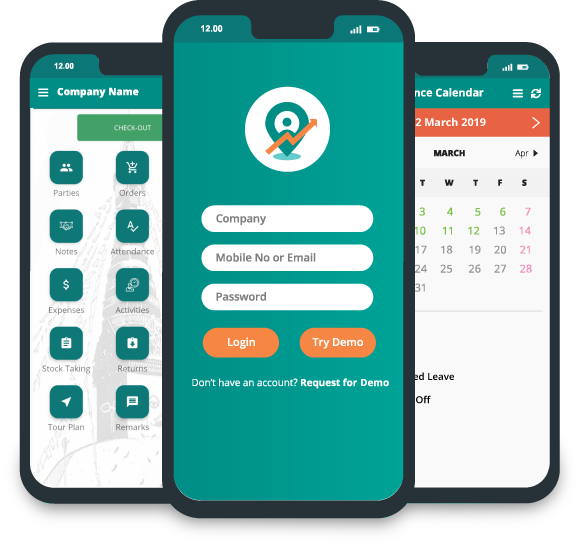
For FMCG brands managing distributed field sales teams, Delta Sales App provides tools to monitor and manage day-to-day field activities from a centralized platform.
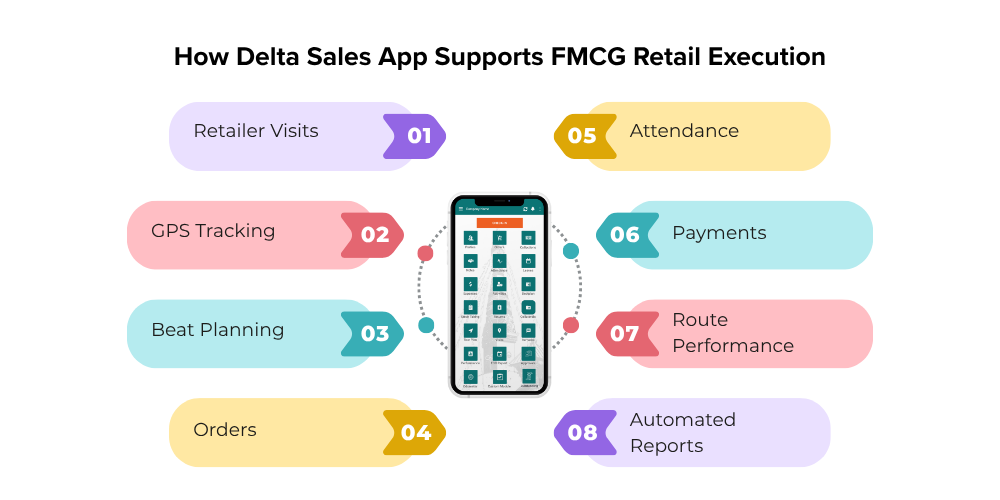
Sales managers can use the platform to improve visibility into:
-
Retailer and customer visits
-
Sales representative locations
-
Planned and completed visits
-
Orders captured from the field
-
Route and territory performance
-
Daily field activities
-
Attendance
-
Payments and collections
-
Automated reports
The platform can also support beat planning, GPS-based employee tracking, customer visit monitoring, order management, and field reporting. This can help FMCG businesses connect field execution activities with measurable sales and distribution performance. The objective is not simply to track employees. It is to give sales managers the information they need to identify execution gaps, improve market coverage, and make better decisions based on field data.
Conclusion
Retail execution plays a critical role in FMCG sales performance. Even a strong product and distribution strategy can underperform when products are unavailable, promotions are poorly executed, shelves are not maintained, or sales teams fail to reach planned outlets.
The most important retail execution KPIs include retailer coverage, visit compliance, numeric distribution, weighted distribution, on-shelf availability, out-of-stock rate, planogram compliance, share of shelf, promotion compliance, perfect store score, order conversion rate, average order value, sales representative productivity, sales per outlet, and stock availability.
However, FMCG brands should not track KPIs simply for reporting purposes. The real value comes from using these metrics to identify execution gaps and take corrective action.
Want to improve your FMCG field sales and retail execution?
Book a demo of Delta Sales App today and discover how it can help your business improve field execution and sales productivity and see how Delta Sales App can help your team track field activities, retailer visits, orders, sales representative locations, routes, and performance from one centralized platform.

-1792906895-resized320.png)