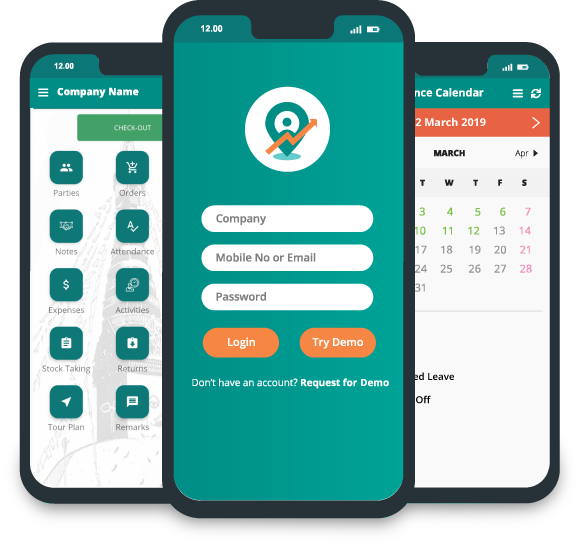

Boosting Sales Team Productivity with Advanced Field Employee Location Tracking
For any business with a field sales force, there is a constant, nagging question that keeps managers up at night: "Where is my team right now, and are they being productive?" It’s a question that has traditionally been met with vague answers, paper logs filled out at the end of the day, or the dreaded "network issue" message on a missed check-in call.
In the early stages of a business, managing a sales team is hands-on. You know everyone personally, and trust is built on relationships. But as you scale from a local operation to a regional or national player, that personal oversight vanishes. You are no longer managing people; you are managing data about people. The challenge becomes separating the "busy" workers from the "productive" workers, and ensuring that the company's most valuable assets and its feet on the street are optimized for maximum output.
This is where advanced field employee location tracking evolves from a surveillance tool into a productivity powerhouse. It’s not about watching over your shoulders, it’s about clearing the path for your team to sell more in less time. In this blog, we’ll explore how modern location intelligence can revolutionize your sales operations, moving beyond simple check-ins to create a rhythm of accountability, efficiency, and growth.
The Productivity Drain: Why "Busy" Doesn't Equal "Effective"
Before we dive into the solutions, we have to diagnose the disease. The biggest enemy of field sales productivity isn't laziness; it's friction. It's the time wasted traveling between two stores that are on opposite sides of town. It’s the confusion when a sales rep arrives at an outlet only to find the owner is at a wedding, making the visit a waste of petrol and time. It’s the manual data entry at the end of the day that steals an hour that could have been used for one last client call.
According to countless industry studies, sales reps spend less than 35% of their day actually selling. The rest is consumed by administrative tasks, unoptimized travel, and waiting. When you have a team of 50 reps, that is a staggering amount of lost opportunity cost.
Location tracking, when implemented thoughtfully, directly attacks this friction. It provides the raw data needed to restructure the workday. For instance, by analyzing historical location data, a manager can see that a specific rep is spending two hours in traffic every Friday. That insight allows them to adjust the beat plan, swapping a far-flung route for a more localized one, effectively reclaiming those two hours for face-to-face selling. This level of optimization is impossible with guesswork. It requires the kind of granular data provided by a robust field sales management app that captures movement patterns, not just start and end points.
Replacing the "Paper Trail" with a "Data Trail"
For decades, the proof of a field visit was a piece of paper with a shopkeeper's signature. This system is archaic, prone to fraud, and offers zero analytical value. A signature tells you a rep was somewhere in the vicinity at some point in the day. It doesn't tell you if they arrived during peak hours, how long they stayed, or if they actually performed the tasks required.
Advanced location tracking digitizes this entire process. When a rep checks in at a store using geofencing technology, the system timestamps their arrival and departure automatically. The manager doesn't need to ask; they can see it on a live dashboard.

This data trail does more than just verify attendance. It builds a profile of every customer interaction. Did the rep spend 40 minutes at a high-potential outlet, suggesting a deep conversation about volume discounts? Or did they breeze through a key distributor in five minutes, indicating a potential service gap? By integrating these location stamps with sales data, you can correlate visit duration with order value. This allows you to coach your team on the "Art of the Visit." You can identify top performers based on the quality of their time allocation, not just the quantity of their stops. Implementing a system with daily work logs ensures that the narrative of the day is backed by indisputable geographic evidence, turning subjective performance reviews into objective coaching sessions.
Optimizing the Beat Plan: The Science of Route Planning
One of the most underrated aspects of sales productivity is the route itself. In most growing companies, beat plans are legacy artifacts. They are passed down from senior reps to new hires, based on tradition rather than data. "We visit Sharma Ji on Tuesdays because that's what we've always done." But what if the data shows that Sharma Ji is most receptive and least busy on Thursdays?
Advanced location tracking provides the heat maps needed to redesign territories for efficiency. By analyzing the GPS-tracking breadcrumbs of your entire team over a month, you can identify overlapping territories, excessive travel times, and under-served pockets of high-potential outlets.
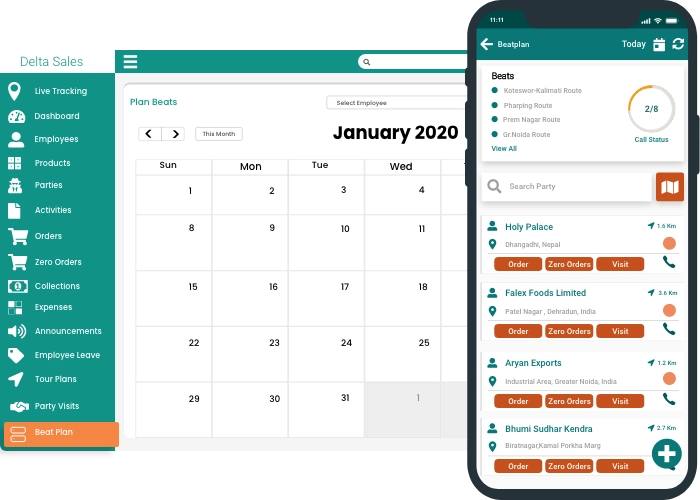
The goal is to minimize windshields time and maximize shelf time. A modern system allows managers to create dynamic beat plans that cluster outlets geographically. The rep opens their app in the morning and sees a optimized route designed by the system. This isn't just about saving fuel; it’s about enabling more visits. If you can shave 30 minutes of travel off a rep's day, that's an extra 10 hours of selling time a month per rep. For a team of 20, that's 200 extra hours of market coverage.
To achieve this level of logistical precision, brands are increasingly turning to sales tracking tools that offer live route optimization. These tools consider traffic patterns, visit durations, and outlet priority to build the most efficient path, ensuring your team spends their energy on selling, not steering.
The Trust Factor: Transparency Between Field and Office
There is often an "us vs. them" mentality between the field force and the head office. Reps feel surveilled, and managers feel misled. Location tracking, when communicated poorly, can exacerbate this tension. However, when positioned correctly, it becomes a tool for building trust.
Transparency is a two-way street. While the manager gains visibility into the rep’s activities, the rep gains visibility into their own performance metrics. They can see their own data: how many stores they visited, how their travel time compares to the team average, and where they are excelling or falling behind. This transforms the data from a disciplinary tool into a coaching tool.
Furthermore, location tracking can protect the rep. In industries where reps carry cash or high-value samples, having a verified location trail provides an alibi and ensures safety protocols are followed. If a vehicle breaks down, the manager knows exactly where the rep is stranded and can dispatch help immediately.

Real-Time Interventions: Fixing Problems Before They Become Losses
In a traditional setup, the feedback loop is painfully slow. A rep has a bad week, and the manager finds out about it during the Monday review, seven days later. By then, the damage is done, relationships are strained, stock is aged, and opportunities are missed.
Real-time location tracking, combined with activity feeds, enables micro-interventions. Imagine a scenario where a new product is launched with a massive trade scheme. The marketing team expects visibility across all top-tier stores within 48 hours. By 11:00 AM on launch day, the manager checks the live dashboard. They see that three reps are stuck in traffic due to a rally, and two reps are running behind schedule. Another rep, however, has already covered their five key stores and is ahead of schedule.
Reducing Attrition Through Fairness
Sales is a high-pressure job, and field sales attrition is notoriously high. One of the primary drivers of this churn is the perception of unfairness. When territories are assigned arbitrarily and targets are set without context, reps burn out.
Location data provides the context needed to create equitable workloads. It allows managers to quantify the difficulty of territory management. Rep A might have a lower sales volume than Rep B, but the data might show that Rep A travels 50% further between outlets due to the rural nature of their beat. When setting targets and incentives, this data is invaluable.
By using objective data to balance the load, you signal to your team that you understand their challenges. This builds loyalty and reduces the "grass is greener" syndrome that causes reps to jump ship to competitors. They realize that their current employer has a sophisticated understanding of the field reality, making their job more sustainable. Integrating customer tracking with location data gives a 360-degree view of the territory, allowing for fairer distribution of accounts and more realistic sales forecasting.

The Data-Driven Sales Culture
Ultimately, boosting productivity with location tracking is about building a culture of continuous improvement. It moves the conversation from subjective opinions ("I feel like you're not working hard enough") to objective data ("I see you only spent 15 minutes in the top 10% of your accounts this week").
This cultural shift encourages healthy competition. Leaderboards based on visit adherence, order conversion rates by location, and territory penetration rates become powerful motivators. Reps start to self-correct. If they see that their check-in compliance is lower than the team average, they will often fix it themselves without managerial intervention.
This ecosystem of visibility, powered by field sales automation software, creates a self-optimizing team. The data highlights who needs help and who deserves recognition. It allows managers to stop chasing people for reports and start coaching them on strategies. The result is a leaner, meaner, and significantly more productive sales engine that can scale without proportionally scaling management overhead.
Conclusion
Boosting sales team productivity in the modern era is no longer just about hiring charismatic closers. It’s about architecting an environment where those closers can operate at peak efficiency. Advanced field employee location tracking provides the architectural blueprint. It eliminates wasted time, optimizes travel, verifies execution, and builds a bridge of trust between the field and the office. It transforms the sales force from a collection of individuals into a synchronized, high-performance unit.
For businesses ready to move beyond the chaos of spreadsheets and WhatsApp updates, the path forward lies in adopting a unified platform designed for the complexities of field operations. This is precisely where Delta Sales App becomes an indispensable asset. By leveraging its advanced GPS-based check-ins, geo-tracking capabilities, and intelligent route optimization, you can instantly gain the visibility needed to drive productivity. It empowers your managers to conduct real-time interventions and equips your reps with a tool that simplifies their day, replacing manual logs with seamless automation. The app’s ability to integrate location data with actual sales outcomes means you’re not just tracking movement; you’re tracking meaningful business activity that directly impacts your bottom line. If you are looking to eliminate the productivity drains in your field team and replace them with a streamlined, data-driven workflow, it’s time to embrace a smarter approach.
Book a Free Demo Today and see how Delta Sales App can transform your field force into your biggest competitive advantage.