
Sales Automation vs. Marketing Automation: How Are They Different?
In today’s fast-moving business environment, automation is no longer a luxury, it's a necessity. Companies that rely solely on manual processes struggle to keep up with customer expectations, sales cycles, and competition. This is where automation steps in, particularly sales automation and marketing automation.
Although these two terms are often used interchangeably, they serve very different purposes. Understanding how they differ and how they complement each other can help businesses drive growth more efficiently, align teams, and deliver better customer experiences.
Let’s explore these differences in a structured, comparison-based format.
What is Sales Automation? & its Core Purpose
Sales automation focuses on streamlining and optimizing tasks performed by sales teams. Its primary goal is to reduce manual effort so sales representatives can spend more time selling and building relationships. Instead of tracking leads on spreadsheets or manually following up with prospects, sales automation tools handle repetitive activities such as:
-
Lead assignment and routing
-
Follow-up reminders
-
Order and invoice generation
-
Sales pipeline tracking
-
Field activity reporting
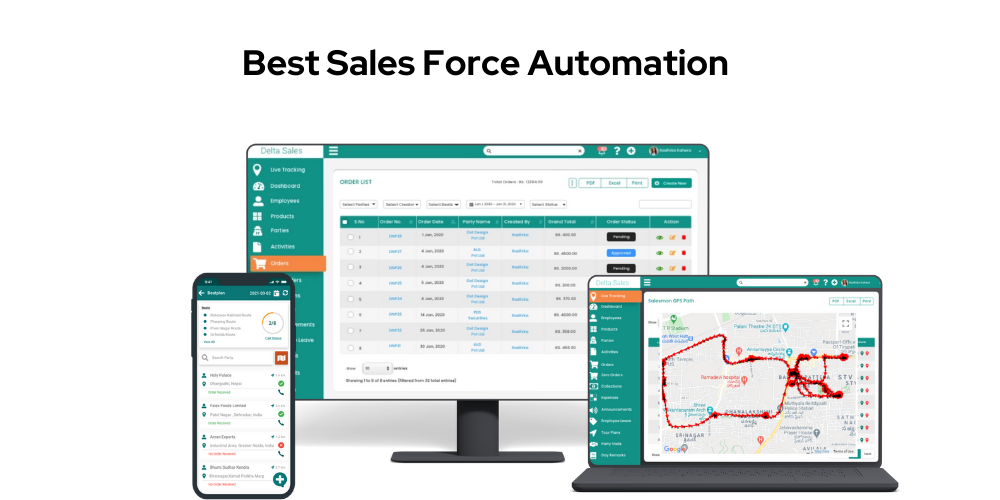
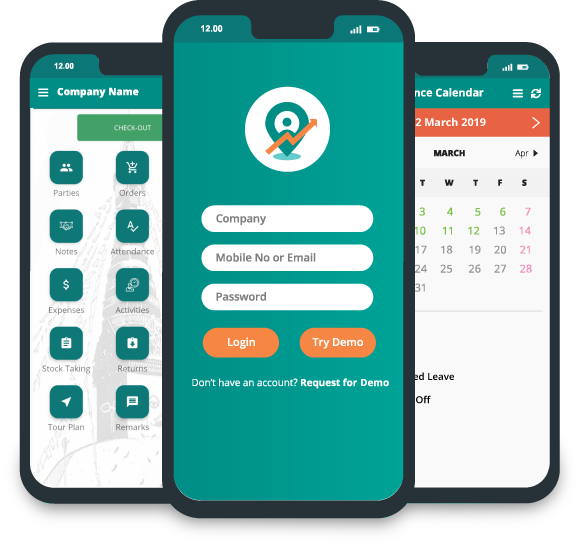
For organizations with on-ground teams, tools like field sales automation software help reps manage daily visits, record orders instantly, and track performance without paperwork. In short, sales automation is about execution and closing deals faster.
Sales automation focuses on closing deals and managing customer relationships. It automates repetitive sales tasks so sales teams can focus on conversations, negotiations, and revenue generation. Tools such as field sales automation software help sales representatives manage daily visits, capture orders instantly, and track follow-ups without manual paperwork.
What is Marketing Automation? & its Core Purpose
Marketing automation, on the other hand, focuses on attracting and nurturing potential customers before they are ready to speak to sales. It automates marketing workflows such as:
-
Email campaigns
-
Lead nurturing sequences
-
Customer segmentation
-
Social media scheduling
-
Campaign performance tracking

Marketing automation tools help businesses engage prospects with the right message at the right time. For example, a visitor downloading a brochure may automatically receive a follow-up email or be added to a targeted campaign. Solutions like lead management and nurturing tools ensure that prospects are warmed up before they enter the sales funnel. Simply put, marketing automation is about generating and preparing leads.
Marketing automation focuses on attracting, engaging, and nurturing prospects. It ensures that potential customers receive relevant communication until they are ready to speak with sales. Systems like lead management and nurturing tools help marketers qualify prospects before passing them to the sales team.
Difference in Funnel Stage Focus
Sales Automation
-
Operates mainly in the middle to bottom of the sales funnel: Sales automation supports stages where prospects are evaluating options, negotiating, and making purchase decisions, ensuring smooth progress from opportunity to final deal closure.
-
Focuses on qualified leads and active prospects: It helps sales teams prioritize sales-ready leads, manage ongoing conversations, and take timely actions that move active prospects closer to conversion.
-
Drives deal closure, repeat orders, and upselling: By automating follow-ups, order processing, and customer history tracking, sales automation increases close rates while encouraging repeat purchases and upsell opportunities.
Sales force automation systems provide real-time insights into deal status, team activity, and forecast accuracy, enabling managers to identify gaps and improve sales performance.
Marketing Automation
-
Works at the top and middle of the funnel: Marketing automation supports early buyer stages by capturing attention, engaging prospects, and nurturing interest before they are ready to interact with sales teams.
-
Builds awareness and interest: It consistently delivers targeted messages through emails, content, and campaigns, helping potential customers recognize problems, explore solutions, and develop brand familiarity.
-
Educates prospects before they show buying intent: Marketing automation shares relevant content and information that helps prospects understand their needs and available solutions, even before they actively consider purchasing.
By scoring and nurturing leads, marketing automation filters unqualified contacts and passes knowledgeable, high-intent prospects to sales, improving conversion efficiency.
Difference in Users and Teams
Sales Automation Users
-
Sales representatives: It uses sales automation to manage leads, track follow-ups, record customer interactions, and close deals efficiently with less manual effort.
-
Field sales executives: It relies on automation tools to plan visits, capture orders on-site, update customer data, and maintain accurate activity records while working on the move.
-
Sales managers: It uses sales automation to monitor pipelines, track team performance, forecast revenue, and make data-driven decisions to improve sales outcomes.
-
Distributor and channel teams: It uses sales automation to manage orders, inventory visibility, partner performance, and ensure consistent execution across indirect sales networks.
Sales team tracking in real-time tools give managers instant visibility into field activities, sales progress, and productivity, helping identify bottlenecks and optimize team performance quickly.
Marketing Automation Users
-
Marketing managers: It uses marketing automation to plan campaigns, segment audiences, track performance metrics, and optimize strategies based on engagement and lead behavior.
-
Digital marketing teams: It leverage automation to manage email campaigns, website interactions, and lead capture while ensuring consistent messaging across multiple digital channels.
-
Growth and content teams: It uses automation to distribute content strategically, nurture prospects, analyze engagement trends, and improve conversion through data-driven content planning.
-
Campaign strategists: It relies on marketing automation to design multi-channel campaigns, test messaging, track results, and refine targeting for better campaign effectiveness.
Marketing teams measure success through engagement indicators like clicks, opens, conversions, and lead quality, which indirectly contribute to revenue growth over time.
Difference in Tasks and Workflows
Sales Automation Tasks
-
Sales automation handles task-based workflows: Sales automation focuses on automating daily operational tasks that sales teams perform repeatedly, helping reduce manual effort, improve accuracy, and increase overall sales productivity.
-
Lead assignment and routing: Automation assigns incoming leads to the right sales representatives based on rules like territory, workload, or priority, ensuring faster response times and balanced lead distribution.
-
Follow-up reminders: Automated reminders notify sales reps about calls, meetings, or pending actions, preventing missed follow-ups and helping maintain consistent communication with prospects and customers.
-
Order creation and invoicing: Sales automation simplifies order processing by generating orders and invoices automatically, reducing errors, speeding up billing cycles, and improving overall transaction efficiency.
-
Visit tracking and reporting: Automation records sales visits, locations, and outcomes in real time, providing accurate reports that help managers evaluate field activity and execution quality.
By streamlining order capture, inventory visibility, and follow-ups, retail execution reduces delays and errors, resulting in quicker fulfillment and improved customer experience.
Marketing Automation Tasks
-
Marketing automation manages campaign-based workflows: Marketing automation focuses on automating structured campaigns across multiple channels, enabling consistent communication, better targeting, and scalable audience engagement.
-
Email and SMS campaigns: Automation schedules and delivers personalized email and SMS messages at scale, ensuring timely outreach while maintaining consistent messaging across customer segments.
-
Lead scoring and segmentation: Marketing automation evaluates lead behavior and attributes to score prospects and group them into segments, helping prioritize high-quality leads for sales follow-up.
-
Automated drip campaigns: Drip campaigns deliver pre-planned messages over time, nurturing prospects gradually with relevant content until they show readiness for sales interaction.
-
Campaign performance analysis: Automation tools track opens, clicks, conversions, and ROI, enabling marketers to measure campaign effectiveness and optimize future strategies.
While sales automation streamlines individual sales tasks, marketing automation manages broader campaign workflows, supporting different teams and stages within the customer journey.
Difference in Data and Insights
Sales Automation Data
-
Customer profiles: Sales automation stores detailed customer information like contact details, preferences, and past interactions to personalize sales efforts and improve relationship management.
-
Purchase history: It tracks all previous purchases, helping sales teams understand buying patterns and tailor offers or upsell opportunities effectively.
-
Pricing and discounts: Sales automation manages pricing details, special discounts, and promotions applied to customers, ensuring accurate quotes and invoices.
-
Sales visits and outcomes: Records data from sales visits, including meeting results and customer feedback, helping managers analyze field performance and identify improvement areas.
-
Revenue and forecasts: Tracks actual sales revenue and forecasts future sales based on pipeline data, assisting in planning and target setting.
CRM integration centralizes sales data, reducing errors and providing real-time insights to support better sales decisions.
Marketing Automation Data
-
Website activity: Marketing automation captures user behavior on websites, such as pages visited and time spent, to understand interests and tailor marketing messages.
-
Email engagement: Tracks opens, clicks, and responses to emails, providing insights into audience interest and campaign effectiveness.
-
Content downloads: Monitors when prospects download brochures, whitepapers, or other resources, indicating deeper engagement or buying intent.
-
Campaign responses: Collects data on interactions with marketing campaigns across channels, helping optimize messaging and targeting.
-
Lead scores: Assigns scores to leads based on their behavior and demographics, prioritizing those most likely to convert.
Integrating sales and marketing data offers a 360-degree perspective on customer behavior, improving targeting, personalization, and sales effectiveness.
Difference in Performance Metrics
Sales Automation Metrics
-
Conversion rate: Measures the percentage of leads that successfully turn into paying customers, indicating sales effectiveness and pipeline quality.
-
Deal value: Tracks the average revenue generated per closed deal, helping assess sales profitability and customer value.
-
Sales cycle length: Calculates the time taken from initial contact to deal closure, showing sales efficiency and process speed.
-
Revenue per sales rep: Measures how much revenue each sales representative generates, useful for evaluating individual performance and setting targets.
-
Order frequency: Tracks how often customers place orders, providing insights into customer loyalty and repeat business.
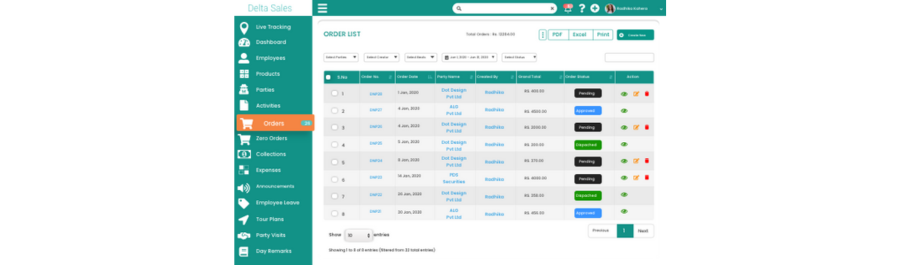
Advanced teams use analytics-driven sales performance tools to forecast growth accurately. By analyzing these metrics, teams can predict future sales trends and make informed strategic decisions.
Marketing Automation Metrics
-
Number of leads generated: Counts how many new potential customers marketing campaigns attract, reflecting lead generation effectiveness.
-
Cost per lead: Calculates marketing spend divided by leads acquired, measuring campaign efficiency and budget utilization.
-
Campaign ROI: Assesses the return on investment for marketing campaigns by comparing revenue generated to campaign costs.
-
Email open and click-through rates: Track engagement levels with email campaigns, indicating content relevance and audience interest.
-
Lead-to-MQL conversion: Measures the percentage of leads that become Marketing Qualified Leads, showing the quality of lead nurturing.
Though focused on different metrics, both sales and marketing automation work together to drive business growth and profitability.
Difference in Customer Journey Impact
Sales Automation Impact
-
Response speed: Sales automation speeds up responses to customer inquiries, helping sales teams act quickly and increase the chances of closing deals.
-
Follow-up consistency: Automated reminders ensure sales reps consistently follow up with prospects, building stronger relationships and preventing leads from slipping away.
-
Order accuracy: Automation minimizes errors in order processing, ensuring customers receive the right products and quantities, which improves satisfaction and trust.
-
Customer retention: By streamlining interactions and delivering personalized service, sales automation helps keep customers loyal and encourages repeat business.
Mobile-enabled platforms like mobile sales tool automation solutions are especially effective for field-driven organizations. Mobile sales tools empower field reps with instant access to data, improving efficiency and enabling better customer engagement on the move.
Marketing Automation Impact
-
Brand awareness: Marketing automation delivers consistent messaging across channels, boosting brand visibility and making prospects more familiar with the company.
-
Prospect engagement: Automated campaigns nurture prospects with timely, relevant content that keeps them interested and moves them closer to purchase.
-
Lead quality: Marketing automation scores and segments lead to focus sales efforts on the most promising prospects, improving conversion rates.
-
Personalization at scale: Automation enables marketers to send tailored messages to large audiences, creating personalized experiences without manual effort.
Sales and marketing automation work hand-in-hand to guide customers smoothly through every stage, enhancing satisfaction and driving revenue.
Summary difference Table
|
Aspect |
Sales Automation |
Marketing Automation |
|
Primary Goal |
Close deals and generate revenue |
Attract and nurture leads |
|
Funnel Stage |
Middle to bottom |
Top to middle |
|
Main Users |
Sales reps and managers |
Marketing teams |
|
Focus Area |
Execution and conversion |
Awareness and engagement |
|
Type of Automation |
Task-based workflows |
Campaign-based workflows |
|
Key Data |
Orders, customers, revenue |
Leads, engagement, behavior |
|
Success Metrics |
Conversion rate, sales value |
Lead volume, campaign ROI |
|
Customer Role |
Buyers and active prospects |
Visitors and early-stage leads |
Which One Should a Business Choose?
Businesses rarely succeed by choosing just one.
-
If deal execution is slow, sales visibility is poor, or field teams struggle with manual work, sales automation is critical.
-
If lead generation is inconsistent or prospects are not sales-ready, marketing automation becomes essential.
Companies working with distributors or indirect sales models often depend on distribution sales automation platforms alongside marketing systems for balanced growth.

Conclusion
Sales automation and marketing automation are not rivals, they are partners in growth. Marketing automation builds demand and interest, while sales automation turns that demand into revenue.
For businesses that rely heavily on on-ground sales execution, visibility, and order management, Delta Sales App plays a focused role by strengthening sales operations after leads are qualified helping teams execute faster, sell smarter, and grow consistently.
Understanding the difference between these two automation approaches enables businesses to build a more aligned, scalable, and future-ready sales ecosystem.
Discover how Delta Sales App can empower your team to close deals faster and improve field efficiency. Get started today!