
Why Is Data Accuracy Critical in Field Sales Reporting?

A sales report can look perfectly complete and still tell the wrong story. A few incorrect order quantities, a missed customer visit, an outdated outlet status, and a wrongly entered sales figure none of it looks like much on its own. But stack those errors across hundreds of outlets and field reps, and they start skewing forecasts, inventory decisions, territory planning, and even how managers judge their own teams.
That's why data accuracy in field sales reporting isn't just an administrative footnote. It shapes how confidently a business can actually understand what's happening in the market and decide what to do about it. For field teams, accurate reporting connects what happens during a customer visit to what a manager sees on their dashboard.
This post covers what field sales reporting involves, why accurate data matters, common causes of reporting errors, the business consequences those errors create, and practical ways companies can improve reporting accuracy so field teams can support more informed sales planning, stronger execution, and sustainable growth.
What Is Field Sales Reporting?
Field sales reporting is the process of collecting, organizing, and reviewing information a rep generates while working the market: customer visits tracking, orders, sales values, product availability, payments, outlet information, expenses, and everything else that happens during the day.
The purpose isn't just recording what a rep did. Good reporting shows managers where sales activity is happening, what's actually being achieved, where the problems are, and where attention needs to go.
When the information reaching managers is reliable, field sales reporting turns into a real source for planning and performance analysis, not just a box someone checks every evening.
Key Components of a Field Sales Report
A field sales report may contain different information depending on the company's sales process and industry. Common components include:
-
Customer or outlet visits completed
-
Orders booked during visits
-
Sales quantity and value
-
Product availability or stock observations
-
Customer payments and outstanding amounts
-
New customers or outlets added
-
Visit duration and location
-
Sales representative attendance
-
Expenses incurred during field activities
-
Remarks, photos, or follow-up requirements
The quality of these reports depends on how consistently and accurately the information is captured.
Manual vs. Automated Reporting Methods
Traditional reporting often depends on spreadsheets, paper records, phone calls, messaging applications, or end-of-day updates. These methods can work for small teams, but they become harder to control as the number of representatives, outlets, territories, and transactions increases.
Automated reporting reduces the amount of information that representatives need to enter manually. Structured forms, predefined fields, location-based records, and automated syncing can create more consistent reports while reducing opportunities for human error.
The difference is important: manual reporting primarily depends on people remembering and entering information correctly, while automated processes can build accuracy into the workflow itself. See our detailed comparison of manual vs. automated field sales reporting for a closer look at the trade-offs.
Why Data Accuracy Matters in Field Sales
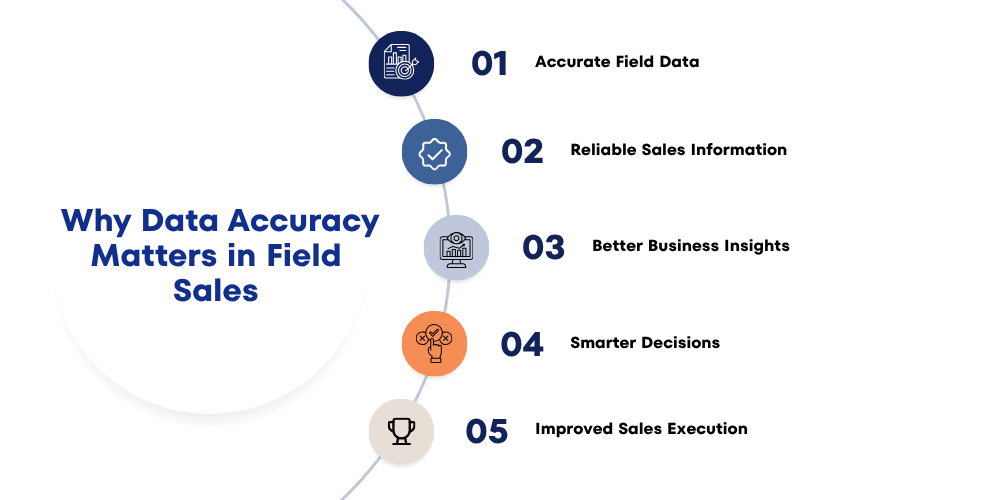
Sales teams make decisions based on the information they receive from the market. If that information is incomplete or incorrect, even a well-planned strategy can produce poor results. Accurate information gives managers a clearer view of sales activity and helps connect field execution with business outcomes.
-
Impact on Sales Forecasting and Planning
Sales forecasting relies significantly on both past and present sales data. When the figures reported are off, it can lead managers to misjudge future demand. For instance, if a few sales representatives don’t accurately report their orders, management might mistakenly see a dip in sales as a sign of a sluggish market. This misunderstanding can have ripple effects on future goals, purchasing choices, product distribution, and planning for sales territories. Having trustworthy sales data creates a more solid basis for forecasting, allowing managers to work with numbers that truly reflect what’s happening in the market.
-
Effect on Decision-Making at the Management Level
Managers make constant decisions about territories, sales targets, product focus, visit frequency, distributor requirements, and team allocation. Those decisions only work well when there's trustworthy information behind them. Accurate field data lets management spot real patterns instead of leaning on assumptions or a verbal update from last week. It's also what makes data-driven decision-making actually possible by showing what's happening across different teams, locations, outlets, and products, not just what one person remembers.
-
Role in Customer Relationship Management
Customer information is another area where accuracy matters a lot. Incorrect contact details, outdated outlet information, missed follow-ups, and incomplete order histories- any of that makes maintaining a consistent relationship genuinely hard. Good CRM data quality means a rep knows the customer's actual history and gives managers real visibility into account activity. Knowing when an outlet was last visited, what it ordered, and whether a follow-up is still pending lets a sales rep walk in with actual context instead of starting from scratch every time.
Common Causes of Inaccurate Sales Data
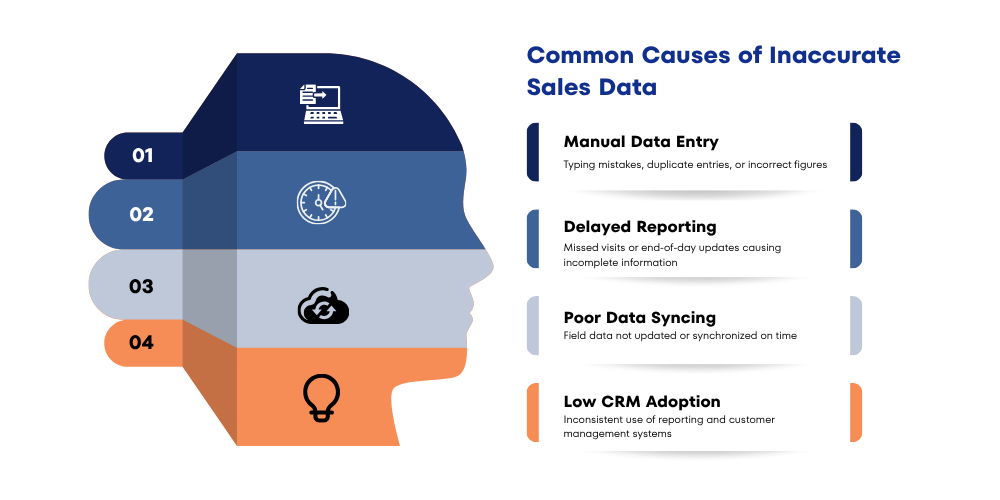
Before improving reporting accuracy, companies need to understand where errors originate. Several problems can affect the reliability of field information.
-
Manual Data Entry Errors
Typing numbers manually creates opportunities for mistakes. A representative may enter the wrong quantity, select the wrong outlet, forget a product line, or accidentally submit incomplete information. These errors can become particularly difficult to identify when reports are consolidated from multiple spreadsheets or sources.
-
Delayed or Missed Field Visit Reporting
When reps put off reporting until the end of the day, important details get forgotten or logged wrong. A busy rep might remember that a visit happened but forget the exact order quantity, what the customer actually needed, or why a visit got skipped. That delay is what creates the gap between the actual activity and what managers end up seeing.
-
Lack of Real-Time Data Syncing
When information doesn't reach managers promptly, decisions get made on outdated records. A manager reviewing yesterday's inventory or order data might not even know a significant order already came in today. Real-time sales data closes that gap and gives managers a picture of the market that's actually current, not a day behind.
-
Poor CRM Adoption by Sales Reps
Even the best CRM can't produce reliable information if reps don't actually use it consistently. If some employees update customer information while others rely on offline notes or messaging, the organization ends up with records that don't match up. Poor adoption is as much a data-quality problem as it is a technology one, no matter how good the tool itself is.
Consequences of Inaccurate Field Sales Data
Inaccurate field sales data does not stay confined to a report. Once incorrect or incomplete information enters the system, it can influence forecasting, planning, resource allocation, and customer follow-ups across the organization. What starts as a missed visit update or an incorrect order quantity can eventually affect larger business decisions.
The impact becomes more significant when these errors occur repeatedly across multiple representatives and territories. From missed revenue opportunities to reduced team productivity, unreliable data can create problems that are difficult to identify until they begin affecting business performance.
-
Lost Revenue Opportunities
Bad information causes sales teams to miss real opportunities that should have been obvious. An outlet can look inactive when it actually has real purchasing potential sitting there. A follow-up gets skipped because a previous interaction never got recorded. A product need goes unnoticed because the field observation was never logged. Those gaps compound over time, and eventually they show up as lost revenue growth.
-
Misinformed Business Strategies
Management ends up changing pricing, product focus, territory allocation, or sales targets based on information that doesn't accurately reflect the market. Underreported sales in a territory, for instance, can convince managers that the territory has weak potential when the real problem is just incomplete reporting, not weak demand at all.
-
Reduced Sales Team Productivity
Poor-quality data creates its own extra workload, too. Managers end up checking reports, calling reps for clarification, comparing spreadsheets, or fixing duplicate records instead of spending that time coaching or thinking through strategy. For reps, unclear reporting requirements pile on admin work and eat into the time that could've gone to actual customer interactions.
-
Damaged Customer Trust
Incorrect customer records create a genuinely inconsistent experience for the customer. A rep can show up without knowing about a previous request, miss a follow-up on an issue, or hand over information that flat-out contradicts an earlier conversation. When that keeps happening, customers start losing confidence in the sales team's reliability, fair or not. Accurate information is what keeps continuity across interactions instead of every visit feeling disconnected from the last.
How to Improve Data Accuracy in Field Sales Reporting
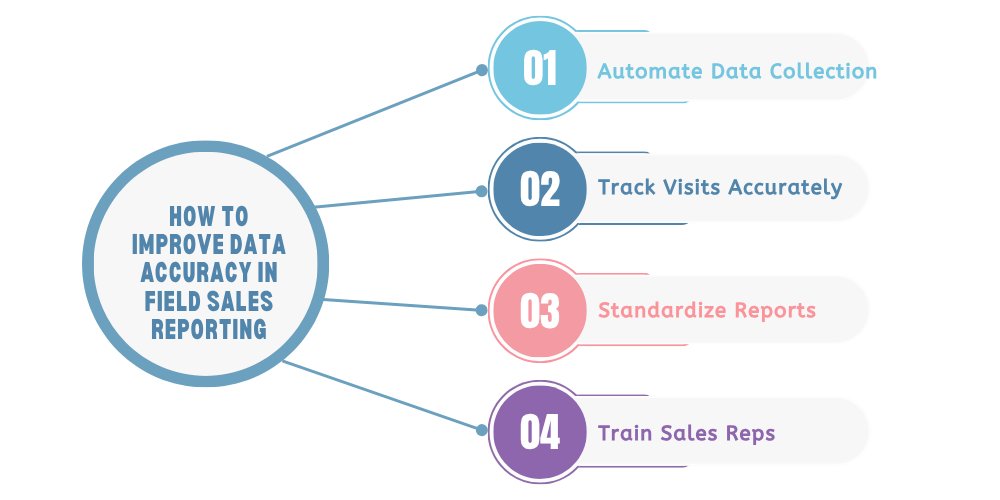
Accurate sales data doesn't come from simply asking reps to be more careful. It requires a reporting process where information is easy to capture, consistent across the whole team, and available exactly when it's needed. Combining clear reporting standards with the right technology and regular training is what actually cuts errors and creates a genuinely reliable flow of information from the field back to management.
-
Implementing Field Sales Automation Tools
Field force automation app cuts out the repetitive manual work by bringing attendance, customer visits, orders, expenses, and reporting into one structured workflow instead of scattered records everywhere. Standardized fields and automated workflows also make it easier for managers to review information the same way every time, and for organizations with larger field teams, that can genuinely improve how reliable operational data ends up being.
-
Real-Time GPS and Visit Tracking
Location-based tracking helps verify whether planned customer visits actually happened, giving managers real visibility into field activity instead of taking someone's word for it. A GPS-based tracking app captures things like customer location, visit time, and visit status, which creates a far more objective record than relying on a manual end-of-day summary.
-
Standardizing Reporting Formats
Different reps shouldn't be recording the same kind of information in completely different ways. Companies can fix that with standard reporting fields, naming conventions, required information, and consistent reporting timelines. Every customer visit report, for instance, could follow the same structure for order details, visit outcome, remarks, and follow-up requirements. That standardization makes information easy to compare across the whole team and cuts out a lot of the ambiguity that creeps in otherwise.
-
Training Sales Reps on Data Hygiene
Technology alone can't fix every reporting problem. Reps need to genuinely understand why accurate information matters and how poor data ripples out to the rest of the organization. Training should cover correct data entry, timely reporting, customer information updates, order recording, and why completing required fields actually matters. Once reps understand that their reports directly shape forecasting, inventory, customer management, and the decisions their manager makes, reporting stops feeling like busywork and starts feeling like part of the actual job.
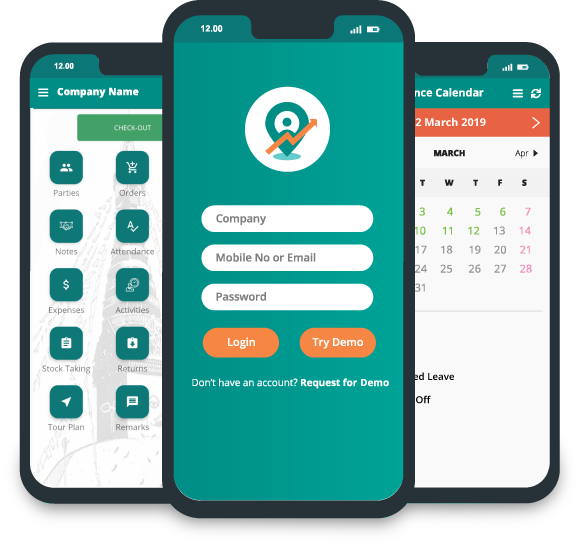
A structured platform like Delta Sales App supports exactly this by bringing field activity and reporting into a centralized system. Sales teams capture information directly from the field, managers get real visibility into activity and results, and information flows consistently from the market to management, without the usual gaps and delays.
Benefits of Accurate Field Sales Data
When field information is accurate, its value extends far beyond producing reliable reports. Clean and timely data gives sales managers a clearer understanding of what is happening across territories, customers, products, and field teams. It also makes it easier to identify patterns, respond to problems, and act on opportunities with greater confidence.

From improving inventory decisions to strengthening team accountability, accurate data can support better execution at multiple levels of the sales operation. The key benefits become especially visible when reliable field information is consistently collected and used across the organization.
-
Better Forecasting and Inventory Planning
Reliable sales information gives a company a much clearer read on actual demand patterns. Managers can compare sales activity across products, outlets, territories, and time periods, which makes stock planning easier and helps avoid the mismatches between supply and demand that come from bad data. Accurate information is really the foundation of everything else, inventory planning and distribution decisions included, gets built on top of.
-
Improved Sales Rep Accountability
Clear records let managers see where reps are performing well, where more support is needed, and whether the planned work is actually getting completed, the kind of visibility a sales tracker app is built to provide.
-
Stronger Customer Relationships
Reliable customer records let a rep walk into every interaction with real information already in hand: previous orders, outstanding follow-ups, what the customer actually needs, and continuity from the last visit. That keeps customer interactions organized and cuts down the odds of something important getting lost between different reps handling the same account over time.
-
Data-Driven Strategic Growth
Accurate information gives leadership a genuinely dependable view of the market. Field sales analytics can show which territories are actually growing, which products are gaining traction, where outlet coverage is weak, and where sales resources should be redirected. Instead of running strategy off assumptions or fragmented reports, a business can use consistent field information to actually catch opportunities and respond as market conditions shift.
Conclusion
Field sales reporting is only as valuable as the information sitting behind it. When sales figures, customer visits, orders, outlet information, and field activities get recorded inaccurately, the reports built on top of them steer managers toward the wrong conclusions, no matter how good the dashboard looks.
Improving data quality takes a combination of standardized processes, timely reporting, rep training, and the right technology working together. With accurate information actually flowing from the field to management, companies can sharpen forecasting, strengthen accountability, understand customers better, and make decisions grounded in something real.
For businesses looking for more consistency and visibility in their field operations, a centralized sales reporting solution makes accurate reporting a lot easier to achieve and, more importantly, maintain over time.
Want to improve the accuracy and visibility of your field sales reporting? Book a free demo of Delta Sales App and see how it can support your sales team.