
How Can Businesses Identify Low-Value Sales Visits?
A busy sales day and a productive one aren't the same thing. Reps can be out visiting customers, collecting orders, and covering their whole territory, and still have a lot of that time not really paying off if too many of those visits generate small orders, no orders, or no real progress. Every field visit has a cost. Reps spend time traveling, meeting customers, demoing products, taking orders, updating records, and chasing follow-ups, and if that time keeps getting poured into accounts with little revenue or growth potential, a business can bleed selling hours without ever noticing.
So measuring sales productivity can't stop at counting visits. Businesses need to know which visits actually lead to revenue, which create real opportunities, and which just eat up resources without producing anything. A low-value visit doesn't automatically mean the customer doesn't matter, either. A small retailer today might have real potential down the line, and a high-revenue account might only need an occasional check-in. The real work is spotting the patterns: customer behavior, purchase history, visit frequency, travel time, order value, and actual results over time.
By effectively tracking customer visits, understanding customer data, and analyzing sales trends, a company can uncover valuable insights and make informed choices about how sales representatives should allocate their time. In this blog, we’ll explore the telltale signs of a low-value sales visit, the metrics that can help businesses assess customer worth, and actionable strategies to enhance field sales performance.
What Is a Low-Value Sales Visit?
A low-value sales visit is one that takes up real sales resources but doesn't return much business value for the effort. That can show up a few ways: a visit that keeps producing a tiny order, no order at all, no real progress toward a deal, or little chance of future revenue. Even a reasonable-looking visit can turn low-value if the travel time eats up more than the revenue justifies.
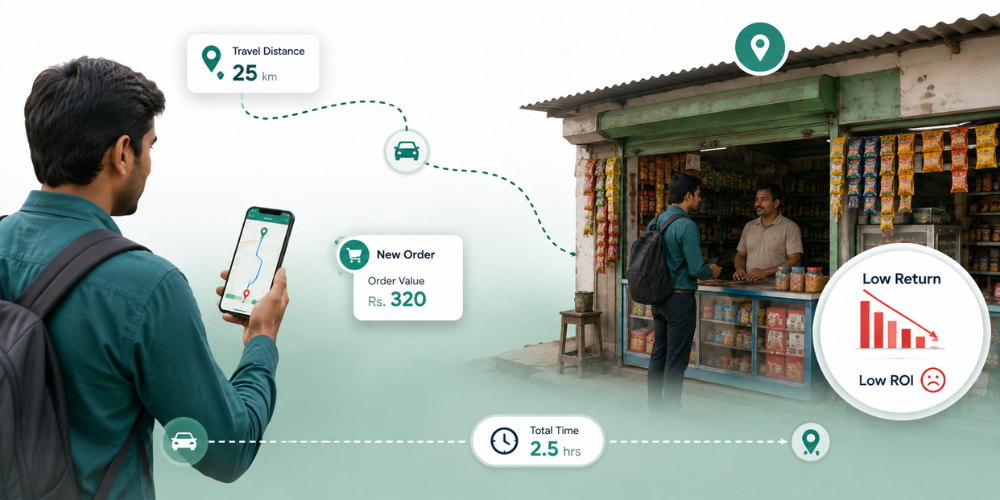
Say a rep visits a retailer every week, 30 minutes of travel plus 20 minutes at the outlet, and the retailer keeps placing a small order that hasn't budged in months. One account like that isn't a big deal on its own. But the same pattern across dozens of accounts adds up fast, and it starts showing up in real numbers on field productivity and sales cost.
This matters especially for FMCG companies, distributors, wholesalers, and other businesses running large field teams. When you're servicing hundreds or thousands of retailers across different territories, even a small amount of wasted effort per account compounds into a real productivity problem. By looking at customer value, visit data, territory performance, and order history together, managers can actually see where reps are spending their time and whether that time is doing anything for the business.
Why It Matters for Sales Productivity and Cost
Every sales visit carries a hidden cost, even if no money is exchanged. A sales representative invests time traveling to meet a customer, waiting at the store, discussing products, checking stock, taking orders, jotting down visit notes, and moving on to the next stop. When a visit results in a significant order or deepens a promising customer relationship, that effort feels worthwhile. However, if the same level of effort consistently yields minimal or no results, it can drain sales productivity.
This is why companies must look beyond the sheer number of sales visits their field team makes and assess the actual value those visits bring to the business.
1. Low-Value Visits Reduce Selling Time
A field rep only has so many productive hours in a day. If too much of that time goes to accounts that never generate much return, there's less time left for customers and prospects who actually have real potential. A rep might spend an hour traveling to and completing a visit that nets a tiny order, and in that same hour they could've visited a nearby high-value retailer, followed up with a promising prospect, or worked on an underperforming territory instead.
Over time, that adds up to real opportunity cost. It's not that every customer needs to place a huge order. It's that visit frequency needs to actually match the customer's value and potential, not just habit or routine.
2. Unnecessary Visits Increase Field Sales Costs
Inefficient visits can significantly raise the expenses of managing a field sales team. The typical costs tied to these visits include:
-
Fuel and transportation costs
-
Time spent traveling by employees
-
Maintenance of vehicles
-
Travel reimbursements
-
Communication and operational expenses
-
Time managers invest in overseeing activities
-
The lost opportunity cost from unproductive selling hours
Imagine a team of 50 sales representatives. If each one makes several unnecessary visits each week, the company could be wasting hundreds of valuable working hours on tasks that do little to boost revenue. This highlights that optimizing sales visits is not just about improving productivity; it can have a direct impact on the overall cost-effectiveness of the sales operation.
3. Visit Count Does Not Always Equal Sales Performance
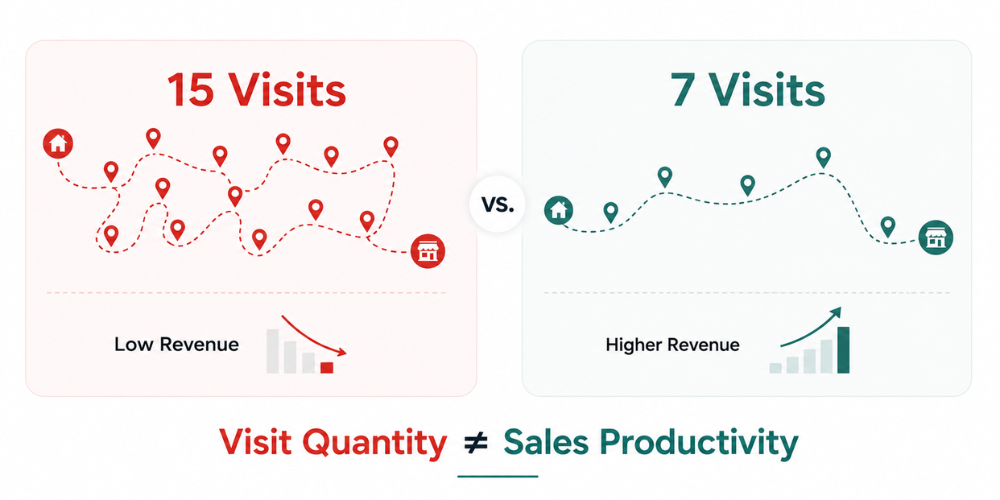
One of the common mistakes in field sales management is treating completed visits as a direct indicator of productivity. A representative who completes 20 visits may appear more productive than someone who completes 12. But what if those 12 visits generated significantly more revenue, larger orders, better customer retention, and more new opportunities? This is why businesses should look at visit quality alongside visit quantity rather than relying on visit count alone. Metrics such as revenue per visit, order conversion, average order value, sales growth, and customer engagement can provide a more accurate picture of sales representative performance.
4. Poor Visit Allocation Can Affect Customer Coverage
Low-value visits don't just eat into one rep's time. They shape how an entire territory gets covered. When too much time goes to low-performing accounts, other customers end up shortchanged: high-value retailers get less attention than they should, new prospects miss timely follow-ups, and growing accounts lose out on cross-selling or upselling opportunities that never come up.
Good territory management means putting sales resources where the customer needs and potential actually are. That doesn't mean writing off smaller accounts. It means using different coverage strategies for different accounts, so a high-value retailer might warrant weekly visits while a lower-volume outlet gets covered less often but still gets covered.
5. Data Helps Managers Make Better Decisions
Low-value sales visits can often fly under the radar in daily activity reports. A manager might glance at a representative's record of visiting 15 outlets and mistakenly conclude that the day was a success. However, without linking those visits to actual orders, revenue generated, customer history, and travel time, it becomes challenging to assess whether those interactions truly added value. This is why implementing a field sales tracking system and utilizing sales analytics is crucial for gaining deeper insights.
Key Signs of a Low-Value Sales Visit
Identifying a low-value visit isn't about writing off a rep because of one visit that didn't lead anywhere. Plenty of legitimate reasons explain a single unsuccessful visit: seasonal demand, temporary stock issues, pricing, or just where the customer is in their buying cycle. The real problem is when the same pattern keeps repeating.
By comparing visit data against customer purchase history, order values, visit frequency, travel time, and deal outcomes, managers can spot the accounts where the current visit strategy just isn't paying off.
1. Low Order Size or Purchase History
One of the first things worth checking is how visit frequency stacks up against order value. An account that keeps generating tiny orders despite frequent visits probably needs a different coverage approach. But low order value on its own isn't enough to call an account low-value. Growth potential, product category, purchasing capacity, and past behavior all need to factor in.
A retailer placing small orders now might still be worth the visits if that order size keeps climbing. An account that's been flat for years, on the other hand, probably doesn't need the same level of physical coverage it's getting. That's why order management and customer data need to be looked at together, not judged off a single number.
2. High Visit Frequency with No Revenue Growth
More visits don't automatically mean effective sales activity. If a rep keeps visiting an account and the customer's sales stay flat, that's worth asking about. A retailer might get weekly visits and still order the same limited quantity every month regardless. More visits won't move revenue if no real demand or growth is sitting underneath.
Managers can look at visit frequency, revenue growth, and order frequency together. If visit frequency goes up while revenue stays flat or drops, that's a sign resources aren't being allocated well. A field sales tracking system surfaces that pattern by showing customer visit history alongside sales and order activity, letting a manager move past "the rep just needs to visit more" to a data-backed call on the right visit frequency.
3. High Travel Time vs. Low Return
Not every sales visit costs the same to make. Two retailers might bring in identical revenue, but one's five minutes away, and the other takes an hour to reach. From a productivity standpoint, those two visits aren't equivalent at all, and that matters a lot for businesses covering large territories, rural markets, or retailers spread out geographically.
Managers should look at travel time, visit duration, and revenue generated together. If a rep is burning a big chunk of the day traveling to accounts that don't bring in much, that's a sign the territory or route needs a second look.
4. Repeated Stalled or Declined Deals
Not every visit is going to end in an order right away, especially with new prospects or bigger B2B accounts. But repeated visits that go nowhere are worth flagging. A rep might visit a prospect five or six times, run through the same products and pricing, and follow up again and again, and the deal just never moves.
Worth watching for: multiple visits with no order, proposals that keep getting turned down, an opportunity that isn't progressing, a customer who keeps pushing off the purchase, no response to upselling or cross-selling, objections that never actually get resolved, and long gaps between conversations and any real purchase.
None of that necessarily means walking away from the prospect. It usually just means the approach needs to change: move the account to a lower-frequency follow-up cycle, hand it to a different rep, try a different offer, or shift it to phone or digital contact until the customer's actually ready to buy.

Tools That Help Spot Low-Value Visits
Identifying low-value visits by hand gets hard as a field team grows. A manager might manage to review a handful of visits in a spreadsheet, but analyzing thousands across multiple reps, territories, and accounts is a different problem entirely, especially when visit data, orders, customer history, and reports all live in separate places. This is exactly where field sales technology, CRM systems, sales analytics, and route optimization earn their keep.
The point was never just tracking where reps go. The real value is connecting that field activity to actual business outcomes.
1. CRM and Sales Analytics Software
A CRM or field sales management software can consolidate customer information, sales activity, order history, and performance data into a single system. Instead of seeing visits as discrete activities, managers can evaluate them in conjunction with metrics like
-
Number of visits to each customer
-
How often you visit
-
Order history
-
Income received
-
Order size average
-
Revenue per visit (RPV)
-
Sales increases
-
Date of last purchase
-
Outcomes of visit
-
Sales Representative Activities
-
Customer and territory results
This makes it easier to identify patterns that may not be visible in basic attendance or activity reports. For example, a manager might discover that a particular retailer has received 12 visits over the past three months but generated very little additional revenue. Another account may have received only six visits but generated significantly higher sales and consistent growth.
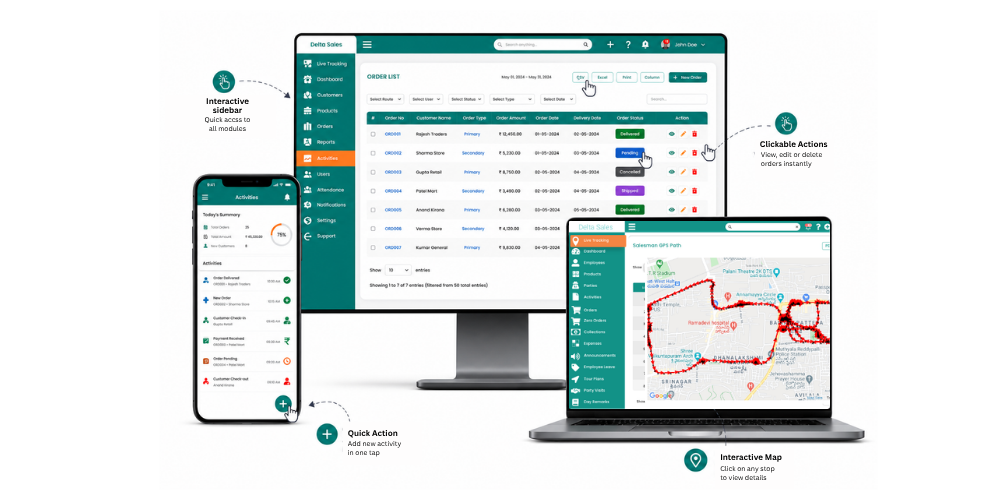
The Delta Sales App integrates field activity tracking with sales and customer information to give managers better insight into daily sales operations for companies with field sales teams.
The platform enables businesses to track customer visits, orders, sales activity, and field performance from one centralized system. Managers can use this information to analyze customer order history, frequency of visits, sales performance, and revenue patterns. For instance, when a retailer is experiencing frequent visits but always generating small orders, managers can identify the pattern and determine whether the current visit frequency is appropriate.
Companies can also compare sales activity between territories and reps to see where field resources are driving better results. This information may assist in decisions on:
-
Field sales productivity
-
Retailer coverage
-
Planning the Beat
-
Managing territory
-
Customer Prioritization
-
Sales representative performance
-
Order management
-
Sales reporting and analytics
The important point is that technology does not decide which customers are valuable on its own. Instead, it gives managers the data and visibility needed to make better coverage decisions.
2. GPS Tracking Tools for Understanding Field Activity
A GPS-based tracking system adds another layer when evaluating visits. Location data shows managers where reps are actually spending their working hours, how much time goes to travel, whether planned visits are actually happening, distance covered between customer locations, territory coverage, and potentially inefficient routes.
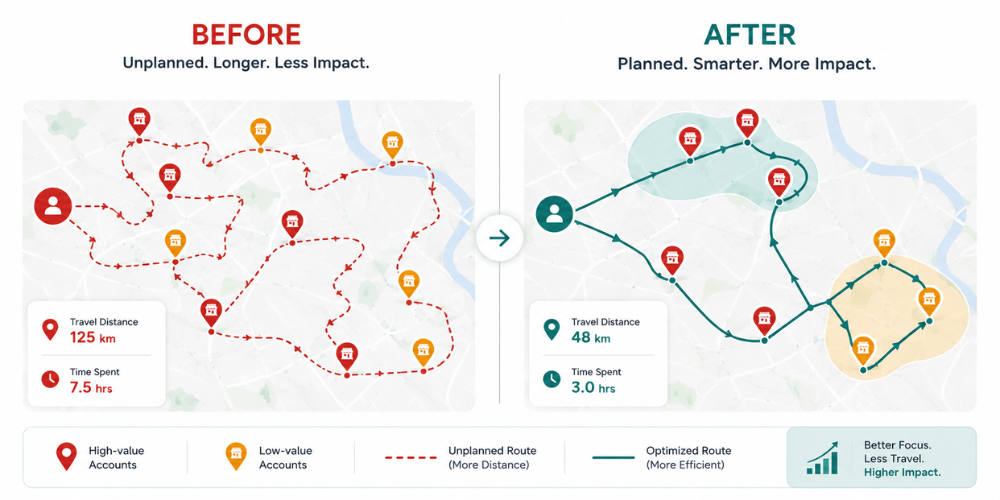
If a rep is spending a lot of time traveling to several low-revenue accounts, that's worth a second look at whether those stops belong in the regular route. GPS tracking isn't really about surveillance. Its real value is understanding field movement, territory coverage, and travel efficiency. Paired with sales data, location information gets a lot more useful, since managers can see not just where a rep went, but what actually came out of that activity.
3. Route and Territory Optimization Tools
How a rep's territory and daily route get designed has a big effect on their productivity. Poor territory planning tends to show up as excessive travel, routes that overlap, missed visits, uneven workload between reps, too much time spent getting to low-value accounts, and less time left for actual selling.
Route optimization fixes a lot of that by arranging visits around location, priority, availability, and other practical factors. Instead of scattering five customer visits across a wide geographic area, a manager can organize them into a route that actually makes sense, cutting unnecessary travel and giving reps more time to actually engage with customers instead of sitting in the car. Territory management software helps with the other half of it too, checking whether accounts are distributed fairly across the team in the first place.
Conclusion
Not every sales visit creates the same value. A high visit count can look good on a report without actually meaning reps are spending their time well. Businesses need to look past the raw number and check revenue per visit, order history, customer growth, conversion rates, travel time, and customer value. That's what actually surfaces low-value visit patterns, tells you whether to adjust visit frequency, improve territory coverage, and point reps toward the opportunities that are actually worth the time.
Field sales tracking and automation software makes it a lot easier to keep an eye on. Instead of guessing or digging through spreadsheets, managers get real-time data and reports showing where field teams are spending their time and what that time is actually producing.
Delta Sales App brings field activity, customer visits, orders, sales performance, GPS tracking, and reporting together in one platform, giving managers the visibility to make smarter calls on customer coverage and field productivity.
Book a free demo of Delta Sales App today and see how better sales visibility can help your team plan smarter visits, improve productivity, and get more out of every hour in the field.
FAQs
1. How can businesses tell if a sales visit is low-value?
A sales visit is typically low-value when it repeatedly results in small orders, no orders, or no progress on a deal, especially relative to the travel time and effort involved. The key is looking at patterns across visit frequency, order history, and revenue per visit rather than judging a single visit in isolation.
2. Does a high number of sales visits always mean good performance?
No. Visit count alone does not reflect productivity. A representative completing fewer visits can generate more revenue than one completing many, if those visits are with higher-value accounts. Metrics like revenue per visit and order conversion give a more accurate picture than visit count alone.
3. Should low-value accounts be dropped from the visit schedule?
Not necessarily. Many low-value accounts still have future potential or strategic importance. Instead of dropping them, businesses can shift their coverage strategy, using phone calls, digital communication, or distributor support for lower-value accounts while reserving in-person visits for high-potential ones.
4. How does GPS tracking help identify low-value sales visits?
GPS tracking shows how much time representatives spend traveling versus selling and whether visits are actually completed as planned. When combined with sales data, it helps managers see whether time spent reaching an account matches the revenue that account generates.
5. How does Delta Sales App help businesses identify low-value sales visits?
Delta Sales App brings customer visits, order history, sales activity, and GPS tracking into a single platform, allowing managers to see visit frequency alongside revenue generated for each account. This makes it easier to spot patterns, such as a retailer receiving frequent visits but consistently placing small orders, and to make informed decisions about adjusting visit frequency or reallocating field sales resources.