
How Food & Beverage Companies Can Streamline Van Sales and Field Operations
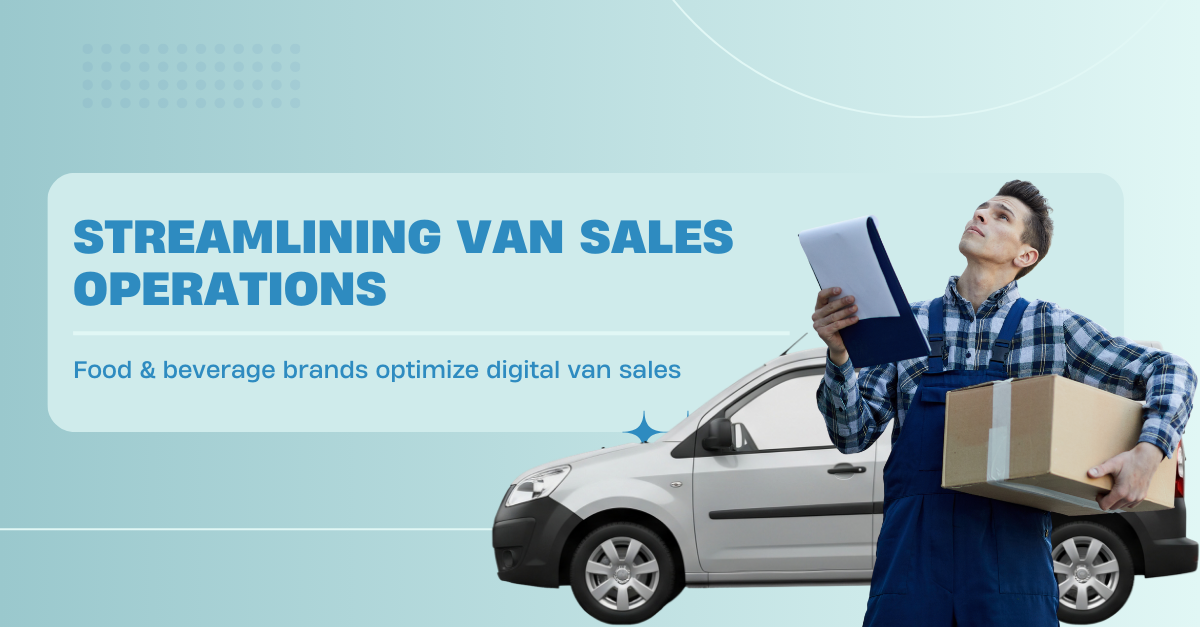
In the highly competitive food and beverage industry, success is determined not only by product quality and brand strength but also by how efficiently goods move from warehouses to retail shelves. As consumer demand increases and distribution networks grow more complex, food and beverage companies are under constant pressure to deliver faster, reduce operational costs, and maintain high service standards across diverse markets.
Traditional distribution and field sales models, heavily dependent on manual processes, paper-based documentation, and fragmented communication, are no longer sufficient. To remain competitive, organizations must modernize their operations by digitizing van sales, empowering field sales teams, and optimizing last-mile execution.
This is where van sales software emerges as a critical enabler. By integrating sales, inventory, route planning, and field execution into a single digital ecosystem, food and beverage companies can transform how they manage fmcg field sales and route sales, ensuring greater visibility, control, and profitability across their distribution networks.
Understanding the Complexity of Van Sales in Food & Beverage Distribution
Van sales play a pivotal role in food and beverage distribution, particularly for fast-moving consumer goods that require frequent replenishment, strict shelf availability, and rapid order fulfillment. Unlike centralized distribution models, van sales involve direct selling from vehicles, making field representatives responsible for order booking, invoicing, collections, and merchandising in a single visit.
However, managing van sales at scale introduces multiple challenges:
-
Limited real-time visibility into stock movement and sales performance: Lack of live data restricts managers from tracking inventory levels and sales progress, leading to stock mismatches, delayed decisions, and reduced operational control.
-
Inefficient route planning leading to fuel wastage and missed outlets: Poorly optimized routes increase travel time and fuel costs while reducing outlet coverage, resulting in missed sales opportunities and inconsistent market presence.
-
Manual order processing resulting in billing errors and delayed reporting: Paper-based order entry increases the risk of pricing mistakes, incorrect invoicing, and slow data consolidation, impacting financial accuracy and management visibility.
-
High dependency on individual salesperson discipline: Operational success relies heavily on salesperson compliance, making performance inconsistent and difficult to standardize across regions and distribution teams.
-
Difficulty managing returns, expiries, and damaged goods: Limited tracking of product movement complicates return handling and expiry control, leading to higher wastage, revenue loss, and strained retailer relationships.
-
Impact of lacking a structured digital framework: Without digital systems, operational challenges intensify, causing revenue leakage, reduced customer satisfaction, and inefficiencies across van sales and field distribution operations.
Without a structured digital framework, these challenges compound, leading to revenue leakage, poor customer satisfaction, and operational inefficiencies.
The Role of Digital Transformation in FMCG Field Sales
Digital transformation has become a strategic priority for FMCG organizations seeking to gain better control over their field operations. By digitizing workflows, companies can replace reactive decision-making with data-driven execution.
Modern fmcg field sales platforms unify multiple operational touchpoints, sales orders, inventory tracking, route execution, and performance analytics into a single system accessible by both field teams and management.
This transformation delivers measurable business benefits, including:
-
Faster order-to-cash cycles: Digitized order capture, invoicing, and collections accelerate payment processes, reduce delays, and improve cash flow visibility across FMCG field sales operations.
-
Improved compliance with sales processes: Standardized digital workflows ensure field teams follow defined sales procedures, pricing policies, and visit plans, reducing deviations and improving operational discipline.
-
Higher productivity per field representative: Automation minimizes manual tasks, enabling sales representatives to spend more time selling, covering more outlets, and maximizing daily revenue opportunities.
-
Greater accuracy in demand forecasting: Real-time sales and inventory data provide reliable insights into consumption patterns, enabling better forecasting, production planning, and inventory replenishment decisions.
-
Enhanced distributor and retailer relationships: Improved service reliability, faster deliveries, and accurate billing strengthen trust with distributors and retailers, driving long-term partnerships and increased order volumes.
At the center of this transformation lies van sales software, purpose-built to address the unique needs of mobile sales operations in food and beverage distribution.
How Van Sales Software Streamlines End-to-End Field Operations
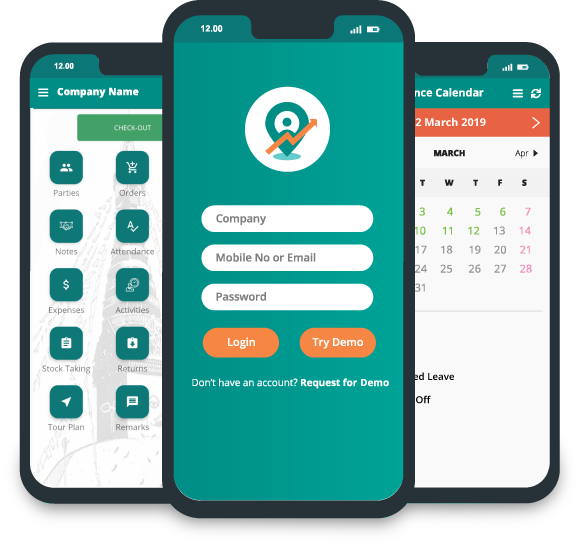
Van sales software serves as a centralized platform that digitizes the complete van sales lifecycle from route planning and stock loading to invoicing and collections. By equipping sales representatives with mobile-enabled tools, organizations can standardize execution while maintaining flexibility on the ground.

Key capabilities include:
-
Real-time inventory visibility at van and warehouse levels: Live inventory tracking provides accurate stock availability across vans and warehouses, preventing stock-outs, overloading, and discrepancies throughout the sales and distribution process.
-
Mobile order booking and instant invoice generation: Sales representatives can capture orders digitally and generate invoices instantly at the outlet, reducing processing time, billing errors, and order-to-delivery delays.
-
Automated pricing, discounts, and tax calculations: System-driven pricing and tax logic ensure consistent application of schemes and regulations, eliminating manual calculation errors and improving billing accuracy across all transactions.
-
GPS-enabled route tracking and visit verification: GPS tracking validates planned versus actual routes and outlet visits, improving route compliance, field accountability, and overall efficiency of daily sales execution.
-
Seamless synchronization with ERP and accounting systems: Automatic data integration with ERP and accounting platforms ensures accurate financial reporting, faster reconciliation, and real-time visibility into sales and inventory performance.
These capabilities eliminate manual errors, reduce administrative workload, and ensure consistent execution across geographies.
Optimizing Route Sales for Higher Market Coverage
Route sales efficiency directly impacts outlet coverage, cost per visit, and overall sales productivity. Poorly planned routes result in wasted time, higher fuel costs, and missed sales opportunities.
Digitized route sales management enables companies to define structured routes based on outlet density, sales potential, delivery frequency, and service priorities. Sales managers gain visibility into planned versus actual visits, ensuring accountability without micromanagement.
With intelligent route execution, organizations can:
-
Increase daily outlet coverage without increasing headcount
Optimized route planning enables sales teams to visit more outlets within the same working hours, maximizing coverage and revenue potential without adding additional field resources. -
Reduce travel time and operational costs
Efficient route sequencing minimizes unnecessary travel, lowers fuel consumption, and reduces vehicle wear, directly decreasing overall distribution and sales operating expenses. -
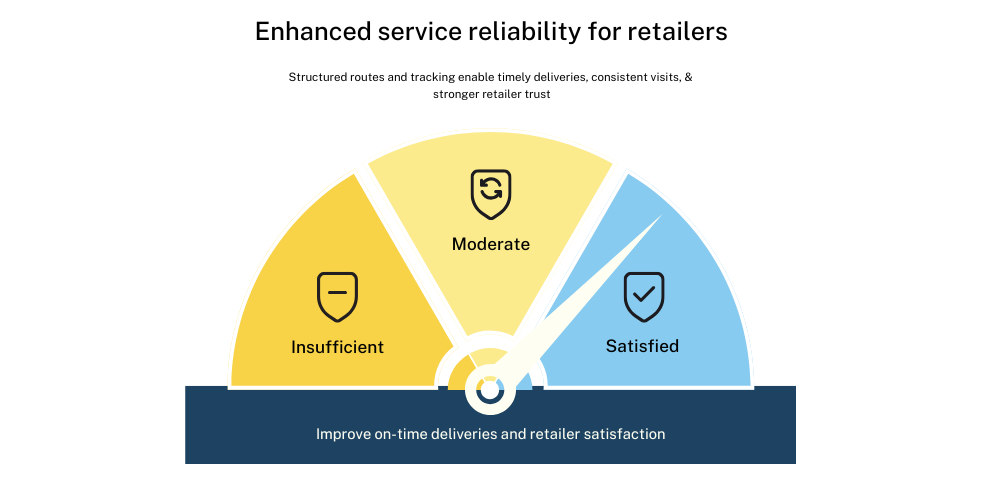
Improve on-time deliveries and retailer satisfaction
Structured routes and real-time tracking ensure timely deliveries, consistent visit schedules, and faster service, enhancing retailer trust and long-term business relationships.
-
Ensure consistent market presence
Planned and monitored routes guarantee regular outlet visits, improving product availability, shelf visibility, and brand consistency across all assigned sales territories. -
Strategic importance of route optimization
Focusing on Route Optimization for Food Distribution Teams helps organizations balance service quality, cost efficiency, and scalability within complex food and beverage distribution networks.
Improving Inventory Accuracy and Stock Rotation
Food and beverage products are often perishable, making inventory accuracy and stock rotation critical to minimizing losses. Manual tracking of stock movement frequently leads to discrepancies, stock-outs, and expired products.
With van sales software, inventory is updated in real time as sales occur, providing accurate visibility into stock levels at every stage. Automated FIFO (First-In, First-Out) logic ensures older stock is sold first, reducing expiries and returns.
This level of control enables businesses to:
-
Prevent overloading or understocking vans
Real-time inventory visibility helps optimize van loading based on actual demand, avoiding excess stock, stock-outs, and inefficient utilization of vehicle capacity. -
Reduce wastage due to expired products
FIFO-based stock rotation ensures older inventory is sold first, minimizing product expiries, reducing returns, and protecting margins in perishable goods distribution. -
Improve demand forecasting accuracy
Accurate, real-time sales and inventory data provide reliable insights into consumption patterns, enabling better forecasting and inventory replenishment planning. -
Align production and dispatch planning with real sales data
Sales-driven inventory insights allow manufacturers to synchronize production schedules and dispatch quantities with actual market demand, reducing excess inventory and supply gaps.
Enhancing Sales Representative Productivity and Accountability
Sales representative productivity is directly linked to how efficiently time is utilized in the field. In traditional van sales operations, representatives often spend a large part of their day handling manual tasks such as writing orders, preparing invoices, and compiling reports. These administrative activities reduce the time available for productive selling, retailer engagement, and market expansion, ultimately impacting overall sales performance.
Mobile-enabled van sales software addresses these challenges by automating routine field processes. Sales representatives can quickly capture orders, generate invoices instantly, and submit reports digitally, allowing them to focus on revenue-generating activities. Additionally, GPS tracking and time-stamped outlet visits provide real-time visibility into field execution, ensuring planned routes and visits are followed. This transparency improves accountability while maintaining trust between managers and field teams. By streamlining operations and providing actionable insights, digital van sales solutions help organizations boost productivity, improve sales effectiveness, and drive consistent performance across the field sales network.
Key Metrics Every Food & Beverage Brand Should Track in Van Sales
-
Sales Achievement vs Targets
Core indicator of revenue performance, helping managers track goal attainment, identify gaps, and drive timely corrective actions across routes and sales teams. -
Outlet Coverage Percentage
Ensures consistent market presence by measuring planned versus actual outlet visits, directly impacting availability, shelf visibility, and long-term retailer relationships. -
Inventory Accuracy and Stock Aging
Critical for perishable products, this metric helps prevent stock-outs, reduce expiries, and maintain FIFO compliance across vans and warehouses. -
Sales Representative Productivity
Measures efficiency and effectiveness of field teams based on outlets covered, orders booked, and sales value, enabling better performance management and targeted coaching.
-1766299649.png)
Strengthening Van Sales for Beverage Brands
Beverage distribution presents unique challenges due to high SKU counts, seasonal demand fluctuations, and frequent replenishment cycles. Managing cold-chain compliance, promotional pricing, and returnable packaging adds further complexity.
Digital solutions designed specifically for beverage distribution help brands maintain consistency and control across large-scale operations. Many organizations now prioritize Van Sales Automation for Beverage Brands to streamline execution and improve visibility from depots to retail outlets.
By automating van sales processes, beverage companies can:
-
Ensure accurate pricing and promotions across markets
Automated pricing engines apply standardized rates and promotional schemes consistently across regions, preventing billing discrepancies and ensuring compliance with centrally defined pricing policies. -
Track empty bottle and crate returns efficiently
Digital tracking of returnable assets improves visibility into bottle and crate movements, reducing losses, disputes, and reconciliation issues across beverage distribution channels. -
Improve distributor and retailer collaboration
Shared access to accurate order, inventory, and delivery data strengthens coordination, improves service reliability, and builds long-term trust with distributors and retail partners. -
Respond quickly to demand spikes during peak seasons
Real-time sales insights enable rapid inventory reallocation and route adjustments, allowing beverage brands to capitalize on seasonal demand surges without service disruptions.
Minimizing Returns and Disputes with Automated Sales Order Management
Returns and disputes are common pain points in food and beverage distribution, often caused by incorrect order entry, pricing mismatches, or expired stock. These issues not only erode margins but also strain retailer relationships.
Digital sales order management significantly reduces these risks by standardizing order capture and validation at the point of sale. Automated checks ensure correct SKUs, quantities, and pricing before invoices are generated.
Organizations increasingly focus on Reduce Returns Using Sales Order Apps to create transparency and trust across the sales process. With digitally captured orders and customer confirmations, disputes are resolved faster, and unnecessary returns are minimized.
Improving Retailer Relationships Through Faster Service
Retailers value consistency, accuracy, and speed. Delays in order fulfillment, billing errors, or stock unavailability directly impact retailer confidence and shelf presence.
By leveraging van sales software, food and beverage companies can deliver faster service with fewer errors. Instant invoicing, real-time stock visibility, and predictable visit schedules improve the overall retailer experience.
Stronger retailer relationships result in:
-
Increased shelf space and product visibility: Reliable service and consistent availability build retailer trust, encouraging greater shelf allocation and improved in-store visibility for products.
-
Higher order volumes and repeat purchases: Accurate billing and timely deliveries strengthen retailer confidence, leading to larger order sizes and more frequent repeat purchases.
-
Better collaboration on promotions and launches: Strong service reliability enables closer collaboration with retailers on promotions, new product launches, and joint growth initiatives.
-
Reduced churn in competitive markets: Faster, error-free service reduces dissatisfaction, helping retain retailers and prevent switching to competing brands in highly competitive markets.
Leveraging Data and Analytics for Smarter Decision-Making
One of the most powerful advantages of digitizing field operations is access to actionable insights. Every transaction, visit, and movement captured by van sales software contributes to a rich data repository.
Advanced analytics help organizations:
-
Identify high-performing routes and territories: Analytics reveal routes and territories generating the highest sales and efficiency, enabling focused investments, route optimization, and strategic expansion decisions.
-
Analyze SKU-wise and channel-wise performance: Detailed performance data highlights how each product and sales channel performs, supporting assortment optimization, targeted promotions, and improved channel strategies.
-
Forecast demand with greater accuracy: Historical and real-time sales insights improve demand forecasts, enabling better inventory planning, production scheduling, and reduced stock-outs or excess inventory.
-
Optimize pricing and promotional strategies: Data-driven analysis evaluates pricing effectiveness and promotion impact, helping organizations refine strategies to maximize margins and sales performance.
Leadership teams gain a holistic view of field execution, enabling proactive decision-making rather than reactive firefighting.
Scaling Operations Without Increasing Complexity
As food and beverage companies expand into new markets, maintaining consistent sales execution and operational control becomes increasingly challenging. Manual, paper-based processes fail to scale effectively, often resulting in inefficiencies, inconsistent practices, and limited visibility across regions.
Digitized fmcg field sales platforms provide a standardized and centralized framework that supports growth without significantly increasing operational complexity or administrative overhead. New routes, products, distributors, or sales teams can be onboarded quickly through configurable workflows and unified systems.
This scalability enables organizations to pursue expansion opportunities confidently while preserving service quality, operational discipline, and performance consistency across diverse and growing distribution networks.
Conclusion
Streamlining van sales and field operations is no longer a tactical improvement, it is a strategic necessity for food and beverage companies seeking sustainable growth. From route optimization and inventory accuracy to sales automation and analytics, digital solutions redefine how distribution networks operate.
By adopting modern van sales software such as the Delta Sales App, food and beverage brands can eliminate inefficiencies, reduce operational risk, and build stronger relationships with retailers and distributors. The result is a more agile, data-driven, and profitable distribution ecosystem ready to meet the evolving demands of today’s dynamic markets.
Transform your van sales operations with the Delta Sales App optimize routes, improve visibility, and drive smarter field sales growth.