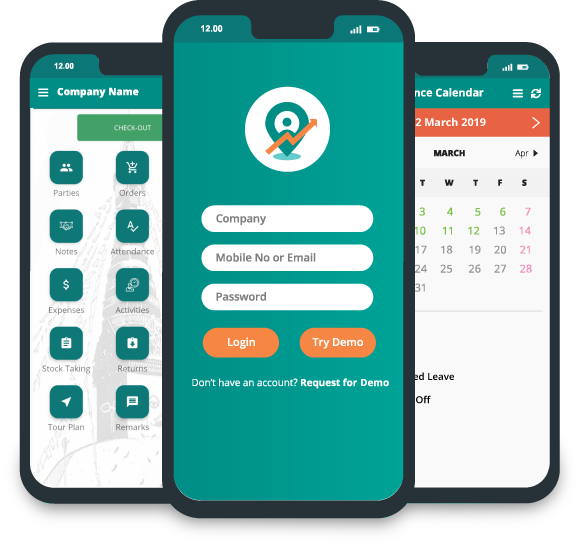

The Complete Guide to Distributor Management Software: Orders, Inventory, Secondary Sales & Distributor Performance in 2026
Distribution has undergone a fundamental transformation. What was once a relationship-driven, manually coordinated ecosystem has now evolved into a data-centric, technology-enabled network. Businesses in FMCG, pharma, and manufacturing sectors are no longer relying on spreadsheets, phone calls, and delayed reporting. Instead, they are adopting intelligent systems that enable real-time visibility, automation, and predictive decision-making.
In 2026, the complexity of supply chains has increased significantly. Multi-tier distribution, fragmented markets, and rising competition demand precision and speed. Companies that fail to modernize their distribution processes risk losing market share, facing stockouts, and struggling with inefficiencies.
This is where distributor management software becomes a strategic asset, enabling organizations to streamline operations, improve visibility, and enhance distributor relationships.
Understanding Distributor Management Software
To understand the foundation of modern distribution, it's essential to clearly define what is distributor management software. It is a centralized platform designed to manage and optimize the entire distributor lifecycle, from order placement and inventory tracking to secondary sales monitoring and performance evaluation.
This software acts as a bridge between manufacturers, distributors, and field sales teams. It ensures that data flows seamlessly across all stakeholders, eliminating silos and enabling better coordination.
Unlike traditional systems, modern platforms go beyond basic order processing. They integrate analytics, automation, and mobility to provide a holistic view of the distribution network.
Key Capabilities of Distributor Management Software
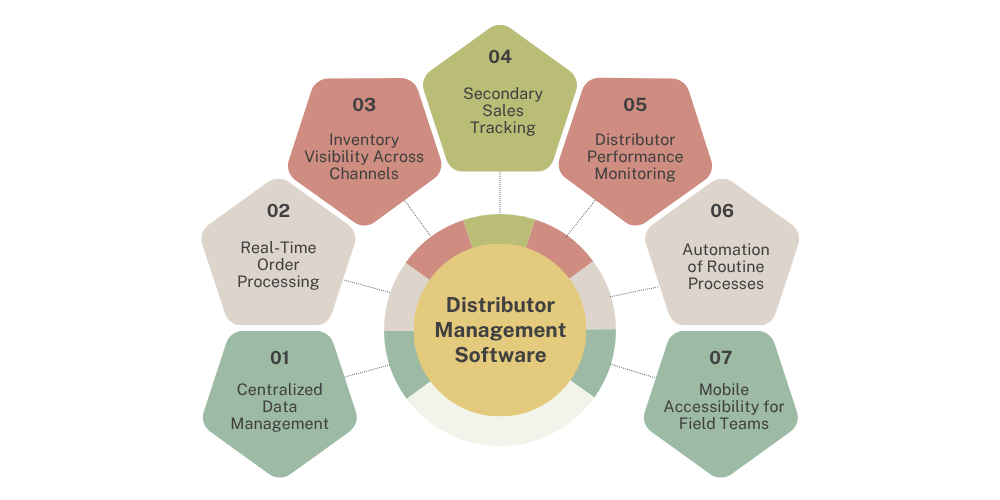
- Centralized Data Management
Consolidates data from distributors, sales teams, and warehouses into a single system, ensuring accuracy, consistency, and easy access to critical business information. - Real-Time Order Processing
Enables instant order capture, validation, and tracking, reducing delays and improving order fulfillment efficiency across the distribution network. - Inventory Visibility Across Channels
Provides live tracking of stock levels across warehouses and distributor locations, helping businesses prevent stockouts and optimize inventory movement. - Secondary Sales Tracking
Captures distributor-to-retailer sales data, offering deeper insights into actual market demand and improving forecasting accuracy. - Distributor Performance Monitoring
Tracks key metrics such as sales volume, coverage, and order frequency, enabling businesses to evaluate and improve distributor efficiency. - Automation of Routine Processes
Reduces manual effort by automating workflows like order approvals, invoicing, and reporting, increasing operational efficiency. - Mobile Accessibility for Field Teams
Allows sales representatives to capture orders, update data, and access insights on the go, improving productivity and real-time decision-making.
Why Traditional Distribution Models Are Failing
Legacy distribution models are no longer equipped to handle the demands of today's market. The reliance on manual processes leads to several inefficiencies:
- Delayed Order Processing : Manual order handling relies on calls, emails, or paper entries, causing delays, errors, and slower fulfillment cycles, ultimately impacting customer satisfaction and distributor efficiency.
- Lack of Real-Time Inventory Visibility : Without live inventory tracking, businesses cannot monitor stock levels accurately, leading to frequent stockouts or overstocking, disrupting supply chain efficiency and sales continuity.
- Inaccurate Sales Data : Manual data collection often results in incomplete or incorrect sales records, making it difficult to analyze performance, forecast demand, and take timely strategic decisions.
- Poor Distributor Accountability : Traditional systems lack transparency, making it difficult to track distributor activities, sales efforts, and compliance, resulting in reduced control and inconsistent market execution.
- Limited Scalability : Manual processes cannot handle growing distribution networks, increased order volumes, or expanding territories, restricting business growth and making operations inefficient as complexity increases.
These challenges highlight the difference between distributor management and distribution management. While traditional distribution focuses on logistics and movement of goods, distributor management emphasizes relationship management, performance tracking, and data-driven decision-making.
Key Components of a Modern Distribution System
A modern distribution ecosystem is no longer just about moving goods from point A to point B, it is about creating a synchronized, data-driven network that connects manufacturers, distributors, and field sales teams in real time. To achieve operational excellence and scalability, businesses must build their distribution framework on four critical pillars:
Order Management
Order management streamlines order capture, validation, processing, and fulfillment through digital systems, reducing errors, improving speed, ensuring real-time tracking, and enhancing coordination between sales teams and distributors.
Inventory Management
Inventory management provides real-time visibility of stock across warehouses and distributors, preventing stockouts or overstocking, optimizing replenishment cycles, reducing carrying costs, and improving overall supply chain efficiency.
Secondary Sales Tracking
Secondary sales tracking captures distributor-to-retailer transactions, offering visibility into actual market demand, enabling better forecasting, improving product availability, and ensuring stronger alignment between supply and consumption trends.
Distributor Performance Monitoring
Distributor performance monitoring evaluates sales, coverage, order frequency, and efficiency using KPIs, enabling accountability, identifying underperformance, supporting data-driven decisions, and strengthening distributor relationships for consistent business growth.
Together, these pillars form the foundation for smart inventory management for distributors, enabling better control and optimized stock movement across the network.
Order Management: From Manual to Automated Workflows
Order management has transitioned from fragmented, manual processes to streamlined, automated workflows that enhance speed, accuracy, and visibility across the distribution network. Below is a structured breakdown:
Manual Order Management: Challenges & Limitations
- Dependence on Traditional Methods
Orders are collected via phone calls, paper notes, or messaging apps, leading to inconsistent data capture and higher chances of miscommunication between sales teams and distributors. - Delayed Processing Cycles
Multiple handoffs, from sales reps to back-office teams, slow down order confirmation, increasing turnaround time and affecting timely product delivery to retailers. - High Risk of Errors
Manual entry often results in incorrect quantities, pricing mismatches, or missed orders, directly impacting revenue and customer satisfaction. - Lack of Real-Time Visibility
Businesses cannot track order status instantly, making it difficult to monitor fulfillment stages or resolve issues proactively. - Limited Control Over Pricing & Credit
Without automated checks, enforcing pricing policies, discount structures, and credit limits becomes inconsistent and error-prone.
Automated Order Management: Modern Approach
- Digital Order Capture
Sales representatives and distributors place orders through mobile apps or web portals, ensuring accurate, real-time data entry into a centralized system. - Real-Time Validation & Approval
Systems automatically verify stock availability, apply pricing rules, and check credit limits before confirming orders, reducing manual intervention and errors. - Faster Order Processing
Automation eliminates delays by instantly routing orders for approval and fulfillment, significantly improving order cycle time. - End-to-End Order Tracking
Businesses gain complete visibility into order statu, from placement to delivery, enabling better coordination and proactive issue resolution. - Seamless System Integration
Orders are automatically linked with inventory, billing, and logistics systems, triggering invoice generation, stock updates, and dispatch planning without manual effort. - Data-Driven Insights
Digitally captured order data allows businesses to analyze trends, identify high-demand products, and optimize distribution strategies for improved performance.
Inventory Visibility Across the Distribution Network
Inventory visibility is essential for managing stock efficiently across warehouses, depots, and distributor locations. It provides real-time insights into stock levels, movement, and availability, eliminating data gaps and improving decision-making.
In traditional systems, limited visibility often leads to stockouts, overstocking, and delayed order fulfillment. Modern distribution systems solve this by centralizing inventory data, allowing businesses to monitor and manage stock across the entire network seamlessly.
With accurate and up-to-date information, companies can quickly identify imbalances, optimize replenishment, and respond effectively to changing market demand. Features like batch tracking and expiry management further help reduce wastage, especially in FMCG and pharma sectors.
Overall, inventory visibility enables better control, improves efficiency, and ensures consistent product availability across the distribution network.
Understanding Secondary Sales vs Primary Sales
One of the most critical aspects of distribution is understanding the difference between primary and secondary sales, as both play a distinct role in shaping your overall sales strategy and market visibility.
Primary Sales:
Primary sales refer to the movement of goods from the manufacturer to distributors, stockists, or wholesalers. This is often considered the first level of revenue generation and is typically easier to track since it involves fewer stakeholders and is recorded directly in the company’s billing systems. Strong primary sales indicate effective production planning and distributor onboarding, but they don’t necessarily reflect actual market demand.
Key Characteristics of Primary Sales:
- Easier Tracking & Documentation
Transactions are recorded directly in internal systems, making data collection accurate, structured, and easy to analyze. - Focus on Supply Push Strategy
Primary sales are driven by how effectively products are pushed into the distribution network rather than actual consumer demand. - Limited Market Visibility
While it shows how much stock is dispatched, it does not provide insights into product movement at the retail or end-customer level.

Secondary Sales:
Secondary sales occur when distributors sell products to retailers or directly to end customers. This level of sales provides a much clearer picture of real market consumption, product movement, and customer demand. Unlike primary sales, secondary sales data is more complex to capture because it requires visibility into distributor activities and retail-level transactions.
Key Characteristics of Secondary Sales:
- Reflects Actual Market Demand
Provides real insights into what products are selling, helping businesses align supply with real consumption patterns. - Requires Real-Time Data Capture
Needs digital tools or systems to track distributor-to-retailer transactions accurately and consistently. - Improves Demand Forecasting & Planning
Enables businesses to make data-driven decisions, optimize inventory, and reduce stock imbalances across the distribution network.
Modern sales and distribution systems help bridge the gap between primary and secondary sales by providing real-time tracking, automated reporting, and actionable insights. Businesses can integrate distributor-level data collection, mobile sales apps, and analytics dashboards to gain end-to-end visibility across the supply chain.
Real-Time Data & Analytics in Distribution
Data is the new currency in distribution management. Real-time analytics enable businesses to:
Monitor sales trends:
Monitor sales trends in real time to identify demand patterns, seasonal fluctuations, and emerging opportunities, enabling businesses to respond quickly with data-driven sales strategies effectively.
Identify high-performing distributors:
Identify high-performing distributors by analyzing sales volume, order frequency, and territory coverage, helping businesses reward top partners, improve collaboration, and address performance gaps proactively consistently.
Forecast demand accurately:
Forecast demand using historical data, market trends, and real-time inputs, allowing companies to plan production, allocate resources efficiently, and minimize risks of overstocking or stockouts.
Optimize inventory levels:
Optimize inventory levels by leveraging real-time visibility across warehouses and distribution channels, ensuring the right products are available at the time while reducing carrying costs.
With advanced analytics, companies can transform raw data into actionable insights, driving better decision-making.
Distributor Performance Metrics That Matter

Tracking the right KPIs is essential for evaluating distributor efficiency and ensuring your distribution network operates at peak performance. Without measurable benchmarks, it becomes difficult to identify gaps, optimize processes, or scale effectively. The following distribution KPIs provide a comprehensive framework for assessing distributor performance and driving continuous improvement:
1. Sales Volume and Growth Rate
Sales volume reflects the total quantity or value of products sold by a distributor within a specific period, while growth rate measures the increase or decline over time. Together, these metrics indicate how effectively a distributor is pushing products into the market. Consistent growth signals strong market demand, efficient sales execution, and good distributor engagement. On the other hand, stagnant or declining sales may highlight issues such as poor territory management, weak retailer relationships, or increased competition.
2. Order Fulfillment Time
Order fulfillment time measures how quickly a distributor processes and delivers orders from the moment they are received. Faster fulfillment indicates operational efficiency, strong inventory management, and streamlined logistics. Delays in order processing or delivery can lead to stockouts at retail points, negatively impacting customer satisfaction and brand loyalty. Monitoring this KPI helps businesses ensure timely deliveries and maintain a reliable supply chain.
3. Inventory Turnover Ratio
This metric evaluates how frequently a distributor sells and replenishes inventory over a given period. A high inventory turnover ratio suggests strong product demand and efficient inventory movement, reducing the risk of dead stock. Conversely, a low turnover ratio may indicate overstocking, slow-moving products, or ineffective sales strategies. Maintaining an optimal balance is crucial to ensure product availability without tying up excessive working capital.
4. Return Rates
Return rates measure the percentage of products returned by retailers or customers. High return rates can indicate issues such as product defects, incorrect deliveries, poor quality, or mismatched market demand. Monitoring returns helps businesses identify operational inefficiencies, improve product quality, and refine distribution strategies. Reducing return rates not only saves costs but also strengthens trust across the distribution network.
5. Market Coverage
Market coverage assesses the extent to which a distributor reaches potential retailers or customers within a defined territory. It includes metrics such as the number of active outlets served, geographic penetration, and frequency of visits by sales representatives. Strong market coverage ensures better product visibility, higher brand presence, and increased sales opportunities. Limited coverage, on the other hand, may result in missed revenue potential and weak competitive positioning.
These are the distribution KPIs every sales leader should track to ensure consistent growth, accountability, and operational excellence.
Challenges in Managing Distributors Without Automation
Managing distributors manually presents several operational and strategic challenges that can directly impact efficiency, visibility, and revenue growth:
Lack of Transparency
Without a centralized system, businesses have limited visibility into distributor activities, stock levels, and sales performance. This lack of transparency makes it difficult to track real-time operations, leading to blind spots in decision-making and reduced control over the distribution network.
Inefficient Communication
Manual coordination through calls, emails, or messaging apps often results in fragmented and inconsistent communication. Important updates, order details, or scheme information may be delayed or misinterpreted, causing confusion and slowing down execution across the channel.
Data Inaccuracies
Relying on spreadsheets or manual data entry increases the likelihood of human errors, duplication, and outdated records. Inaccurate data affects reporting, forecasting, and planning, ultimately leading to poor business decisions and operational inefficiencies.
Delayed Reporting
In a manual setup, collecting and consolidating data from multiple distributors takes time. Reports are often delayed, which means businesses are working with outdated insights instead of real-time information, reducing their ability to respond quickly to market changes.
Difficulty in Scaling Operations
As the business grows and the distributor network expands, manual processes become increasingly complex and unmanageable. What works for a small network fails at scale, limiting the company’s ability to expand efficiently into new markets.
Impact on Business Performance
These challenges collectively result in revenue leakage, missed sales opportunities, inefficient resource utilization, and poor market execution. Without automation, businesses struggle to maintain consistency, accuracy, and agility in an increasingly competitive distribution landscape.
Key Features to Look for in Distributor Management Solutions
Before selecting a solution, it is essential to evaluate the must-have features in a distributor management system that ensure long-term efficiency and scalability. A robust system should not only streamline day-to-day processes but also empower decision-makers with actionable insights. Below are the must-have features to consider:
1. Real-Time Order Tracking
A strong distributor management system should provide end-to-end visibility into the order lifecycle from placement to fulfillment and delivery. Real-time order tracking helps businesses monitor order status, reduce delays, and ensure timely execution. It also enables quick identification of bottlenecks, improving overall supply chain responsiveness and customer satisfaction.
2. Inventory Visibility
Inventory visibility across all distribution points is critical for maintaining optimal stock levels. The system should allow businesses to track inventory in warehouses, distributor locations, and transit. This helps prevent stockouts and overstocking, ensures better demand planning, and improves working capital management by reducing excess inventory holding.
3. Secondary Sales Tracking
Capturing secondary sales data is essential for understanding actual market demand. A good solution should enable distributors or sales teams to record sales to retailers or end customers in real time. This provides deeper insights into product movement, helps identify fast-moving and slow-moving SKUs, and supports more accurate forecasting and sales planning.
4. Performance Dashboards
Interactive dashboards and analytics tools are key to monitoring distributor performance effectively. The system should offer visual reports on KPIs such as sales volume, growth rate, order frequency, and market coverage. These dashboards allow managers to quickly identify high-performing distributors, detect underperformance, and make data-driven decisions to optimize the distribution network.
5. Mobile Accessibility
In today’s fast-paced environment, mobile accessibility is essential. A distributor management solution should include mobile apps for field sales teams and distributors, enabling them to place orders, update sales data, and access information on the go. This ensures real-time data capture, faster communication, and improved productivity, especially in geographically dispersed markets.
6. Integration Capabilities
Seamless integration with existing systems such as ERP, CRM, accounting software, and supply chain tools is crucial. Integration ensures smooth data flow across departments, eliminates data silos, and enhances overall operational efficiency. It also reduces manual data entry and ensures consistency across all business functions.
7. Claims and Settlement Management
An often-overlooked but critical feature is the ability to manage distributor claims and settlements efficiently. This includes handling schemes, discounts, returns, and promotional claims. A well-designed system ensures accurate validation, faster processing, and transparent settlements, which helps build trust and maintain strong relationships with distributors. Efficiently managing distributor claims and settlements with a DMS ensures faster approvals, reduces disputes, and strengthens distributor relationships.
Why These Features Matter
Together, these features create a connected and intelligent distribution ecosystem. They enable businesses to gain real-time insights, improve operational control, enhance distributor collaboration, and scale efficiently. Investing in a solution with these capabilities ensures long-term growth, better decision-making, and a competitive edge in the market.
Role of Mobile Apps in Field Sales & Distribution
Mobile technology has revolutionized field sales operations. Sales representatives can now:
- Capture orders on the go:
Enables sales representatives to capture orders instantly during field visits using mobile devices, reducing dependency on manual processes, improving order accuracy, and accelerating the entire order-to-cash cycle. - Track visits and routes:
Monitor field sales activities by tracking visit locations and routes in real time, ensuring better territory coverage, improved productivity, accountability, and optimized travel planning for maximum efficiency. - Access real-time data:
Provide instant access to critical business data such as sales performance, inventory levels, and customer information, enabling faster decision-making and empowering teams to respond proactively to market changes. - Update inventory instantly:
Allow field teams and distributors to update inventory levels in real time after every transaction, ensuring accurate stock visibility, reducing discrepancies, and supporting better inventory planning and replenishment decisions.
Modern systems enable tracking outlets, distributors and sales reps in one system, ensuring complete visibility and control over field operations.
Integration with CRM, ERP & Accounting Systems
Integration is a critical component of any modern distribution solution. Without seamless connectivity between systems, businesses often face data silos, duplication, and operational inefficiencies. A robust distributor management system should be designed to integrate effortlessly with core business platforms, creating a unified and synchronized ecosystem.
- CRM Platforms for Customer Management : Integration with CRM systems enables businesses to manage customer data, retailer information, and distributor interactions in a centralized manner. It ensures that sales teams have access to updated customer profiles, purchase history, and engagement records. This alignment improves relationship management, enhances customer experience, and supports more targeted sales and marketing strategies.
- ERP Systems for Operational Efficiency: Connecting with ERP systems allows for streamlined operations across procurement, inventory, order processing, and supply chain management. It ensures that all transactional data, from order placement to delivery, is automatically updated and synchronized. This eliminates manual data entry, reduces errors, and improves overall process efficiency while enabling better resource planning.
- Accounting Software for Financial Tracking : Integration with accounting tools ensures accurate financial management by synchronizing invoices, payments, credit notes, and distributor settlements. It provides real-time visibility into receivables, payables, and overall financial health. This not only improves financial accuracy but also speeds up reconciliation and reduces the risk of discrepancies.
When CRM, ERP, and accounting systems are fully integrated with the distribution platform, businesses benefit from a single source of truth. Data flows seamlessly across departments, enabling faster decision-making, improved collaboration, and enhanced operational control. Ultimately, integration ensures that every function from sales to finance works in alignment, driving efficiency and scalable growth.
Benefits of Implementing a Distribution System
Implementing a structured distribution system is essential for businesses aiming to scale efficiently, improve operational control, and enhance market responsiveness. A well-designed system streamlines processes, connects stakeholders, and provides real-time visibility across the entire supply chain.
1. Improved Operational Efficiency
A distribution system automates key processes such as order management, inventory tracking, and reporting. This reduces manual effort, minimizes errors, and accelerates workflows, allowing teams to focus on strategic activities rather than routine tasks.
2. Real-Time Visibility and Control
With centralized data and real-time tracking, businesses gain complete visibility into distributor activities, stock levels, and sales performance. This enables better monitoring, faster decision-making, and proactive issue resolution.
3. Accurate Demand Forecasting
By leveraging real-time and historical data, businesses can forecast demand more accurately. This helps in aligning production, optimizing inventory levels, and ensuring that the right products are available at the right time.
4. Enhanced Distributor Collaboration
A unified system improves communication and coordination between companies and their distributors. It ensures that everyone has access to the same information, reducing misunderstandings and strengthening business relationships.
5. Better Inventory Management
With end-to-end inventory visibility, businesses can avoid stockouts and overstocking. This leads to improved stock rotation, reduced carrying costs, and more efficient use of working capital.
6. Increased Sales and Revenue Growth
By streamlining order processes, improving market coverage, and enabling faster response to demand, a distribution system directly contributes to higher sales and revenue generation.
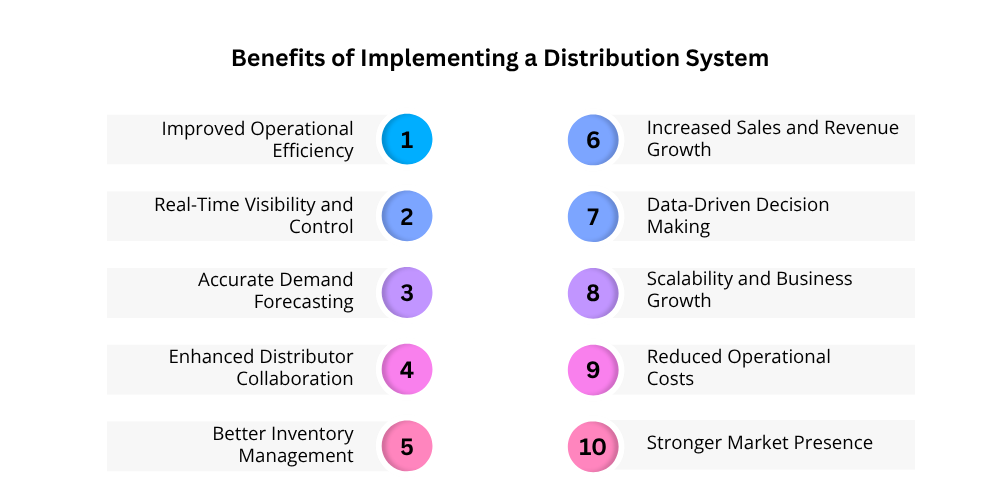
7. Data-Driven Decision Making
Advanced analytics and reporting tools transform raw data into actionable insights. Businesses can track KPIs, identify trends, and make informed decisions that drive performance and competitiveness.
8. Scalability and Business Growth
A robust distribution system supports expansion by handling increased volumes, multiple distributors, and wider geographic coverage without operational complexity. It provides the foundation needed for sustainable growth.
9. Reduced Operational Costs
Automation and process optimization help reduce labor costs, minimize errors, and eliminate inefficiencies. This results in lower operational expenses and improved profitability.
10. Stronger Market Presence
With better control, visibility, and execution, businesses can ensure consistent product availability and improved service levels, leading to stronger brand presence and competitive advantage in the market.
Implementing a distribution system is no longer optional in today’s competitive landscape. It empowers businesses with the tools, insights, and efficiency needed to optimize operations, strengthen distributor networks, and achieve long-term growth. Businesses leveraging cloud-based FMCG distribution software can scale operations easily while reducing infrastructure costs.
Industry Use Cases (FMCG, Pharma, Manufacturing)
Different industries operate with distinct distribution models, challenges, and compliance requirements. A flexible and scalable distribution system must adapt to these variations to deliver maximum efficiency and control.
FMCG (Fast-Moving Consumer Goods) : High-volume, fast-moving products require real-time inventory tracking, quick replenishment, efficient route planning, and strong secondary sales visibility to ensure availability, reduce stockouts, and maximize retail execution.
Pharma : Strict regulatory compliance demands batch-wise tracking, expiry management, and complete traceability across the supply chain, ensuring product safety, accurate reporting, and adherence to government regulations. This makes it an ideal distributor management software for pharma supply chains, where compliance, traceability, and accuracy are critical.
Manufacturing : Complex supply chains require seamless integration with ERP systems, automated workflows, and efficient coordination across production, inventory, and distribution to reduce delays and optimize overall operational performance.
How to Choose the Right Software for Your Business
Selecting the right solution requires careful evaluation. Businesses should consider:
- Scalability : Scalability ensures the software can handle business growth, increasing users, data volume, and transactions without performance issues. It allows long-term adaptability and avoids costly system replacements.
- Ease of Use : Ease of use focuses on how intuitive and user-friendly the software is for your team. A simple interface reduces training time, improves adoption, and enhances overall productivity.
- Integration Capabilities : Integration capabilities determine how well the software connects with existing systems like CRM, ERP, or other tools, ensuring seamless data flow and eliminating operational silos.
- Customization Options : Customization allows businesses to tailor the software to their specific workflows and requirements. Flexible configuration ensures better alignment with unique processes without heavy development or ongoing maintenance challenges.
- Vendor Support : Vendor support plays a crucial role in long-term success, including technical assistance, updates, training, and issue resolution. Reliable support ensures system stability and minimizes downtime risks.
Understanding how to choose the right distributor management system ensures long-term success and ROI.
Additionally, identifying the signs your business needs a distributor management system, such as inefficiencies, lack of visibility, and growth challenges can help in making timely decisions.
Common Pitfalls to Avoid When Selecting Business Software
Choosing the right software is critical, but avoiding common mistakes is equally important to ensure a smooth implementation and long-term success. Many businesses invest in powerful tools but fail to achieve desired outcomes due to avoidable errors.
Choosing Overly Complex Systems
Businesses often select feature-heavy software assuming more functionality equals better performance. However, overly complex systems can overwhelm users, slow down adoption, and increase implementation time, ultimately reducing overall efficiency.
Ignoring User Training
Even the best software fails if users don’t understand how to use it effectively. Skipping proper training leads to low adoption rates, frequent errors, and underutilization of key features that drive value.
Lack of Integration Planning
Failing to plan integrations with existing systems like CRM, ERP, or accounting tools can create data silos. This results in manual work, inconsistent data, and inefficient workflows across departments.
Underestimating Data Migration Challenges
Migrating data from legacy systems to new software is often more complex than expected. Poor planning can lead to data loss, inconsistencies, and delays, impacting business continuity and decision-making.
By proactively addressing these common pitfalls, businesses can ensure smoother implementation, faster user adoption, and better return on investment. A well-planned approach not only reduces risks but also maximizes the value of the software in the long run.

The Future of Distribution Management: Trends Shaping the Next Era
The distribution landscape is rapidly evolving, driven by advancements in technology and increasing demand for speed, accuracy, and data-driven decision-making. Modern distribution systems are no longer just operational tools they are becoming intelligent ecosystems that enable businesses to stay competitive and agile.
AI-Powered Demand Forecasting
Artificial Intelligence is transforming how businesses predict demand by analyzing historical data, seasonal trends, and market behavior. AI-driven forecasting reduces uncertainty, improves planning accuracy, and helps businesses align production and inventory with real market needs.
Predictive Analytics for Inventory Planning
Predictive analytics enables companies to anticipate inventory requirements before demand fluctuations occur. By leveraging data patterns and trends, businesses can maintain optimal stock levels, reduce carrying costs, and prevent stockouts or overstocking across distribution channels.
Automation of Repetitive Tasks
Automation is streamlining routine processes such as order processing, invoicing, reporting, and inventory updates. By reducing manual intervention, businesses can minimize errors, increase efficiency, and allow teams to focus on strategic activities that drive growth.
Enhanced Mobile Capabilities
With the rise of mobile-first operations, distribution systems are increasingly optimized for smartphones and tablets. Field sales teams and distributors can access real-time data, place orders, update inventory, and track performance from anywhere, improving productivity and responsiveness.
The Rise of Intelligent DMS
The concept of Distributor Management Systems (DMS) in the age of automation highlights a shift toward smarter, more connected platforms. These systems integrate AI, analytics, and automation to provide end-to-end visibility, real-time insights, and seamless collaboration across the distribution network.
The concept of DMS in the age of automation highlights how technology is reshaping distribution processes.
Final Thoughts
Distribution management is no longer just an operational function, it is a strategic differentiator. Businesses that embrace technology can achieve greater efficiency, visibility, and scalability.
As markets become more competitive, leveraging advanced tools becomes essential. Whether it's optimizing inventory, tracking secondary sales, or improving distributor performance, the right approach can transform your entire distribution ecosystem.
For businesses exploring modernization, addressing FMCG distribution questions answered through data-driven insights can provide clarity and direction.
Ultimately, adopting the right system is not just about technology, it's about building a resilient, future-ready distribution network.
Book a free demo of Delta Sales App today and discover how it can help you automate order management, track secondary sales, optimize inventory, and manage distributors more efficiently, all from a single platform.

-1792906895-resized320.png)